

A Rohingya man came to Buffalo for refuge. He died after Border Patrol left him at a coffee shop.
"After coming to the U.S., [Shah Alam] was not able to experience freedom," said Iman Fazal, a fellow Rohingya refugee. "Instead, he experienced something horrible, then he lost his life."
Friends and family of Nurul Amin Shah Alam gathered in the Erie County Holding Center on the morning of Feb. 20, awaiting the release of the Rohingya refugee who had been in custody for the last year.
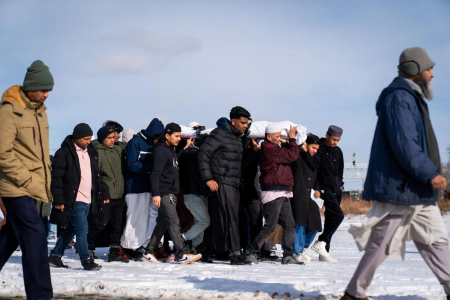
Mourners carry the body of Nurul Amin Shah Alam to his gravesite at Masjid Zakariya Cemetery Thursday, Feb. 26, 2026.
Joshua Bessex/Buffalo News
It was supposed to be an encouraging moment ahead of Shah Alam's sentencing next month.
Recent events had shown promise: Shah Alam, previously indicted by a grand jury on three felony charges, had pleaded guilty to two misdemeanors, which, according to Erie County District Attorney Michael J. Keane, meant he would avoid deportation. Shah Alam's local attorneys confirmed Thursday that Shah Alam's family had been advised by an outside immigration attorney that it was safe to post bail.
The family waited for hours, said Imran Fazal, a local Rohingya community leader who for the last seven months navigated Shah Alam's legal proceedings alongside the incarcerated refugee's son, 22-year-old Faisal, and the Legal Aid Bureau of Buffalo.
Shah Alam never came out of the Holding Center to see his supporters. Unbeknownst to them, he had been released to federal agents hours before.
His family never saw him again.
"When they went to the police and asked them (why he wasn't coming out), that's when they told them Border Patrol took him," Fazal said. "No one bothered to come to let the family know he's not here."
For reasons Fazal said were still uncertain, Border Patrol dropped Shah Alam off at a closed Tim Hortons on Niagara Street in Black Rock, according to Mayor Sean Ryan, after an Immigrations and Customs Enforcement facility did not accept him. Shah Alam, a practicing Muslim, had likely not eaten due to Ramadan fasts and the lack of halal meals at the Holding Center, Fazal said.
He was not close to home: Shah Alam's family resides in an East Side neighborhood, amid the growing Rohingya community in Buffalo. It had been several months since his family moved from the West Side.
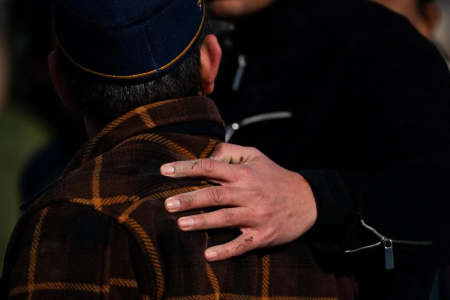
Mourners gather after burying Nurul Amin Shah Alam at at Masjid Zakariya Cemetery on Thursday.
Joshua Bessex, Buffalo News
Five days later, the body of the 56-year-old refugee who spoke no English, did not have a cellphone, was not wearing shoes and was almost completely blind was found downtown on Perry Street.
On Thursday morning, Fazal and Shah Alam's family still lacked answers.
"It's shocking," Fazal said of the lack of communication from authorities. "I didn't expect something like this in a country like the United States. It's horrible."
As the story of Shah Alam's death was shared internationally, the Rohingya community of about 2,000 in Buffalo was left to grieve at Shah Alam's funeral Thursday afternoon and, more broadly, wrestle with a tragic outcome in a country long perceived as refuge from genocide
"After coming to the United States, he was not able to experience freedom," Fazal said. "Instead, he experienced something horrible, and then he lost his life."
Barriers from the start
Shah Alam arrived in Buffalo from Malaysia on Dec. 24, 2024, just days before the start of President Trump's second term. Like many Rohingya over the last decade, he had escaped civil war. Some of his family members remained in Malaysia, but Shah Alam pursued a life in the U.S."We have been persecuted for decades," said Fazal, a 31-year-old Rohingya who also escaped conflict. "It didn't just happen yesterday, right? We don't even have numbers. Thousands of people were killed back home, and we don't have the numbers."
Shah Alam was resettled by Jewish Family Services, one of six resettlement agencies in Buffalo, Fazal said, and was provided housing near the border of the Black Rock and Riverside neighborhoods. The resettlement process was interrupted for Shah Alam, however, as Trump suspended refugee admissions and cut off funding from resettlement agencies, which as a result laid off several employees.
Due to the cuts, Shah Alam did not receive the cultural orientation training crucial for refugees new to America, Fazal continued, which became a contributing factor when he was approached by police after a person at a Tonawanda Street residence called 911 to report his presence inside their fenced-in yard. Shah Alam was arrested shortly after for injuring two Buffalo police officers.
Shah Alam's son, in a statement via Fazal before his father's death, shed light on the original arrest on Feb. 15, 2025.
"My father was arrested because he was standing in front of someone’s house for a few minutes to take shelter while it was snowing heavily that night," said Faisal Alam. "A dog began barking, and the homeowner called the police. Unfortunately, my father could not understand the officers’ instructions, which led to a tragic misunderstanding. His actions were not out of defiance or bad intent, but confusion and lack of understanding."
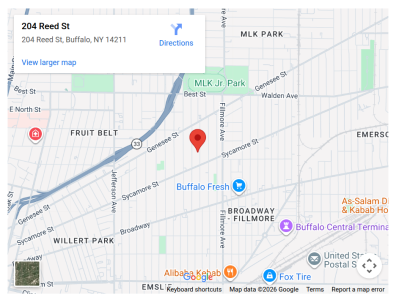
Fazal, who in October founded the Rohingya Empowerment Community center on Reed Street, a few blocks south of Martin Luther King Jr. Park, said understanding Western culture is very difficult for Rohingya. In the minority group's freedom efforts in Myanmar, education was not available, jobs were not attainable and movement was restricted between villages. Their language is oral – not written – which is an additional barrier to communicating effectively with English speakers.
Shah Alam "didn't learn anything about the culture, so he didn't know how to react when police comes and if they ask you to do something," Fazal said. "So it wasn't his responsibility to understand the police, it was the responsibility of the police to understand that he doesn't speak English. He needs an interpreter, right?"
When he was dropped off by Border Patrol at the Tim Hortons last week, Shah Alam was likely in a similar predicament, his legal counsel said.
"He would not have known where he was or had the wherewithal to contact his family or avail himself of other resources or services that could have assisted him," Legal Aid Bureau of Buffalo said in a statement.
It was not only the actions of Border Patrol that incensed community members who spread the missing person message regarding Shah Alam, but the manner in which he was incarcerated in the first place last year.
"Nurul was not a criminal and mistakenly taken simply for taking a walk and being a member of his community," said Alexsandra Lopez, a Buffalo resident who shared frequent updates regarding Shah Alam's status. "May his memory live on to soften the hearts of our collective for systemic change."
America's place as a beacon of freedom feels more like a dark cloud to Fazal after the death of Shah Alam.
"He left his country with his family just to save his life," Fazal said. "He's a genocide survivor."
In a cruel irony, Shah Alam was also not safe in a place of refuge.
"It's a tragic situation that he lost his life," Fazal said. "It makes sense if someone loses their life back home because of the persecution, but losing your life under the circumstances in a country like United States doesn't make any sense.
"What is the system? What is the justice?"