

How Ray Davis and the Bills became the NFL's best kickoff return unit in 2025
Davis entered Week 16 as the NFL's leader in average kick return (32.4 yards), and he's a legitimate candidate to represent the Bills in the Pro Bowl.
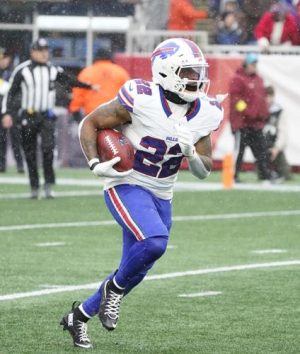
Bills kick returner Ray Davis had a big day in the win over the Patriots on Sunday.
Harry Scull Jr., Buffalo News
Two weeks into his second NFL training camp, Ray Davis was lining up next to Josh Allen with the rest of the Buffalo Bills' starters on offense.
No one knew how long Davis would need to take those snaps because James Cook, the team's top running back, chose to sit out practices to try to gain leverage in negotiations for a contract extension.
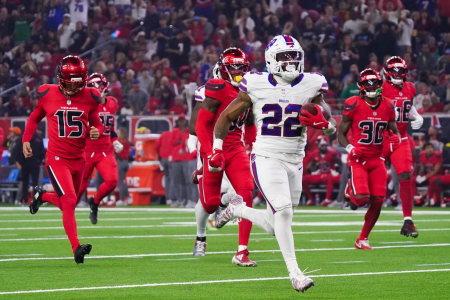
Bills running back Ray Davis leads the NFL in kick return average this season.
Joshua Bessex, Buffalo News
Once Cook's hold-in ended, Davis returned to a backup role. And once the season began, the Bills did not involve him on offense as often as they did during his rookie campaign. It took several weeks and a path Davis did not expect, but he found a way to make a significant impact on a 10-4 team that can clinch a playoff spot Sunday with a win over the Cleveland Browns (3-11) at Huntington Bank Field.
Davis entered Week 16 as the NFL's leader in average kick return (32.4 yards), and he's a legitimate candidate to represent the Bills in the Pro Bowl. Six of his returns have gone for more than 40 yards, including a 97-yard touchdown in Buffalo's loss to the Houston Texans on Nov. 20.
"I just want to be great at it," said Davis. "I just wanted to be really good. I knew I’ve got to be able to put the offense in the right position to succeed and that’s flipping the field and putting us in good field position. I’ve embraced it. I’ve loved it. Obviously, I thought things would be different, but, you know, it is what it is. To be able to be at the top of the NFL in yards per average, that’s showing all the hard work that I put in this offseason."
The NFL made more tweaks to the dynamic kickoff rules last offseason to try to create more long returns, but the Bills weren't taking advantage.
They went nine weeks without reaching the 40-yard line and 10 weeks without reaching the 50. Blocking usually wasn't the issue, either. Chris Tabor, their special teams coordinator, had to get his players to stop committing holding penalties and he needed the right returner, someone who could set up blocks and burst through the narrow gaps on those plays.
In Week 9, ahead of a game against the Kansas City Chiefs, Tabor tabbed Davis as one of Buffalo's returners. Davis doubted whether he had the skill set to execute on such a challenging play, but Tabor insisted that this change would work. Davis returned the opening kickoff 29 yards, but the Bills were called for holding.
His next three returns went for 28, 26 and 30 yards. The following week, during a loss to the Miami Dolphins, Davis had a 32-yard return and his 39-yarder got called back because of holding. The Bills were getting closer.
"Recently, we’ve known we had to limit those penalties," said linebacker Dorian Williams. "Get our hands inside. Run our feet. Let go when our returner gets by us. Ray has done a hell of a job getting downhill. He’s a running back. He’s finding those holes. He’s hitting the gap hard and he’s tiptoeing. That helps with the penalties and everything that comes with the big returns."
The breakthrough finally arrived in Week 11, albeit with a different returner. Mecole Hardman, a veteran wide receiver signed days earlier, gave the Bills' offense the ball at Tampa Bay's 36-yard line with a 61-yard return. Davis added returns of 44, 41 and 44 yards as the Bills' average starting field position was their own 37.
During its next game, at a time when Buffalo desperately needed a momentum swing, Davis returned a kick 97 yards for a touchdown in Houston. The blocking schemes look different from week to week as Tabor makes subtle changes based on the opponent. Last Sunday, for example, Tabor used backup offensive lineman Alec Anderson as the up back. Davis was told to run behind Anderson, then pick whether to run left or right.
Anderson blocked New England Patriots linebacker Christian Ellis and Davis ran to the right. He fooled kicker Andres Borregales with a juke to return the kickoff 58 yards. Davis also had returns of 45 and 38 yards, and the Bills' offense scored on each of those drives to complete a 21-point comeback in a win over the Patriots.
"He built that confidence in me and he built the confidence in everybody else, but it takes all 11 guys to do it, right?" Davis said of Tabor. "It’s not just me. It’s everybody taking care of their blocks and staying on their man."
Every yard matters, especially during the playoffs. The Bills' issues on special teams last season led coach Sean McDermott to replace special teams coordinator Matthew Smiley with Tabor. Field position wasn't an issue for Buffalo in 2024, in large part because of the Bills' plus-24 turnover margin, but the Bills were 26th in average kick return.
Tabor, a longtime coordinator, studied the dynamic kickoffs last season while he was not on an NFL staff and he returned with a plan on how to take advantage of the new rules.
Tabor, like every other coordinator, had to learn and adjust. More changes were implemented last offseason, with modified requirements for receiving team players in the setup zone and touchbacks were moved to the 35-yard line to encourage more returns.
The Bills have returned 58 kickoffs through 14 games this season, compared to 26 through 17 games last season. Players needed to see how the plays would be officiated. The Bills have committed eight holding penalties on kickoffs this season, but they haven't been called for one in the past three games.
In its simplest form, though, the goal for the return team is to find weaknesses in coverage units and areas where stronger players can clear a path for the returner.
"It’s kind of like a little bit NBA basketball," said Tabor. "It’s matchups. Where do put your big people versus their big people or small people? You have to work at that because obviously they can change it at any moment and can you change? The kickers, what they can do with the football, just moving it around. Where is it going to go? That’s a stressful thing, too. There’s a lot of unattended consequences that are happening on this play that are making it fun behind the scenes."
Communication is paramount for return units. Davis discusses blocking schemes with his teammates, most notably fullback Reggie Gilliam, and the group works together each week to execute the plan. Davis has texted or called Tabor on Monday night, hours after the group installed the latest changes, to ask questions or share observations that were gleaned through watching video.
Davis has 54 fewer carries than he did through 14 games last season because Cook has been one of the best running backs in the NFL. Unlikely to see his role on offense grow, Davis is determined to make a significant impact in the role he earned.
"He's gotten better and better," Tabor said.