

Inside the Buffalo Sabres' turnaround on and off the ice
Pete Guelli, the Buffalo Sabres' president of business operations, and owner Terry Pegula shared their insight with The Buffalo News on the changes that led to a turnaround no one expected a few months ago.
On the day he was introduced as owner of the Buffalo Sabres in February 2011, Terry Pegula communicated a vision that made his hockey-obsessed fan base want to run through a wall.
"Starting today, the Buffalo Sabres' reason for existence will be to win the Stanley Cup," the oil and gas magnate exclaimed.
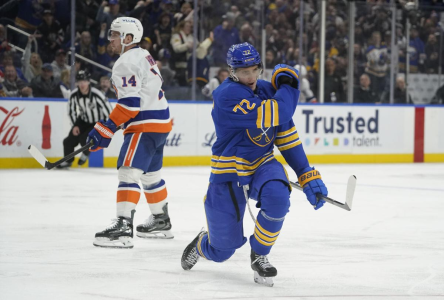
Sabres center Tage Thompson celebrates his goal against the New York Islanders during the third period on Tuesday at KeyBank Center.
Harry Scull Jr., Buffalo News
Less than three months later, the Sabres were eliminated by the Philadelphia Flyers in Game 7 of a first-round playoff series. For the next 14 seasons, the franchise performed poorly on and off the ice. There were bad decisions in hockey operations, such as tanking consecutive seasons to try to draft superstar talents, to cycling through seven head coaches and four general managers. As the team struggled, so did the business.
There seemed to be no end in sight for the cycle of mediocrity and dysfunction, until a road trip to Western Canada in December propelled the Sabres on a historic run that led to sell-out crowds at their home arena, KeyBank Center. Outsiders suggested the transformation happened seemingly overnight. Behind the scenes, both in hockey and business operations, the Sabres made changes over the past 24 months that awakened the sleeping giant.
Finally, hours before their game Saturday night in Washington, D.C., the Sabres' NHL-record 14-year playoff drought ended. For the first time since 2011, there will be Stanley Cup playoff games in Buffalo. Pete Guelli, their president of business operations, and owner Terry Pegula shared their insight with The Buffalo News on the changes that led to a turnaround no one expected a few months ago.
"To me, it has been 5% here and 5% there," Pegula wrote in an email to The Buffalo News, replying to a question about the changes he has seen over the past five months. "We became healthy. Our youngest players have matured quickly. It’s a credit to Lindy, the coaches, and their veteran teammates. Rasmus Dahlin's fiancée, Carolina, is surviving an unbelievably sudden health crisis. Our strength and conditioning staff has been a big contributor to our success. I think Tage (Thompson) has matured since winning the Gold. Our fans have demonstrated so much passion, and the players are feeding off that passion, fueled by the winning."
Foundation
The organizational weaknesses that emerged during the Sabres’ 14th season outside the Stanley Cup playoffs led Pegula and Guelli to recommend changes in April 2025.One, the Sabres needed more experienced people around their general manager. For five seasons, Kevyn Adams ran the hockey operations department with nobody on his staff who had executed an NHL trade or spearheaded negotiations for an NHL contract. His associate general manager, Jason Karmanos, had Stanley Cup rings from working in similar roles with the Carolina Hurricanes and Pittsburgh Penguins, but his trips to Buffalo were infrequent. Adams had no experience in a significant hockey operations role before he was hired in June 2020 as general manager. He brought a fresh perspective and a different approach; however, he did not know how to navigate every aspect of the job. In too many areas, the Sabres were not run like an NHL team.
Guelli and Pegula informed Adams of their plan to hire a senior advisor. A list of candidates had already been assembled, and the name at the top stood out among the rest. Jarmo Kekalainen, who led the Columbus Blue Jackets as general manager from 2011-24.
In May, the Sabres hired former NHL player Eric Staal, a teammate of Adams’ in Carolina, as special assistant to the general manager. Three weeks later, Kekalainen became Adams’ special adviser. Pegula did not intend to eventually replace Adams with Kekalainen, but the team was in the position to pivot if the 2025-26 season started poorly and the new hire proved to be the experienced manager it was missing.
“We knew we needed someone with more experience and institutional knowledge to put us in a position to, hopefully, turn the corner,” Guelli, who joined the Sabres and Bills as chief operating officer in March 2024, said. “Because we did all that work, when the timing was right to pivot, we were prepared for that. There are a lot of pieces that really had to come together, but there was a lot of preparation that went into putting us in this position.”
Second, the Sabres needed a new approach to strength and conditioning. During the first season of his second stint as coach, Lindy Ruff fixed the team’s poor starts to games. Buffalo had a plus-24 goal differential in the first period, the third-best mark in the NHL, but its goal differential in the second and third periods was an abysmal minus-44. Though young players such as Zach Benson, Jack Quinn, and Owen Power showed growth on the ice, they still weren’t strong enough to win enough puck or net-front battles throughout a game.
Ed Gannon, the Sabres’ head strength and conditioning coach, got fired, and his replacement, Brian Gallivan, joined the team following a six-year stint as director of sports science for the USA Hockey National Team Development Program. Gallivan understood how to tailor a hockey-specific strength program to a specific player’s needs, and his background prepared him to help the Sabres navigate the grind of a compressed 82-game schedule.
Guelli and Pegula did not need to tell Adams that his roster had to improve. The Sabres needed a right-shot defenseman. An experienced goalie could push their starter, Ukko-Pekka Luukkonen, in a way that a young backup could not. One of their most talented forwards, JJ Peterka, had no interest in signing a long-term contract with Buffalo. On June 26, the Sabres sent the disgruntled winger to Utah for winger Josh Doan and defenseman Michael Kesselring. Doan, 24, has 23 goals and 47 points this season. In January, Kekalainen signed Doan to a seven-year contract extension.
It was the latest in a line of successful trades by Adams. Previously, the Sabres ended their dispute with their former captain, Jack Eichel, by trading him to Vegas for winger Alex Tuch and center Peyton Krebs. Before the trade deadline in 2024, Adams acquired defenseman Bowen Byram for center Casey Mittelstadt. A few months later, the Sabres sent 2022 first-round pick Matt Savoie to the Edmonton Oilers for center Ryan McLeod. Each player added in those deals became a building block for Buffalo’s first playoff roster in 15 years. In free agency in July, the Sabres signed goalie Alex Lyon to pair with Luukkonen.
Talent had not been the issue, though. The pieces had been in place to reach the playoffs, as illustrated in 2022-23 by their 91-point finish that brought them to within one win of a postseason berth. Their problem, especially during the disappointing start to this season, centered around a lack of competitiveness. Too often, the Sabres looked like an immature team. Their performance did not reflect the personality and standards of their coach.
It had been an issue since the 2023-24 season, when the Sabres' point total dropped to 84 under their coach, Don Granato. Adams fired Granato and hired Ruff, but the transition to a new style of play was trickier than anticipated. In 2024-25, Buffalo had just 79 standings points. Its season was seemingly over in December because of a 13-game winless streak.
“There’s been games this year where we looked like it was going to be easy, and then we lost because we got outworked,” Kekalainen said during his press conference as general manager on Dec. 16. “That’s unacceptable, and that’s going to be something that we’re going to focus on every day here, every day. Because the talent, the skill alone, is not going to get you the wins in this league. Every team’s too good, so you’ve got to work, and you’ve got to compete. You’ve got to be relentless, and that’s what I want the identity of the Buffalo Sabres to be.”
The decision
An NHL playing career that lasted nearly a decade, including a Stanley Cup victory as a worker-bee bottom-six center, taught Adams the importance of culture-building and communication with players.His transparent approach to the job earned their respect, especially during the months in 2021 that bookended the Sabres trading their franchise pillars: Eichel and Sam Reinhart. In 2022-23, a season in which they were not expected to compete, coach Granato led Buffalo to within one win of a playoff berth.
The decisions that followed slowly chipped away the trust Adams had built with his players. They disagreed with his decision not to acquire a top-six forward after Quinn tore an Achilles tendon. Instead, the Sabres kept Benson on their roster even though he was an undersized teenager whom they drafted only a few months earlier. Adams’ players did not understand the decision to rush NCAA record-setting goalie Devon Levi to the NHL. Adams told the team that it was time to win, but his actions did not always support his message. The roster was too young and lacked the skill sets that are common on playoff teams.
The 2024 offseason was Adams’ best as general manager. He traded for McLeod, signed veteran winger Jason Zucker, acquired fourth-line grinder Beck Malenstyn, and, the most important change of all, replaced Granato with Ruff as head coach.
It took one trip to Prague to see that the Sabres were going to need time to transition to a new coach. Ruff didn’t have a full training camp to implement the changes that he viewed as necessary to transform his team into a playoff-caliber unit. Buffalo endured a 13-game winless streak in which Adams did not make any substantive changes to the roster. In December 2024, he made an irreparable mistake in a press conference when he suggested that cold weather and state taxes were a reason why NHL players were unwilling to waive their no-trade protection to come to Buffalo. The tumultuous stretch ruined their season and confirmed to Guelli that Adams would benefit from having more experience on his staff.
The start of the 2025-26 season wasn’t much better. Shut out at home 5-0 by the New Jersey Devils one day after Thanksgiving. Thirteen goals against in two losses to the Calgary Flames. Last in the Eastern Conference with an 11-14-4 record through 29 games. On Dec. 15, 2½ years into his sixth season, Adams was fired.
“I have surely been patient with our most recent rebuild, and I obviously wish this had happened a lot sooner,” Pegula wrote in an emailed response to The News. “The Eichel situation set us back, but over the last 2 offseasons, we have changed a lot, and I like our direction. I am really happy for the fans. They deserve a team that plays like this, and the support has been great to see.”
Replacing Adams with Kekalainen was not the only change that factored into the Sabres’ remarkable turnaround. Important players got healthy. More leadership emerged in their dressing room. And, finally, their players, especially defensemen, became comfortable executing the plan created by Ruff and his coaching staff. The lineup fixtures that Ruff urged the team to keep last offseason, including Quinn and defenseman Mattias Samuelsson, became significant contributors.
After dropping three games to start a road trip, the Sabres won 10 in a row. Across a span of 40 games, they went 32-6-2. It’s the fourth-best stretch in NHL history, and no team has performed better in that amount of time since the 1995-96 Detroit Red Wings, who are regarded as one of the best in NHL history.
On March 31, the Sabres were atop the Eastern Conference with their first 100-point season since 2010. Since Dec. 9, six days before Adams’ firing, Buffalo leads the NHL with 74 standings points (35-9-4). It also ranks fourth in goals and third in goals against. Kekalainen did not make a significant move until the trade deadline, when he acquired three players. However, he brought credibility and experience to the Sabres' hockey operations department.
“The one thing I learned from my first year in the NHL is it's a very compressed timeline,” Guelli said. “You get into the season, you start approaching that trade deadline, you've got to start making decisions on restricted free agents, unrestricted free agents. That window can close pretty quickly, and if you don't act at the right time, you may be throwing away a future season. Ultimately, Terry didn't want to do that. He felt like we needed to make a move and change things up so that, as we are starting to approach some of these big decisions, we were confident we were in a position to make the right ones.
“The decision was made, and obviously, we're thrilled with how things have taken off and where they've gone, but I think if you asked him, it's several things, including that big move, that have put us in this position. That just put us over the top.”
If you build it ...
Visiting fans filling the lower bowl at KeyBank Center. Merciless booing at the first sign of trouble. The mistakes on and off the ice during an NHL-record playoff drought turned their arena into the most toxic environment in the league.The Sabres’ season-ticket base did not rebound following the COVID-19 pandemic. Many chose not to reinvest in the team after Pegula fired 22 hockey operations employees, including former general manager Jason Botterill, and backed his medical staff during a dispute with Eichel over his preference to have an artificial disk replacement to fix his injured neck. The captain’s eventual departure was the biggest move during the franchise’s second rebuild in less than a decade.
The trust with the fan base was fractured. It was going to take sustained success to convince the hockey diehards in Western New York to pay to watch the team.
In 2022-23, the Sabres averaged just 15,567 spectators per home game. In 2023-24, the number increased by fewer than 400. Last season, they ranked 27th out of 32 teams in average attendance. Tuesday, they had their 15th consecutive sellout, and their total attendance ranks in the top half of the NHL. According to Guelli, the team has gained 2,600 season-ticket holders for next season. Its total is over 11,000, and the Sabres had a renewal rate of approximately 97%.
“The fans have come back even faster than I could have anticipated,” Guelli said. “They were so disenfranchised and so angry, you knew the passion was still there. I never for one second thought that this was not still a hockey market. It's really pretty incredible. … These are numbers that typically take years to accomplish, even if you have a good plan in place. I think it's a credit to the work that's been done, but it's also a credit to the fan base. They were hungry.”
Capitalizing on the on-ice success would not be possible if the Sabres did not restructure their business operations. The organization lacked direction in the years after Kim Pegula went into cardiac arrest and could not continue as president of the Bills and Sabres. Pegula Sports and Entertainment, the parent company created by ownership to oversee their various holdings, created redundancies and, during Kim’s absence, a lack of direction.
Terry Pegula tried to rectify the issue in January 2023, when he hired a business partner, John Roth, as COO. Roth restructured the Sabres’ commercial departments and neglected to create an organizational hierarchy, causing confusion and an unorthodox reporting structure. After Roth was dismissed for an inappropriate relationship with a colleague, Pegula hired Guelli, who previously spent 10 years with the Bills and, as COO of the NBA’s Charlotte Hornets, helped revitalize the franchise’s business.
A flat organizational structure had to be replaced. Year 1 was Guelli's opportunity to evaluate business and hockey operations. He identified five employees to head his executive team: Rob Minter, senior vice president of business operations; Kyle Allen, vice president of planning and analysis; Cara Murphy, vice president of marketing; Nicole Hendricks, vice president of communications; and Anna Stolzenburg, vice president of content and production.
To modernize the franchise’s approach to growing the business, Guelli hired Jake Vernon as chief commercial officer in the summer. Vernon spent the previous 12 seasons with the NBA’s Minnesota Timberwolves and WNBA’s Minnesota Lynx. The changes implemented by Vernon may not be noticeable to fans, but he revamped their approach to ticketing. Season-ticket renewals were sent out earlier this season than ever before. The team was finally in a position to leverage the on-ice success. After years of bleeding money from missing the playoffs, the business of the Sabres is finally flourishing.
Playoff hockey is returning to Buffalo soon. The goal, however, is to build the Sabres in a way that a drought never happens again.
“This can’t be one season,” Guelli said.