

How Cole Bishop helped change the math on the Bills’ playoff hopes
We take a look at how the safeties have improved Buffalo's defensive fortunes in 2025.
 www.nytimes.com
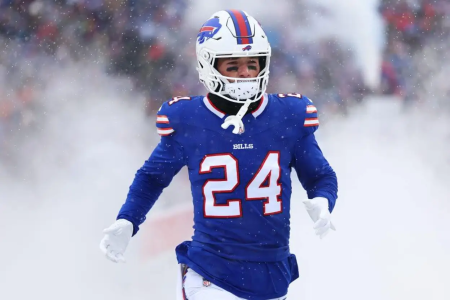
Cole Bishop has made a big impact in his first season as a starter. Jamie Schwaberow / Getty Images
With the Buffalo Bills’ narrow Week 16 victory over the Cleveland Browns, along with the Indianapolis Colts’ loss Monday night, the Bills have officially made the playoffs for the seventh consecutive season and the eighth time in nine years.
Even though the win over the Browns was a bit closer than they would have liked, the Bills were still able to come away with a fourth consecutive victory, with the postseason only two regular-season games away. The Browns game was also a learning opportunity, specifically from a personnel perspective, and how the Bills have become a lot more successful down the stretch of the season.
After studying the All-22 from Week 16, here’s a deep dive on the position that may have changed their defensive fortunes in 2025.
Why safeties changed the math for the Bills
As 2024 played out for the Bills, both in the regular season and the playoffs, there was one stark difference from their previous playoff teams. The play of their starting safeties was the worst it had been since Sean McDermott took over as head coach in 2017. It wasn’t just that the Bills went the whole season without the dynamic longtime duo of Micah Hyde and Jordan Poyer, but it was that their replacements were proving to be a liability.The starters in 2024, Taylor Rapp and Damar Hamlin, each had their flaws. Rapp was just a touch late in many situations and a bit heavy-handed in his tackle attempts to make up for it. Hamlin was extra cautious, and while he was rarely out of position in a technical sense, he wasn’t getting downhill quickly enough, so he chose to play it safe. Perhaps it’s because he isn’t the quickest safety, and he did what he could to mitigate that aspect of his game. Still, it left several opportunities for opponents to eat the open space between zone defenders that would otherwise be closed by a more aggressive safety.
When the Bills went into the offseason, they knew the safety room couldn’t remain as it was. It was their most significant defensive detriment last season — a far cry from how it used to be with Hyde and Poyer. It’s the reason why, even with Hamlin re-signing to a one-year deal, there wasn’t even an insinuation that it was an open competition between him and second-year player Cole Bishop.
In Bishop, they had hope to get back to the way things had been — or at least closer to it. He’s quick, showed playmaking skills in college and showed a knack for playing hunches correctly. Still, they had to be patient and develop him the right way, go through the necessary growing pains and not be overreactive with their lineup decisions. Bishop possessed the ceiling-level ability that neither Rapp nor Hamlin would be able to access. And in turn, the 2024 starters wouldn’t make the Bills dramatically better defensively, as they so desperately aimed to achieve through their offseason moves.
As the 2025 season has played out, the Bills’ plan for Bishop has worked — perhaps better than they could have anticipated in his first full year of starting. Bishop went from a humongous question mark early in the season to one of the best players on the Bills, period. It really seemed like Bishop’s aha moment came in Week 4 against the New Orleans Saints, when he changed the game by not only being the only defender to see a trick play coming, but by reacting quickly to get in position to make a play and then showing incredible athleticism to come down with a one-handed interception. He’s been a more confident player since then.
Since the Bills returned from their Week 7 bye, Bishop has carried an outstanding 3.34 GPA in our weekly film study. That mark indicates not only a good player, but an impact player who is helping to change the game in the Bills’ favor every week. Over that span, the only defender with a higher GPA is top cornerback Christian Benford at 3.36, who had one of the most prolific two-game stretches of defending the Bills have seen.
The Browns game was a perfect representation of Bishop. He was routinely in the perfect position. He saw the whole field and what the Browns were trying to do, consistently being one of the first to recognize it and react. He played hunches and made the right plays despite a lot of pre-snap movement. When he was forced onto an island for a tackle attempt, he came through every time. There was a screen pass to a running back that no other defender noticed, with a blocker in front of him. Even though it was a big gain, Bishop recognized it, sprinted upfield to take the action to the ball carrier and made a clutch tackle on a play that could have gone for a touchdown.
There was a jet sweep attempt late in the game that Bishop instantly recognized. Not only did he stop it and make the tackle for loss, but he also covered all potential outcomes by hovering back a little in case the receiver threw the ball. Once he saw a declaration to run, Bishop pounced. What we are seeing is a young player so confident in the work he puts in through the week of film study that he doesn’t second-guess his instincts and uses it to his advantage to make meaningful plays each game. And that helps him play faster.
After one year away, and what by many accounts was a down season by his lofty standards, Poyer’s return to the lineup has been a massive development for the Bills’ defense. With Rapp and Hamlin both heading to IR in October, the door was wide open for Poyer’s return to the starting lineup. Poyer’s fit to the Bills’ scheme, especially because they’ve figured out how to maximize his strengths despite being four months shy of turning 35, has been like a fish to water. The Bills keep Poyer on the field in all early-down and short-yardage situations, only removing him from the lineup when it’s a third-and-long situation that requires a bit more speed on the field.
His response to the 2025 version of the Bills has improved weekly, to the point where he is making consequential plays as he did Sunday. While it isn’t quite the heavy impact that it was earlier in his career, Poyer is playing fast because his recognition of what’s going on around him gives him a head start to influence plays, and that was seen on several occasions against the Browns. Although Poyer was injured late Sunday, the Bills called it day to day, which is a good sign for his playoff availability.
Why is all of this important? The safety position might be the most critical to the Bills’ defensive output. The demands on those players are huge, which is why McDermott has repeatedly called it the second most difficult to learn position, with only quarterback ranking ahead of it.
With all that the safeties are responsible for in pre-snap alignment and attempting to confuse the quarterback in their early and late movement, to turn around post-snap and then have to cover a ton of ground, while recognizing everything that’s happening in front of them, there’s a reason why not everyone is cut out to play safety in the Bills’ scheme. Football IQ and instincts reign supreme. If you can combine those attributes with high-level athleticism, you have one of their best defenders, which is what Bishop has become in a short amount of time.
When the Bills’ safeties are among the most consistent defenders on the team and provide impact plays, it changes the equation of what the defense is capable of, and that’s what we’ve seen since the bye week. The defense has been volatile in 2025, but because of the development at the safety position, going from one of the most glaring weaknesses to one of the biggest strengths, the defense is significantly better. The Bills have their in-game hiccups, but have shown a knack for putting together key stops in bunches, even against very impressive offenses and quarterbacks.
The Bills’ defense certainly isn’t a perfect unit and has frustrating moments every week. They still need to figure out the run defense by utilizing the linebackers and in certain spots of edge contain. However, with Bishop and Poyer playing the way they are, the Bills have the type of defense that can steal a game. The Bills didn’t have that in 2024, and it was part of their undoing in the AFC Championship Game. If the Bills finally accomplish their playoff goals and head to the Super Bowl this season, the high level of play from their safeties will likely play a huge role.
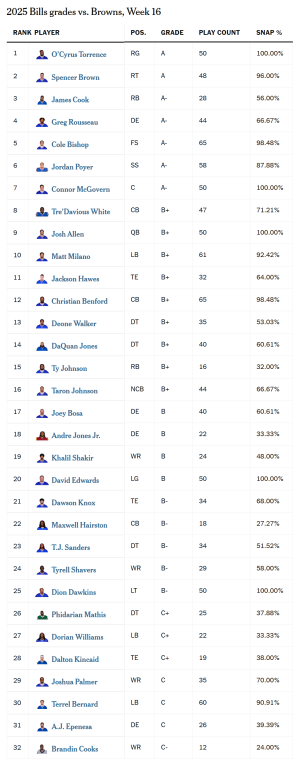
Players with 15 or fewer snaps:
LB Shaq Thompson, DB Cam Lewis (9), RB Ray Davis (8), FB Reggie Gilliam (8), IOL Alec Anderson (2), OT Ryan Van Demark (2), QB Mitchell Trubisky (0), WR Mecole Hardman (0), IOL Sedrick Van Pran-Granger (0), DE Javon Solomon (0), LB Joe Andreessen (0), S Jordan Hancock (0), S Sam Franklin Jr. (0)

*Minimum 200 snaps
How the standards work
When the All-22 film becomes available, we’ll go through and watch every player on every play as many times as necessary to assess letter grades. It is a subjective analysis, and it’s important to note we do not know the play calls and full responsibilities. The grades stem from technique, effort and presumed liability.
The study accounts only for players who take a snap on offense or defense. Players with fewer than 15 snaps — unless they significantly impact the game — will not factor into weekly rankings. The grades range from an ‘A’ (a perfect 4.00 GPA) to ‘F’ (0.00 GPA). There is no such thing as an ‘A+’ in this grading system. Season-long grades will be tallied and documented, with a single game’s grade weighted based on how much the player was on the field in a given week.
