

What’s the future best case and worst case for Alexis Lafrenière and Owen Power?
Two recent No. 1 picks haven't hit the lofty heights they were expected to reach. What do player comps have to say about future outlook?
 www.nytimes.com
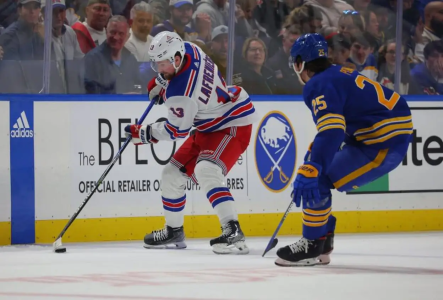
Player comps can give us an idea of what's to come for rising stars Alexis Lafrenière and Owen Power. Timothy T. Ludwig / Imagn Images
It’s easy to get excited about rising stars. It’s also easy to let expectations spiral out of control. That’s especially true for No. 1 picks.
Alexis Lafrenière and Owen Power, who were drafted first in 2020 and 2021, were expected to develop into some of the best players in the world. It comes with the territory of being drafted in that position; players are selected there because they are thought to have 1) an elite ceiling and 2) the chops to hit impact status quickly.
Years after being drafted first, the reality is neither player has lived up to the (sometimes unrealistically high) hype surrounding them. But based on aging curves, Lafrenière and Power are only just approaching the primes of their careers. So what does the future hold? Looking at similar players can help forecast that.
No two NHLers are the same. Every player has their own set of attributes and skills, and it makes for a unique set of traits. Within all of that individuality, though, there are ways to reasonably spot similar traits. Playing styles can be alike, whether players are grouped as net-front threats, snipers, playmakers, play-drivers or defensive stalwarts. Shared traits can extend to a player’s physical attributes or their usage.
Those traits all build toward a player’s similarity score, and using Dom Lusczyszyn’s model, it can outline player comps that show the best- and worst-case scenarios for a player.
Owen Power
Power is just one of five defensemen drafted at No. 1 this century, along with Erik Johnson (2006), Aaron Ekblad (2014), Rasmus Dahlin (2018) and Matthew Schaefer (2025). What also set him apart from most top draft picks was the decision to stay in the NCAA for his draft-plus-one season instead of jumping right to the NHL. And he absolutely thrived in his last year with Michigan, which helped boost him up to No. 1 in Scott Wheeler’s top NHL prospects under 23 in 2022.That season helped solidify the projection that Power had the chops to become a true No. 1 defenseman at the NHL level. And that projection still seemed like a possibility after an impressive rookie year, where Power finished as a finalist for the Calder Trophy. He logged big minutes, with an average ice time of 23:48 in Year 1, and put his puck-moving ability on display with 35 points in 79 games.
He didn’t have the strongest list of matches that year as a 20-year-old, but names like Dahlin, Hampus Lindholm, Mikhail Sergachev and Zach Werenski all had above-average similarity scores, while Tyler Myers and Travis Hamonic represented the worst-case scenario.
The problem is, he hasn’t stayed on that elite path. He isn’t even thought of as an impactful enough No. 2, which held him outside of the top 150 in this year’s Player Tiers after making the cut in 2024. The range of outcomes, based on his play as a 23-year-old, now includes Sergachev and Brent Seabrook as the best-case, while Olli Maatta and Carl Gunarsson are the worst-case scenario. The middle ground is Cam Fowler / Erik Johnson / Alex Edler territory.

The Sergachev comp feels extremely fitting, since his road to becoming a No. 1 in Tampa Bay was blocked by Victor Hedman (while Power’s is by Dahlin). Power, like Sergachev earlier in his career, isn’t his team’s power-play quarterback, which has limited his scoring potential. But the one benefit of not being the team’s true No. 1 is not having to take on as hefty a workload. And in theory, that should free him up to play to his strengths.
There is just a lot of room for improvement on both sides of the puck.
Power’s surroundings obviously contribute to his current situation, considering some of the ups and downs in Buffalo over the years and who he has been partnered with at times. But there are also individual adjustments that would go a long way.
Power doesn’t play like a 6-foot-6 defenseman. It’s less about the fact that he isn’t super physical — because that really has never been a part of his game, anyway — and more that he doesn’t use his size to take control of play. Power should be using his size to close gaps and deny opponents entry over the blue line. He can use his body (and reach) to create more separation in the defensive zone, too. Finding ways to use his physical attributes would unlock another level of defense and put him in a position to play to his strengths: transitioning the puck out of the defensive end with control.
That defensive game can take time to develop — it did for Sergachev, even with Hedman and Ryan McDonagh ahead of him on the depth chart in the early goings of his career. But he eventually proved that he had more in the tank in Tampa Bay, and now in Utah, where he has become a true No. 1.
To Power’s credit, he has been improving on the fly this season. His defense has actually ticked up as the Sabres shot up the standings over the last month-plus of action. The key now is playing at that level more consistently.
As it stands, the Sabres are slightly worse defensively in Power’s five-on-five minutes. But there is just under half a season to change that. With more defensive breakups should come more opportunities to thread the needle offensively. That would ultimately elevate his scoring, which is on pace to be his lowest yet (26 points). That would likely lessen the similarity score between him and Maatta, which would brighten up his outlook tremendously.

Expectations are part of the package of being drafted first, and signing a seven-year contract with a $8.35 million cap hit in his second NHL season only amped up the pressure for Power. The raw skills and potential are still there; it’s just a matter of finally taking the leap — even if it comes later than anticipated.