

What we learned about the Bills from Joe Brady, Brandon Beane at the NFL combine
Questions remain about the wide receiver room and cap space.
 www.nytimes.com
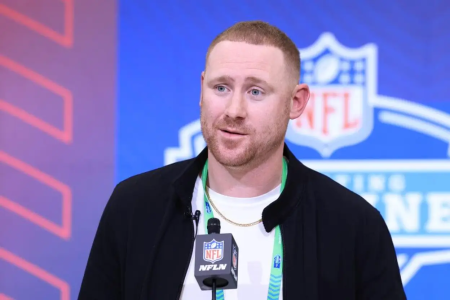
Bills coach Joe Brady, speaking at the NFL combine, touched on the roles of receiver Khalil Shakir and defensive end Greg Rousseau in 2026.
Justin Casterline / Getty Images
With the dust settling on all of the changes in Orchard Park, the Buffalo Bills finally dove headfirst into the 2026 offseason with the start of the NFL combine.
President of football operations and general manager Brandon Beane, along with new head coach Joe Brady, met with reporters during their annual marathon media sessions. With several weeks of roster planning leading to the annual league event, it was our first chance to hear how the Bills could shape a critical offseason.
Here’s what we learned at the 2026 NFL combine about the Bills.
Keon Coleman, sculpting the WR room and why trading for one remains logical path
As the Bills begin to shape their 2026 roster, no position will receive more attention than wide receiver. What they had in 2025 was not good enough, and even with some efforts to improve at the trade deadline, the Bills weren’t successful in bringing in a new piece. Now with Brandin Cooks a free agent, and questions surrounding both what the Bills are looking for and how they want to build the room, some interesting things were said Tuesday.Third-year player Keon Coleman has been a lightning rod for discussion since his rookie season. He’s shown brief flashes, has been invisible at times, and he’s been disciplined by the team for tardiness on multiple occasions. The major question revolves around how much the Bills are considering Coleman a part of their plans this offseason. Beane gave the impression that Coleman has to prove himself to them, which doesn’t exactly scream that they are making him a big piece of their plan. Beane pointed out that Coleman had a great offseason and training camp last year before getting to the main point.
“Some of the things we’ve talked about is just, it’s the maturity. It’s the off-the-field. That can get in the way,” Beane said. “I’ve been in this league 28 — this will be 29 — seasons. I’ve seen that many times get in the way of people’s opportunities to grow, and not only on the field, but to expand their net worth off the field. And so that is kind of the challenge to Keon.”
Beane remarked that if Coleman vanquishes the off-the-field concerns and combines that with a similarly great offseason and summer, he’ll “have every chance.” But NFL teams will not make a coin-flip player a major part of their decision-making, which is why the Bills are likely looking at Coleman as more of a player who, if he pans out this year, will greatly improve their situation. They aren’t depending on him to be that player anymore, though, given the risk involved.
There were also some brief yet intriguing comments from Brady on the usage of slot receiver Khalil Shakir. Over the last two seasons, Shakir has been mostly a slot receiver, and most notably in 2025, his average depth of target was aggressively low. Among wide receivers who ran at least 100 routes in 2025, Shakir’s 3.7-yard average depth of target ranked No. 151 of 153 qualifying players, according to TruMedia. The predictability of Shakir screens was a source of frustration for fans throughout last season, and Brady seemed to acknowledge that.
“There’s really not a lot of things Khalil can’t do. As we watch cutups and as we go through things and put it all together, there’s definitely ways to get the ball in his hands in different ways. And we have to continue to grow his game because he’s such a huge component to our offense. He’s one of our best football players. When the ball’s in his hands, good things is happening, and it doesn’t necessarily always have to be in a short range.”
Brady added that he believes Shakir can play both inside and outside, which will help the versatility of the room and allow times for Coleman and others to get more reps inside than they had in 2025. It also enhances how they can approach the offseason with what they look to add. Make no mistake, adding substantially to the receiver room is likely to be a high priority for the Bills this offseason.
The draft has some quality receiver prospects, but their current projections lack someone who could be a true top target for a team. To me, with the draft class and how the Bills’ receiver room is set up for 2026 currently, it makes the most sense for the Bills to try to swing a trade for a known commodity who they know will have a strong chance to mesh well with Josh Allen and who, paired with Allen’s skills, can become a No. 1 wide receiver in 2026 at least. The Bills may not have many draft picks in 2026, though if they were hoping to land an impact receiver with one of them, trading one for a known commodity seems like the most logical approach at this point.
One player who would make a lot of sense from several perspectives is Chicago’s DJ Moore. In terms of skill set, Moore has what the Bills lack in speed and intermediate to deep separation. He would immediately become the team’s No. 1 wide receiver — one who could flourish with an on-time thrower such as Allen as his quarterback. Moore’s skills also would not duplicate what the Bills have in Shakir or Coleman. He is a known commodity with several productive seasons, is entering only his age-29 season and has an extremely manageable deal for the team trading for him — one the Bills could get out of if it doesn’t work out. Because of his age and a disappointing 2025 season, Moore’s acquisition cost likely will not be exorbitant. The Bills likely won’t need to move more than a mid-round pick. On top of that, Beane has a history of making trades with Bears general manager Ryan Poles, and the Bills had Moore in for a pre-draft visit in 2018. It could be an intriguing buy-low opportunity.
The massive swing would, of course, be Philadelphia’s A.J. Brown, but it seems most likely the Eagles would need to be bowled over with a great offer. Brown’s contract is extremely complicated for future years, as he has an option bonus due each year he’s signed for, which makes getting out of the deal tough, even at the contract’s conclusion. Even with those potentially limiting factors, it’s best not to rule anything out when it comes to the Bills finding impactful receivers, Brown included. However, Moore checks a lot of boxes for deals that usually speak to Beane.
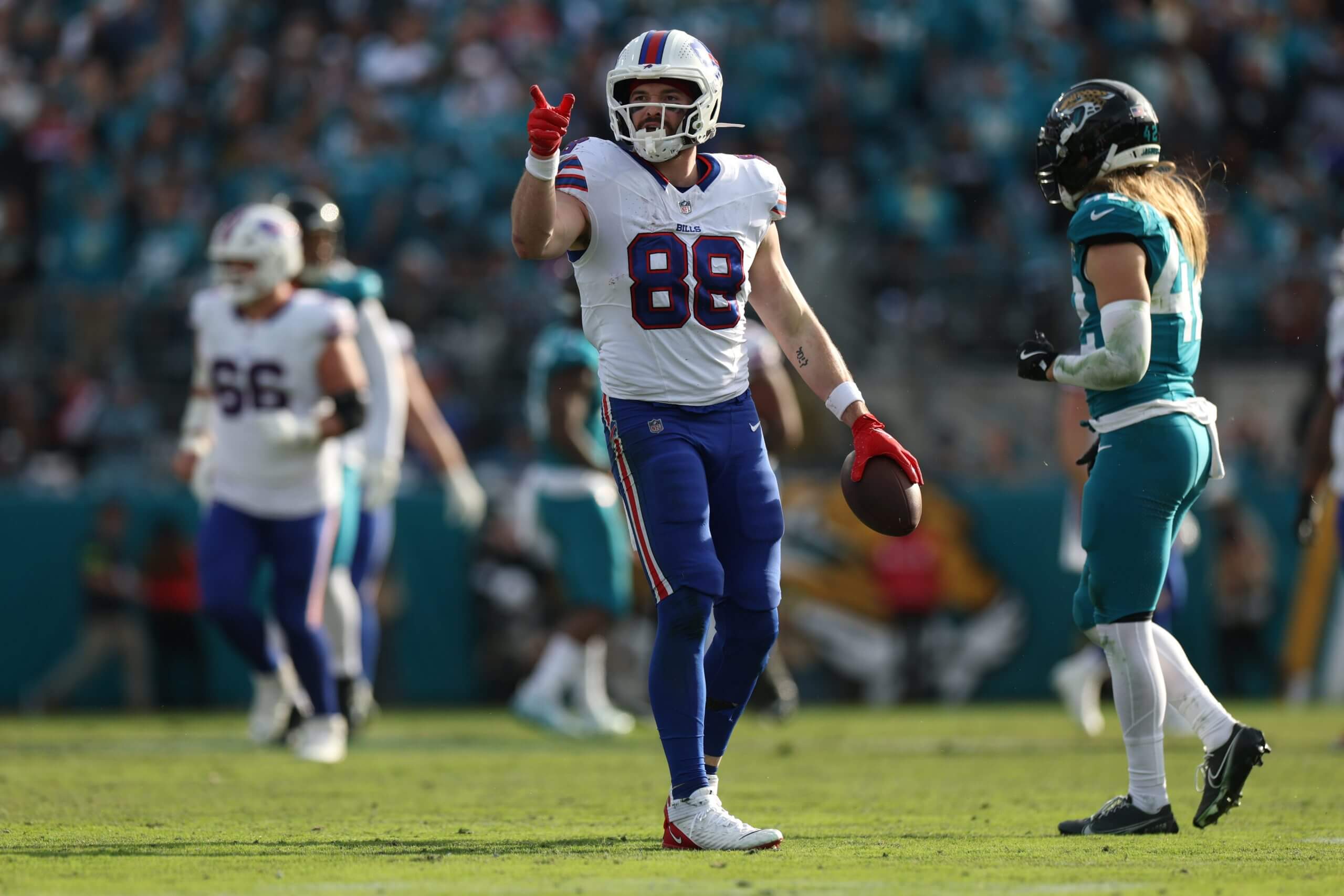
Dawson Knox is a valuable member of the team, but his contract comes with a big cap hit. Nathan Ray Seebeck / Imagn Images
Dawson Knox’s deal sounds like it needs adjustment if he stays in Buffalo
As the Bills begin their offseason work, their first job is to become cap compliant. With a projected cap of $303.5 million, the Bills will be around $15 million over the cap, including Larry Ogunjobi’s voided deal, which turns into dead cap in March, before any moves. There are several ways for them to get under the cap, and the first is through contract restructures they’ve already begun. Beane confirmed Tuesday that the Bills had done a simple restructure to right tackle Spencer Brown’s deal, which, if they used every eligible dollar they could, would yield about $10.42 million in cap savings. That still leaves them over the cap at the moment. They can use other restructures, but the Bills always try to be careful not to overdo it.The other means to find cap space is by cutting players and getting others to agree to pay cuts, and that’s where tight end Dawson Knox comes in. There are some more obvious cut candidates, such as wide receiver Curtis Samuel, but Knox is a complex one. They love him as a player, they know how important he is to their locker room, and they understand how strong a friendship Knox has with Allen. The 29-year-old Knox has an extremely difficult cap hit of over $17 million, which, for a team that has two other tight ends they love in Dalton Kincaid and Jackson Hawes, is too tough a number to leave as is.
Beane said he’s had a dialogue with Knox and left the door wide open to Knox’s return. However, it definitely came across as a situation where the team needs an adjustment to the deal for the partnership to continue.
“We’ve done pay cuts before with players. With those, you have to keep in mind, they’re going to try and figure out what their market is, and that’s what their agents do a great job of,” Beane said. “We’d be crazy not to want a Dawson Knox back. We know we have to make it work for him and work for us.”
Knox is owed $12 million in new money for 2026 between his base salary and bonuses. The only plausible solution for Knox to return is if he agrees to a pay cut with incentives to earn the money back. If the Bills can find their way to removing $3 million to $4 million, bringing his new money number down to $8 million or $9 million, that will still keep Knox just a little below the average annual value his contract extension held. Knox has a $1.5 million roster bonus due March 15, so that is the likely deadline for the Bills to come up with a solution to keep Knox before the deal becomes more difficult to get out of.
Greg Rousseau is a big piece of their defense moving forward, but his role is TBD
As the Bills try to shape their defense into Brady and defensive coordinator Jim Leonhard’s vision, they’ve identified a handful of in-house pieces they are excited to shape it around. One of those is defensive end Greg Rousseau, to whom the team gave a long-term contract extension this time last offseason. With the Bills veering toward a more multiple front, though, where the Bills have Rousseau line up has been a question mark. Rousseau isn’t a traditional outside linebacker for an odd-man front, as he’s not the most explosive, and his strong run defending and length could make him better suited to the defensive end position in that 3-4. The trouble for the Bills is that they really don’t have much at edge rusher, or as they’ll now mostly identify it, outside linebacker.The Bills are extremely excited about Michael Hoecht and how he fits this new scheme, but he’s coming off a torn Achilles, with both his return date and impact in question. Second-year player Landon Jackson suffered a season-ending knee injury, and his role in the defense is unclear. The only two prototypical edge rushers they have for this new defense are Javon Solomon and Andre Jones Jr., who are likely best suited to special teams roles. That’s what makes Rousseau’s situation so complicated. The Bills know they have limited assets this offseason between draft picks and cap space.
“Tell me what else we acquire around him or how we use guys,” Beane said of Rousseau’s role. “So I think Greg is going to be a valuable piece. I think we’ve all decided that, and it’s just a matter of how we deploy him. Part of how we deploy him, which I love what Jim said is, show me the pieces we have, we’ll get him in the right spot.”
It remains a distinct possibility that their long-term vision for Rousseau may differ from where they use him in 2026 if the offseason doesn’t break a certain way. Rousseau’s skills seem like a very strong fit for defensive end in this new scheme, but if the Bills have only Hoecht, Jackson, Solomon and Jones at edge rusher heading into training camp, Rousseau might have to play that spot out of necessity. Given that, expect edge rusher to be a significant need the Bills look to address this offseason, maybe even with a pair of new players if they can find the right ones.