

The 'King on Main Street' still reigns: Shea's celebrates 100 years
One hundred years after its first screening, the now-thriving Shea's Performing Arts Center is looking back at its history as it celebrates its centennial milestone all year long, starting with a birthday party at the main theater on Friday.
On Jan. 16, 1926, Calvin Coolidge was president. It was the Jazz Age, and Prohibition was the law of the land.
And on that day, the Wonder Theatre first opened its brass-handled doors to the public in downtown Buffalo, one of the biggest cities in the nation, as a silent movie establishment. The first flickering lights projected onto The Wonder's silver screen showed "The King on Main Street," starring Adolphe Menjou.
The Jazz Age and the silent film era came and went, as did Prohibition. And the Wonder changed its name to honor its founder, Michael Shea.
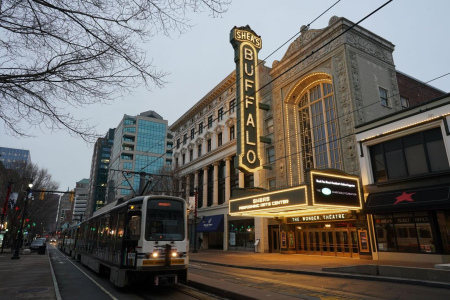
Shea’s Buffalo Theatre, Wednesday, Jan. 14, 2026. Derek Gee/Buffalo News
The decades that followed were not always kind to Shea's. By the 1970s, as downtown hollowed out and movie palaces across the country closed or were demolished, Shea’s fell into financial distress. In 1974, the city foreclosed on the theater for back taxes, putting the once-grand venue at risk of being lost altogether.
One hundred years after its first screening, the now-thriving Shea's Performing Arts Center is looking back at its history as it celebrates its centennial milestone all year long, starting with a birthday party at the main theater on Friday.
“For generations, Shea’s Buffalo Theatre has been a special place where memories are made and shared,” said Brian Higgins, who has served as Shea's CEO since 2024.

Shea’s Performing Arts Center President and CEO Brian Higgins speaks during the ribbon-cutting ceremony
to celebrate the completion of the renovated lounge and cabaret at Shea’s 710 Theatre on Sept. 10, 2025. Derek Gee/Buffalo News
"Its survival and success are rooted in the deep conviction that this theater matters to our culture, our city and our people. This centennial celebrates the community, volunteers, artists and supporters whose passion built, saved, and sustained this extraordinary place," he said.
Its survival owes much to a grassroots rescue effort. After the foreclosure, a group of residents formed the Friends of Buffalo Theatre to save the building from demolition, running it for several years and securing its placement on the National Register of Historic Places in 1975. In 1980, the nonprofit Shea’s O’Connell Preservation Guild was created to manage the theater – an arrangement that remains in place today.
Theater lover, down to its bricks
For 40 of Shea's 100 years, Sue Stapell has been a season ticket holder. She’s a theater lover, she said, especially the epic musical "Les Misérables," which she has seen 14 times in Philadelphia, Toronto and every time it comes to Shea’s.“My love of Shea’s goes back a long, long time, and I always thought how wonderful it would be to volunteer there," said Stapell, 79, who, aside from being a patron for decades, has been a volunteer fundraiser for Shea's since 2011.
She said quality, variety and diversity are what has made Shea’s so popular over the years.
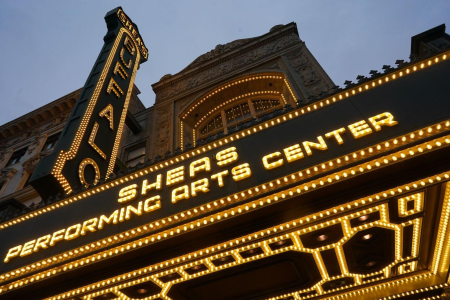
The marquee of Shea’s Buffalo Theatre, which will celebrate its 100th birthday today with a party in the Grand Lobby.
Derek Gee, Buffalo News
“I think that there is a real effort to bring different kinds of shows to appeal to different kinds of audiences, people with all kinds of different backgrounds and interests, so that you broaden the impact of something like that,” she said.
For Higgins, who came to Shea's after 19 years serving Buffalo in the House of Representatives, the theater’s centennial is a full-circle moment. His grandfather was an immigrant from Ireland's County Mayo who came to Buffalo and found work as a bricklayer. He would have been 30 years old in 1926, Higgins said.
“Shea’s was built in 1926 with 520,000 bricks that were hand laid," Higgins said, adding that Richard Williamson, president of Bricklayers & Allied Craftworkers Local 3, said Higgins’ grandfather “definitely worked on that project because at that time, everything in downtown Buffalo was brick, so they just moved bricklayers from project to project.” He said he is proud to have a likely family connection to the old building's bones.
While celebrating the theater’s storied past, Higgins is looking toward the future with an expansion, outreach and redevelopment.
“I'm not of the theater, but I think, like anything in life, this is about vision and execution,” he said.
‘The Wonder' years
Michael Shea was a First Ward native who went from dock laborer and ironworker to one of the most influential entertainment impresarios of the early 20th century, building a vaudeville and movie theater empire that stretched across Buffalo, Toronto and beyond, according to author Timothy Bohen's "Against the Grain," (Bohane Books LLC, 2012), a history of Buffalo's First Ward neighborhood.Known for his instinct for popular taste and his insistence that theater be accessible to working people, Bohen wrote, Shea conceived his Main Street theater as a kind of "cathedral to entertainment."
Shea's Performing Arts Center today is a campus of three theaters downtown: The 3,019-seat main theater at 646 Main St., Shea’s 710 Theatre and Shea’s Smith Theatre.
The main theater was built in a year and a day at a cost of around $1.8 million, roughly equivalent to $32 million in today's currency.

Shea’s Buffalo Theatre, Wednesday, Jan. 14, 2026. Derek Gee, Buffalo News
Originally a movie house under Paramount Pictures, Shea’s Buffalo would later stage vaudeville shows and play host to some of the biggest names in entertainment.
Today, Shea’s Buffalo Theatre is the only surviving Louis Tiffany-designed theater with an original Wurlitzer organ.
Shea’s had 16,881 season ticket subscribers last year, a patron base that is the third-highest in the theater’s history. In 2024, Higgins’ first year as president, there were 17,159, he said.
"We had lines for three weeks at the end of (2024), and into the first two weeks of (2025), 68,000 people came to the doors at Shea’s, spending about $26 million before and after the show,” Higgins said.
“Most of the theaters that are like Shea’s throughout the country have not recovered since the pandemic, and they're down 40%. We're increasing again. I don't know what it is. I think it's just a uniqueness of Buffalo and their affection for the theater to make it work,” Higgins said.
Repairs and improvements
In recent decades, more than $15 million in restoration and improvements have been completed at Shea’s Buffalo. The historic "blade" sign was returned and re-lit in 2004. The carpets were replaced and restored in 2009. The ceilings received attention in 2015. And those are only a few examples.Higgins is looking to do more. The price tag for this renovation is $35 million. Groundbreaking is scheduled for March, with completion expected in 2027.
The expansion is 25,000 square feet. The seating capacity will not increase, but the project will “more than double” the lobby space, including the petite lobby on the first floor, “so you won't have all that congestion that you have now,” Higgins said.
Sixty new restroom fixtures will be added, as well as three high-speed, large-capacity elevators.
“We don’t have any right now for our patrons, and our demographic is older, so a lot of people can’t go to the theater because they can’t move easily,” Higgins said.
A basement lounge, sometimes referred to as a "rathskeller," will be added to create more spaces for people to relax before shows and during intermissions.
The project also calls for creating a grand entrance facing Chippewa, adjacent to the Pearl Street entrance.
“It's an atrium, a glass enclosed atrium, which will have footlights that will shine through the atrium to go with the color scheme of the show,” he said. “So for 'Wicked,' it would be green.”
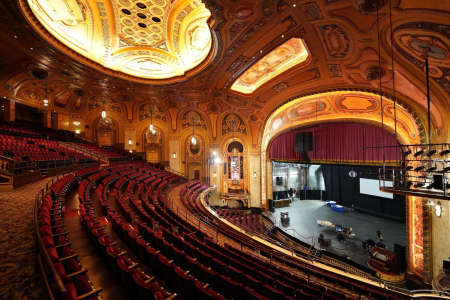
Shea’s Buffalo Theatre opened its doors on Jan. 16, 1926. After decades of disrepair and a period of foreclosure,
the downtown landmark is thriving, with plans for a $35 million renovation to be completed next year. Derek Gee, Buffalo News
Not just a district, a neighborhood
Beyond the landmark theater, Shea’s is working with Buffalo AKG Art Museum, Visit Buffalo, the city of Buffalo and other entities to build a lighted, outdoor art installation near the close-by Alleyway Theatre, to spruce up the area's appearance, and to encourage people to use the alley, which is a city right-of-way, Higgins said.The alley connects Pearl Street with Main Street, and the installation would make the area warm and welcoming.
And Higgins wants to add more outdoor lighting and signs to give Buffalo's Theatre District, which is often a quiet place when no shows are scheduled, more of a feel like a miniature Times Square.
“Theater is about the light and the night, and we want to create a smaller scale, Times Square-type of environment,” Higgins said. “And selfishly, we can use that to promote a show, but to also advertise, which becomes another revenue source.”
Similar plans are in the works for the Michael Bennett walkway, which connects Washington Street with Main Street.
Buffalo Mayor Sean Ryan said this week that Shea's reflects the pride the community takes in its history. It also reflects, Ryan said in an email to The News, "Our belief that the arts are essential to who we are as a city."
Ryan said the Shea's expansion will help make it an anchor for a thriving neighborhood, and he supports the broad strokes of Higgins vision.
"Projects like this are essential to creating an active, vibrant downtown that is a destination for residents and visitors alike," he said.
The last phase of the capital campaign involves adding floors to Shea’s Smith Theatre, a 200-seat black-box theatre owned by Shea's, to create housing or hotel space, or a combination of the two. The goal, Higgins said, is to keep more people in the Theatre District at all times, to create the pedestrian density that’s missing to turn the area into a true neighborhood, Higgins said.
"As we step into our next century," Higgins said, "We do so with a bold commitment to ensuring Shea’s continues to inspire and bring people together for generations to come.”