

‘Just skate my brains out’: Why Sabres center Peyton Krebs is so valuable in late, close-game situations
Buffalo Sabres center Peyton Krebs is among the NHL's leaders in empty-net goals, with four this season.
The most satisfying part of defending a 6-on-5 situation isn’t just about scoring an empty-net goal.
Peyton Krebs knows how to do that, but the Buffalo Sabres' center has a purpose when he goes onto the ice to defend against a team that opts for a sixth skater.
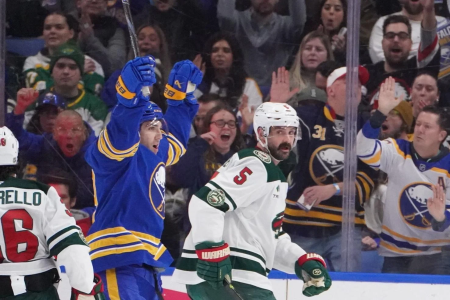
Sabres center Peyton Krebs celebrates his goal in the second period against the Wild on Jan. 17 at KeyBank Center.
Joed Viera, Buffalo News
“You get those opportunities, and you want to keep the puck out of the net,” Krebs said. “That’s the main goal. Then those (goals) are just coming as an added bonus. Getting those looks and putting ’er in the net.”
Krebs has been precise about being proficient in those late-game situations that he’s scored two empty-net goals in back-to-back wins Tuesday at Nashville and Thursday at Montreal.
He has been so precise that Sabres coach Lindy Ruff bestowed a nickname upon Krebs after his empty-net goal with 43.3 seconds left capped a 4-2 win against the Canadiens.
“He’s become the specialist,” Ruff said in Montreal.
Krebs, a center, is one of nine NHL players with four empty-net goals going into Saturday, behind Colorado’s Nathan MacKinnon, Washington’s Alex Ovechkin and Tampa Bay’s Brandon Hagel (five each), as the Sabres prepared to play the New York Islanders at 1 p.m. Saturday at UBS Arena in Elmont. The game didn't end before press time.
Krebs isn’t necessarily known for his scoring prowess; he has 36 goals and 78 assists in 346 career games, including six goals and 14 assists in 50 games this season. Krebs is known for his grind-it-out style of play, one that’s suited to opening up space for linemates off the forecheck.
But, he said, “When you’re scoring empty-netters, it means you’re winning hockey games. It’s a lot of fun.”
Ruff is working the grind-it-out aspect of Krebs’ game to his team’s advantage, particularly on offense. Krebs played on the top line with Josh Doan and Tage Thompson for 14 games from Dec. 11 to Jan. 12, and has played on the Sabres’ fourth line, primarily with Jordan Greenway and Beck Malenstyn in the last six games.
You'll also see Krebs on the ice in 6-on-5 short-handed situations late in the game, when the Sabres hold a one-goal lead and the opposing team pulls its goaltender for a sixth skater, in an attempt to generate offense and possibly tie the game or narrow the lead with a goal late in regulation.
Trailing 4-3, Nashville pulled goalie Justus Annunen for a sixth skater with less than two minutes left in the period Tuesday, and Krebs, working with Thompson, Alex Tuch, Bowen Byram and Mattias Samuelsson to defend the 6-on-5, scored his third empty-net goal.
Two nights later, the Canadiens trailed 3-2 and pulled goalie Samuel Montembeault for a sixth skater. Krebs, Thompson, Tuch, Byram and Owen Power were on the ice to set up Krebs’ goal.
“Part of the reason is to have that extra centerman on the ice,” Ruff said of putting Krebs in the late-game situations. “If we’re in our zone, he can take the draw on his strong side. Tommer (Thompson) can take it on his strong side, so you have a lefty taking it, where he’s not trying to battle a draw through to the referee that’s dropping the puck.
“He’s got a great engine. He’s on the puck. He’s an incredibly hard battler and there’s a lot of good qualities, for the reason why he’s out there.”
The challenge of defending 6-on-5 is being patient.
“A lot of times you maybe want to hit a guy and get a puck, but there’s moments to do that and moments to sit back and be patient and let the puck come to me,” Krebs said. “They’re the ones pressing for the goal. You want to let it come to you, and the rest of it will take care of itself.”
The Sabres have scored 12 empty-net goals in their last 19 games, including Krebs’ four goals, after scoring three in their first 31 games. In those recent 6-on-5 situations, the Sabres have blocked shots, cut down on shooting and passing lanes and have anticipated how to create scoring chances off their defensive efforts.
“We have the support, so we’re anticipating what our defense is doing when they get it,” Ruff said. “A lot of times the other team is going all-out to keep (the puck) in, so you can get behind them on the right read. We’ve been able to do that.”
Krebs has a strategy, too, when he’s on the ice defending against a team that opts for a sixth skater.
“Just skate my brains out,” Krebs said. “They trust my work ethic and my will to win, and when you’re out there, that’s the main goal.
“You don’t go out there to score an empty-netter. You go out there to finish the hockey game. When you end up doing that, it means you win the hockey game.”
