Bills and Sabres to drive more revenue, access by taking on radio broadcasts
The shift away from WGR-AM, which has broadcast Bills games for the past 14 years, provides the team with an additional way to connect with businesses to reel them in as paid sponsors, creating more essential local revenue.

buffalonews.com
Any content associated with the Buffalo Bills has tremendous value these days, and the team's decision to produce and distribute the broadcast of its games on the radio is a big way it's trying to take advantage of that.
The shift away from WGR-AM, which has broadcast Bills games for the past 14 years, provides the team with an additional way to connect with businesses to reel them in as paid sponsors, creating more essential local revenue.
It also gives the team another outlet for fans to listen to Bills games and content.
The Bills confirmed Tuesday that they are leaving WGR as their flagship radio home by the start of next season. Other Bills content on the radio, such as One Bills Live, will be removed as soon as Monday in favor of streaming at the team’s website and on the team's app.
The Bills will go from having a flagship radio station to using affiliates to carry games in local markets.
And, while the Buffalo Sabres will remain on WGR through the remainder of the NHL season, they’ll likely be the next to handle sales and production in-house by using an affiliate network.
It's a business model the teams believe makes more sense in the changing media consumption landscape.
“We’re looking at it through the lens of the Bills and Sabres and all of that inventory,” said Pete Guelli, chief operating officer and executive vice president for both teams.
“It (financially) nets out positively for us, and I think there’s even more positives with the ability to connect even more locally in the market,” he added. “And it will be seamless for our fans, however we work it out.”
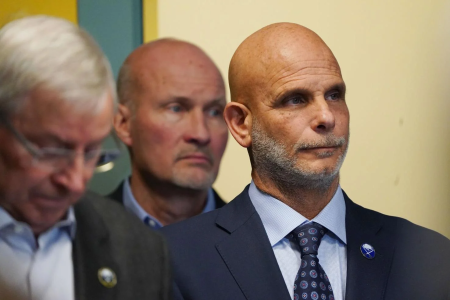 Pete Guelli, right, is leading the effort to have the Buffalo Bills and Sabres handle sales and production of their radio broadcasts and content in-house.
Derek Gee, Buffalo News
Led by reigning Most Valuable Player Josh Allen, the Bills have become so popular globally that it’s created barriers for partners to connect with the team at its new $2.2 billion stadium set to open for the 2026 season. It’s an expense that some businesses just cannot take on as partnerships become even more sought-after at the new stadium.
This may become a way for some of these companies, especially regional ones, to get around that high cost, as the Bills find new ways to still be able to connect with the local business community and increase revenue.
Broadcast content partnerships can be packaged up with elements like intellectual property and hospitality to create more relationships that may not bring in as much money but are still important to the team.
“The way the NFL has grown and the way the Bills brand has grown, the partnership levels, especially going into the new stadium, are pretty significant,” Guelli said. “I really like the flexibility this is going to give us to engage more locally.”
Guelli has experience with this model, working as a top-level executive for the New York Giants. When he got there in 2019, the team was already producing all its content in-house.
The model is becoming more popular around the NFL and other professional sports leagues. Some teams have gone away from the flagship model to do it in-house, while others have created a hybrid model where they have a relationship with a local radio station but split production and sales.
“We’re really confident this is going to work well for this team and the fans,” said Guelli, who’s coming up on two years in this role with the Bills and Sabres.
With the Bills' contract expiring with WGR, Guelli said the two sides couldn’t reach an agreement on terms that made sense for the team, ending the 14-year broadcast partnership.
The Bills plan to negotiate a deal with an affiliate network in Buffalo, Rochester, Southern Ontario, and other significant markets for the team to put game broadcasts on local radio, while creating more access for fans who can’t pick up the broadcast on the radio and now can stream it online.
“Radio, in general, still has a place in the distribution landscape and we’ll absolutely have an affiliate network that will cover our fans in Buffalo, but we just haven’t determined what those outlets will be yet,” Guelli said. “There are a number of different ways to consume audio content and we want to make sure we have a model that reflects where things are going.”
The decision had nothing to do with any criticism from WGR radio hosts about either team, Guelli said. Earlier this year, Bills general manager Brandon Beane made national headlines when he was critical of station radio hosts harping on the team’s need for wide receivers. There’s also been plenty of criticism of the Sabres and many of the team’s decisions over the years as they’ve struggled through a 14-season playoff drought.
“I know it doesn’t have any impact on the decision because I’m the one working on the deal and trying to make the business recommendations that are best for our organizations,” Guelli said. “We’ve really enjoyed our relationship with the folks at WGR, and I’ve gotten to know a lot of people over there. They’ve been great to work with.”
Guelli did not close the door to WGR being the local affiliate for the Bills in Buffalo and said the team will continue to partner and do business with the radio station, but he is unsure yet what form that takes.
One Bills Live with host Chris Brown, the radio voice of the Bills, and former Bills great Steve Tasker will be off the air on WGR and begin streaming Monday, while Sabres Live with host Brian Duff and former Sabres goalie Marty Biron will stay on the radio for at least the remainder of the NHL season. Sabres broadcasts on the radio will also remain on WGR for the rest of the season. Both shows are also on TV on the MSG Western New York network.
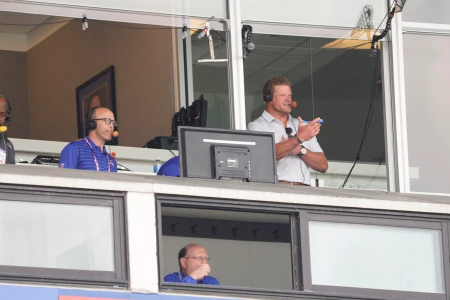 Buffalo Bills play-by-play announcer Chris Brown, left, and analyst Eric Wood call a preseason game at Highmark Stadium in 2024.
Significant changes with the broadcast team are not anticipated. Harry Scull Jr., News file photo
Team officials plan to work to make sure Brown remains on play-by-play for the Bills and that there is consistency in the game broadcasts. Guelli is not anticipating significant changes with either broadcast team.
The Sabres are still working through what their next broadcast home will look like and are in discussions with a number of outlets, Guelli said.
“We’re working through now what will happen after this season,” Guelli said. “We’ve had the luxury of having the Bills and Sabres in one place, which I like in many ways because it is easy for people to find, but we may split it, depending on where these discussions go.”
Even with the expense of building out a team to produce the content and sell it, the revenue opportunities should be a net positive for the teams, according to initial analysis.
The Bills will work with media and marketing company Good Karma Brands to help build out their content and distribution plan.
The teams already create a good deal of content on their own, such as the Bills’ “Embedded” offseason feature series and “Built For Buffalo" series documenting the planning and construction of the new Highmark Stadium.
More recently, the Sabres produced “Dominik Hasek: Always the Goalie,” a film by the team about the Hall of Fame goaltender.
“We need to find the right outlets, so fans don’t feel like they’re missing out on anything,” Guelli said.