

For the Sabres (and Buffalo), better days were a long time coming
The Buffalo Sabres have made the Stanley Cup Playoffs for the first time since 2011. The Sabres are one of 16 teams playing for professional hockey’s holy grail. It’s a moment – and an accomplishment – that needed 14 seasons of what-ifs, so-closes and near-tanks to happen.
Alex Tuch has waited for this.
As an alternate captain. As a hockey player. As a native of the Syracuse area, who watched so many of the Sabres’ playoff runs. As an elementary school student who watched the Sabres reach back-to-back Eastern Conference finals in 2006 and 2007.
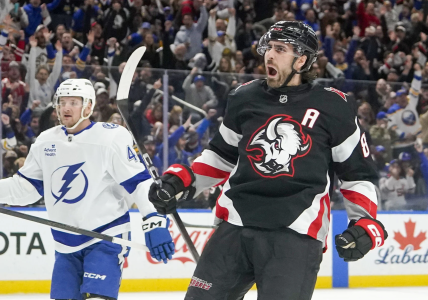
Buffalo Sabres right winger Alex Tuch, a Syracuse native, remembers watching the Sabres' playoff runs in 2005 and ’06 and says he understands what it must mean for kids now to watch
this year's team make the playoffs. "I'm pretty sure (this is) a lot of fun and pretty special to them, and pretty special for their parents to have those moments, like I did with my dad," he said.
Harry Scull Jr., Buffalo News
Tuch had just turned 10 years old in the spring of 2006 when he watched the Sabres go all the way to Game 7 of the Eastern Conference final before losing in Carolina. The heartbreak evoked fans' memories of the 1999 Stanley Cup Final against Dallas and that triple-overtime loss in Game 6, made infamous by the Brett Hull skate-in-the-crease debate.
“I was watching that run back in ’05-06, and I was 9 or 10 years old,” Tuch said. “I was right around the same age as these kids now, and I’m pretty sure it’s a lot of fun and pretty special to them, and pretty special for their parents to have those moments, as I did with my dad.”
The 2025-26 season began filled with cautious optimism, then turned into an unpleasant fever dream by mid-November. The Sabres middled at 11-11-4 as they prepared for a stretch of six road games that began Dec. 3 in Philadelphia and opened with three straight losses. A certain sense of resignation had already set in.
Another empty spring in Buffalo.
A 15th year.
Maybe next year? Maybe never.
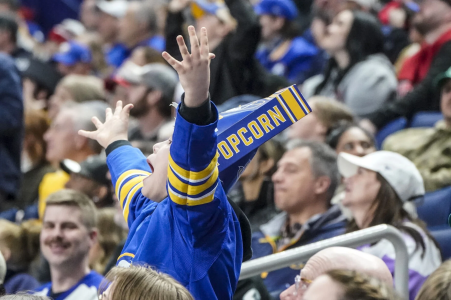
A Sabres fan cheers on the team against the San Jose Sharks on March 10 at KeyBank Center.
Harry Scull Jr., Buffalo News
But then, the switch flipped with a 4-3 overtime win Dec. 9 in Edmonton. A new general manager. A 10-game winning streak, and two more winning streaks of five and eight games. An Olympic gold medal for Tage Thompson, one of the NHL’s top scorers. The continuing recovery of Carolina Matovac, Rasmus Dahlin’s fiancée, who underwent a heart transplant in the summer.
It all culminated with a historic moment on April 4, when the New York Rangers beat the Detroit Red Wings 4-1, clinching the Sabres' first playoff berth since April 9, 2011.
The longest playoff drought in NHL history is finally over.
Are the halcyon days back in Buffalo? The building is bumping Dire Straits as the players step onto the ice in the minutes before a home game. The arena is packed before the opening faceoff, and fans are all in. Blue-and-gold signs are in the windows of local businesses, in support of the Sabres’ most successful season in nearly two decades.
The chatter in local restaurants isn’t about new Bills coach Joe Brady or the start of the Buffalo Bisons’ season. It is about Thompson, Dahlin, Lindy Ruff’s cross-generational coaching ability, and, oh yes, the postseason.
The Stanley Cup Playoffs are about to begin in Buffalo. Not too long ago, the locals could only imagine it. Now, the Sabres are one of 16 teams playing for professional hockey’s Holy Grail. It is a moment that was 14 seasons of what-ifs, so-closes, and near-tanks in the making.
This city and this region couldn’t be more ready. On Sunday, Buffalo will get its first taste of postseason hockey in 15 years when the Sabres open their Eastern Conference quarterfinal series against the Boston Bruins at KeyBank Center.
“Everybody says this is a hockey town, and when the Bills are good, everybody is excited,” Sabres defenseman Conor Timmins said. "They say, ‘Just wait until the Sabres are good.’ ”
That time is now.
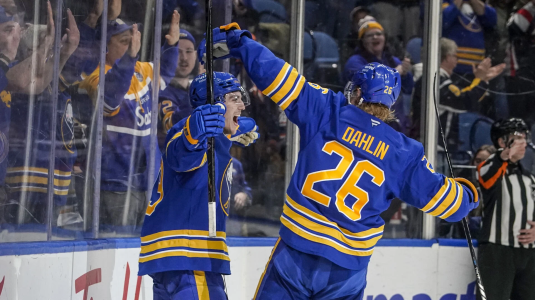
Sabres center Peyton Krebs, left, celebrates his goal with captain Rasmus Dahlin during a game against the New York Islanders on March 31.
The Sabres went 26-10-5 at home this season. Harry Scull Jr., Buffalo News
The local
Tuch got his own experience in a Stanley Cup run as a right winger with the Vegas Golden Knights in 2017-18. The Knights captivated hockey by reaching the Stanley Cup Final in their first season as an NHL franchise, but the Washington Capitals defeated the Knights 4-1 in the best-of-seven series to claim the Stanley Cup that year.Traded to the Sabres with Peyton Krebs in November 2021 as part of a three-player, three-pick trade for Jack Eichel, Tuch went from a Stanley Cup contender to a team that hadn’t made the playoffs in more than 10 years – and seemingly had no hope of making the playoffs for a while. They were close in 2023, edged out by Florida by a point for the final Eastern Conference playoff berth.
Tuch endured, though, and at the start of training camp in September, he talked about a chip the Sabres had on their shoulder. That chip carried the weight of all those near-misses, so-closes, and so-far-aways.
“No one’s going to hand it to you,” Tuch said. “These teams aren’t going to hear it. 32 teams are battling for spots in the playoffs every year, and the teams that have been in it for several years don’t want to give it up. Teams like Florida aren’t going to stop trying to win Cups just because they won the last two. Those are the teams we have to look at.”
More than seven months later, with the Sabres on the verge of earning a playoff spot – and the Panthers, out of the postseason this year after winning the last two Stanley Cups – Tuch put Buffalo's 15-year drought into some perspective.
“If you’re born after 2011, you haven’t seen the Sabres in the playoffs,” Tuch said.
You will now.
A bond to Buffalo
Tanner Pearson doesn’t need too long to remember the Buffalo Sabres' glory days.Pearson, himself now a Sabres left winger, quickly recalls the visits he made with his father, Tim, to the arena in downtown Buffalo, when it was first known as Marine Midland Arena, then as HSBC Arena, and even as First Niagara Center.
Pearson’s father worked for Bauer, the international hockey equipment company, and on some of his visits to Buffalo, he brought Pearson and Pearson’s sister, Ali. Those visits came in the late 1990s and early 2000s, when the Sabres were a perennial postseason contender and a Stanley Cup hopeful. You remember the names the Pearsons rooted for.
Dominik Hasek.
Michael Peca.
Jay McKee.
Maxim Afinogenov.
“My dad would come down in the mornings for pregame skate stuff,” said Pearson, who grew up in Kitchener, Ontario, about a two-hour drive away. “I’d be a little kid, hanging around here in the room and whatnot. As a little kid, I thought that was absolutely awesome, seeing idols up close.”
One day, Pearson’s younger sister was lucky enough to pose for a photo at the stall of Hasek, the eventual Hockey Hall of Fame goaltender. When the family looked at the developed photo, the Pearsons noticed something.
A very specific piece of protective equipment hung above his sister’s head. It’s become a running joke in the Pearson family.
But strangely, it was a bit of foreshadowing. Tanner Pearson joined the Sabres in March as part of a four-player trade with the Winnipeg Jets, and hit the dressing room in Buffalo to be part of the run that saw the Sabres clinch their first playoff berth in 14 seasons.
“This is such a sports town,” Pearson said. “They want their team to do well. To see what we’re doing right now, it’s bringing a lot of energy to the building, and guys are feeding off that. Everyone’s having a blast.”
The newcomers
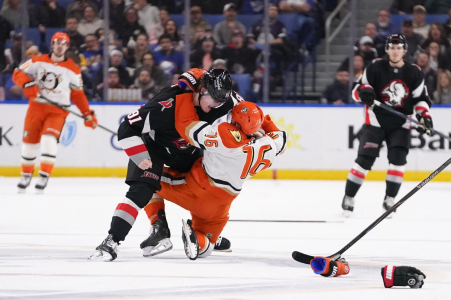
Buffalo Sabres right winger Josh Doan brawls with Anaheim Ducks center Ryan Strome on Jan. 10 at KeyBank Center.
Doan finished fifth on the team in scoring with 52 points in his first full NHL season. Joed Viera, Buffalo News
Josh Doan grew up in a hockey family in a hockey desert – the Sonoran Desert in central Arizona. His father, Shane, spent all 21 seasons of his NHL career with the Arizona Coyotes organization, and Josh Doan played college hockey at Arizona State, then split his first two pro seasons in Arizona, with the Coyotes and Tucson Roadrunners of the American Hockey League.
The Coyotes organization relocated to Utah ahead of the 2024-25 season, and Doan joined the Sabres as part of a trade with the Utah Mammoth in June.
He and Michael Kesselring, also acquired from Utah in the trade for JJ Peterka, spoke with optimism about joining the Sabres.
“This group is going in the right direction,” Doan said in June. “They have the right guys to go in that direction, and it might be one or two pieces or a couple more to fix that, and I think that’s what they’re trying to do.”
At the time, many outsiders saw it as lip service. Doan took the professional approach, a glimpse of what he would bring to the Sabres this season.
He’s having a stellar year in his first full season in the NHL, having finished fifth on the team with 52 points (25 goals, 27 assists), enough to have earned a seven-year contract extension in January.
“Coming here, the talent was in the room, and they had brought in the right pieces over the last couple of years,” Doan said. “There are a lot of guys in there that, if you ask around the league, a lot of people speak very highly of. That was part of Michael and I coming in, feeling confident in this group and feeling like we’re in a good spot.
“But as you’ve seen this season progress, it’s just showing up to things.”
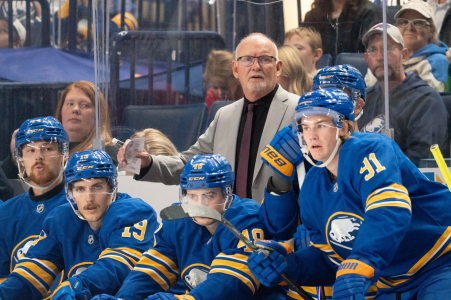
Buffalo Sabres coach Lindy Ruff looks on in the third period against the Colorado Avalanche on Oct. 13 at KeyBank Center.
The Sabres this game but won four of their next five. Joed Viera, Buffalo News
Although Timmins grew up in St. Catharines, Ontario, and spent summers in Fort Erie, he doesn’t remember a lot about the Sabres' playoff years of the 1990s and 2000s.
But as Timmins has meandered around Buffalo over the past few weeks, he started to notice the blue-and-gold flags. More people are wearing their team gear, or T-shirts emblazoned with Tage Thompson’s picture, or personalized jerseys. Local businesses started putting signs in the window in support of the Sabres.
“It’s exciting to be in that position,” Timmins said. “In my time in the league, I felt that even when this team hasn’t been super-successful, the fans are still showing out, despite a rough stretch.”
Doan recently went through one of the Canada-United States border crossings and saw the Sabres logo affixed to a booth.
He recently went to Whole Foods on Sheridan Drive and lost count of how many people were wearing Sabres gear, including a few throwback jerseys – a sign of devotion, through vintage attire.
“When I first got here, it was the Bills,” Doan said. “Everything was ‘Bills,’ and now it’s our season, but you’re seeing support for a team when it does well. That’s just something that shows what the team means.
“You don’t get to see that in a lot of cities. You credit cities for being supportive in their fan bases, but ... there are cars and houses and restaurants, and every store has Sabres stuff, Buffalo stuff. You walk into Wegmans, and there’s Sabres stuff. There’s a ‘Lyon King’ shirt right now at Wegmans. And that’s when you realize how passionate the fan base really is, and it really is what people talked about when you’re coming here.”
The outsiders and one-timers
Jon Cooper wasn’t about to buy into the crafted narrative of the Sabres facing the Tampa Bay Lightning – one of the gold-standard teams in the NHL’s Eastern Conference – for the right to first place in the Atlantic Division.It was March 8. There were still close to six weeks left in the regular season – enough room for an upstart team to tumble in the standings, and Cooper’s priority was to keep his own team in playoff contention.
Cooper, the 14th-year Lightning coach, was buying into this: The Sabres were for real.
“Good for them,” Cooper said. “I’m happy for them. I’m happy for the City of Buffalo. It’s probably our biggest TV market we have in the NHL. They never get to see their own team in the playoffs, so it’s super-cool that they support their team all this time.
“And their team is going to go to the playoffs. That is super-cool.”
A few weeks later, Patrick Kane sat in the visitor’s locker room as the NHL’s all-time leading American-born scorer and, by extension, Western New York’s all-time leading NHL scorer.
Raised in South Buffalo, Kane is in his 19th NHL season, including his third with the Detroit Red Wings, who topped the Sabres 5-2 on March 27, part of their own late-season push to make the playoffs.
Kane looked back on the Sabres games he watched at the Aud and all the times he attended open Sabres practice.
“A little bit of my childhood, right?” Kane said. “Growing up in this rink, and coming to games, and playing mini-sticks in the hallways with my buddies. It’s always cool to come back here and play.”
Kane played for the United States National Team Development program in 2005-06 and then for the London Knights of the Ontario Hockey League in 2006-07, before he became the No. 1 pick in the NHL draft in 2007. He watched both years of the Sabres’ playoff runs in '06 and '07, first from his billet home in Michigan and then from southern Ontario.
He and his friends drove from London, Ontario, to Buffalo for the Sabres’ 2-1 overtime win on May 1, 2007, against the New York Rangers.
Kane offered a word of warning to his friends: “Wait until they score a goal. This place, the roof is going to explode.”
Chris Drury tied the score at 1-1 with 8 seconds left in regulation, and then Maxim Afinogenov scored the game-winner at 4:39 of overtime to give the Sabres a 3-2 lead in the Eastern Conference semifinal series. The Sabres beat the Rangers 5-4 two days later to win the series.
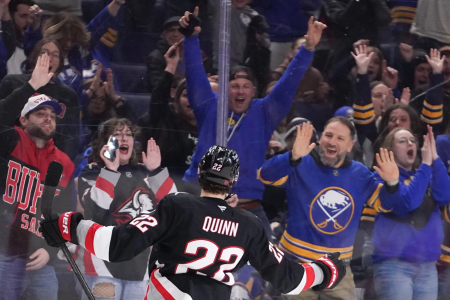
Buffalo Sabres right winger Jack Quinn celebrates his goal with fans in the third period against the Anaheim Ducks on Jan. 10 at KeyBank Center.
It was the Sabres' 13th win in a 15-game stretch. Joed Viera, Buffalo News
Nearly 20 years later, Kane considered the ups and downs of Sabres hockey since that visit. He even considered the last six months, and he made an admission.
“I probably wouldn’t have said that Buffalo would be in this position two or three months ago,” Kane said. “But they’ve really had a great run, and they’re playing some good hockey right now.”
Then, Kane considered the value of having the Sabres be a competitive brand once again.
A playoff team, getting ready for a spring that’s been 14 years in the making.
“You can see it when you watch the games on TV,” Kane said. “You can see the crowds are full, people are into the games, and people are excited. It’s the same type of thing you see with the Bills – the excitement it brings to the city, to the people in the city. When you have a couple of good teams here, I think it’s great for the people here.”