

Bills big picture questions: Does Buffalo have enough to reach new heights in 2026?
Let's deep dive into Joe Brady's potential impact, a possible setup year for the WR room, defensive players who could break out and more.
 www.nytimes.com
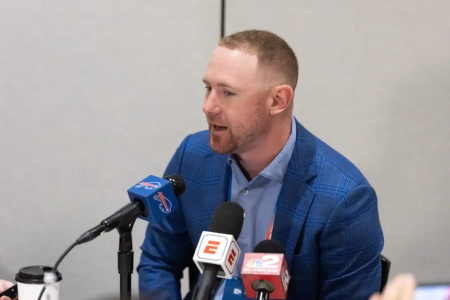
Buffalo Bills head coach Joe Brady has to take a team with high expectations even higher. Mark J. Rebilas / Imagn Images
The Buffalo Bills are entering a critical year.
A new head coach, a franchise quarterback who turns 30 on May 21, and sky-high expectations after seven straight premature playoff exits.
Now that the draft is complete and spring workouts are on the way, it’s a good time to examine the big picture. Here are four pressing Bills questions about the team and what to keep an eye on for the 2026 campaign.
1. Can Joe Brady help raise the Bills’ playoff ceiling?
With due respect to all the roster changes and the new defensive scheme, the single biggest unknown — and potential swing factor — for the 2026 season is what this version of the Bills will be under the leadership of new head coach Joe Brady. While it’s easy to say that they have Josh Allen and that everything else can be figured out, that’s an oversimplification. The truth is that, although the Bills are optimistic about their chances of improving under Brady, a coaching change can also bring growing pains that had been ironed out over years of continuity with the previous staff.To begin the Brady era in Buffalo, the vibes have been overwhelmingly positive from those who have spoken about it. There is just enough of the same and just enough change to create a dynamic rarely seen in the NFL. It’s rare for a longtime head coach of a winning team to be fired and replaced by one of his coordinators. Usually, if the coach gets fired, the whole staff goes with him. But Brady, who has been with the Bills since 2022, is doing his best to make the players and coaches feel like this is a fresh start.
Allen said it was a “good change” while paying respect to the success they had in recent years. Earlier this spring, I spotted Brady and what looked like his entire coaching staff in a team-building exercise, walking and jogging around the perimeter of the One Bills Drive campus when the winter weather finally started to break. There may be some small changes as well, whether it’s the daily schedule, signage around the building, locker room seating charts or anything else that could help make the atmosphere around the team feel new. All the positivity is a promising sign.
That said, it’s also common to see nothing but positivity from new staff before training camp and the regular season. There are no sources of tension at this point. While you can absolutely get a sense of who a head coach is before he hits his first road bump, the true measure is how the new leader handles conflict and how he gets the team to bounce back from adversity. That doesn’t even factor in the coach’s in-game persona, decision-making process, and time management abilities when various commitments are pulling him in a dozen different directions. All of it contributes to the feeling that permeates a building and often sets the stage for how successful a franchise will be under that coach. Until we know that about Brady, the rest is guesswork.
If the team stays bought in and the coach shows an early aptitude for resolving conflicts, change can be a good thing. It’s why most franchises find their answers about a new head coach within the first few years — sometimes sooner. If Brady proves capable of handling the myriad expected and unexpected challenges of his new position while overseeing critical changes to how the Bills operate on offense and defense, the team could absolutely reach the heights it has fallen short of in recent years.
2. Will changing the defensive scheme change the math on defense?
As the Bills adjust to a new staff, one reason they are optimistic is the change to a different play style on defense. New defensive coordinator Jim Leonhard will bring his multiple-front system, rooted in a 3-4 scheme. They plan to dictate to the opposing offense; they’ll likely be a bit more blitz-heavy and, in turn, play more man-to-man coverage than Bills fans have seen over the last nine years.That’s what we know right now. As for the big picture, here’s what I mean by them attempting to “change the math.” The Bills will head into the season without a true, identifiable game-wrecking defensive player on the roster. They have good players, but no singular threat who will keep opposing offensive coordinators up at night.
So if the Bills are hoping to raise the ceiling on defense, two questions become pertinent to changing the math: Can the scheme be enough to compensate for the lack of a true defensive difference-maker? And can the scheme be the catalyst for a currently rostered player to reach that level?
The first question calls for some projection about how players will adapt to the new scheme. They added some veteran helping hands to aid with the change, including outside linebacker Bradley Chubb, nickel Dee Alford, and safety C.J. Gardner-Johnson. But whether or not Leonhard’s defensive vision succeeds will come down to how the players who were in Buffalo before the switch take to it.
That brings us to the next part — players who could ascend in this defense. Rookies notwithstanding, I see four possibilities: defensive lineman Ed Oliver, cornerback Christian Benford, safety Cole Bishop, and outside linebacker Greg Rousseau. Of that group, the new defensive scheme could really speak to Oliver’s skill set. Oliver, 28, is in his prime and has always shown flashes of being that type of player. Now, in a new scheme — after having played in an odd-man front in college — the sheer mass of bodies around him could take attention away from him and yield more one-on-one opportunities. You could make a similar argument for Deone Walker, but Oliver’s explosiveness and ability to penetrate the backfield stand out.
As for the others, I could see Benford shine with more man-to-man coverage responsibilities. He has an all-around game that is tough to find, and his improvement in one-on-one coverage has been notable since he arrived in Buffalo. Bishop will enter his second full season as a starter and will be encouraged to become the playmaking safety he flashed all last year. Rousseau will never have a better chance to hit his ceiling than this year, as the team’s undisputed top edge rusher. Along with that, Chubb’s likely presence on the defensive right side, where he has lined up for most of his career, should allow Rousseau to play on his more natural side, the left. If the 26-year-old Rousseau doesn’t perform like more than just a good, sometimes great starter this season, then that may just be who he is. While it’s still a good asset to have, it could open up the Bills to another major investment in the next offseason or two.
Above all else, the defense’s ability to adopt a new scheme with mostly returning personnel will be another key determinant of the Bills’ ceiling in 2026.
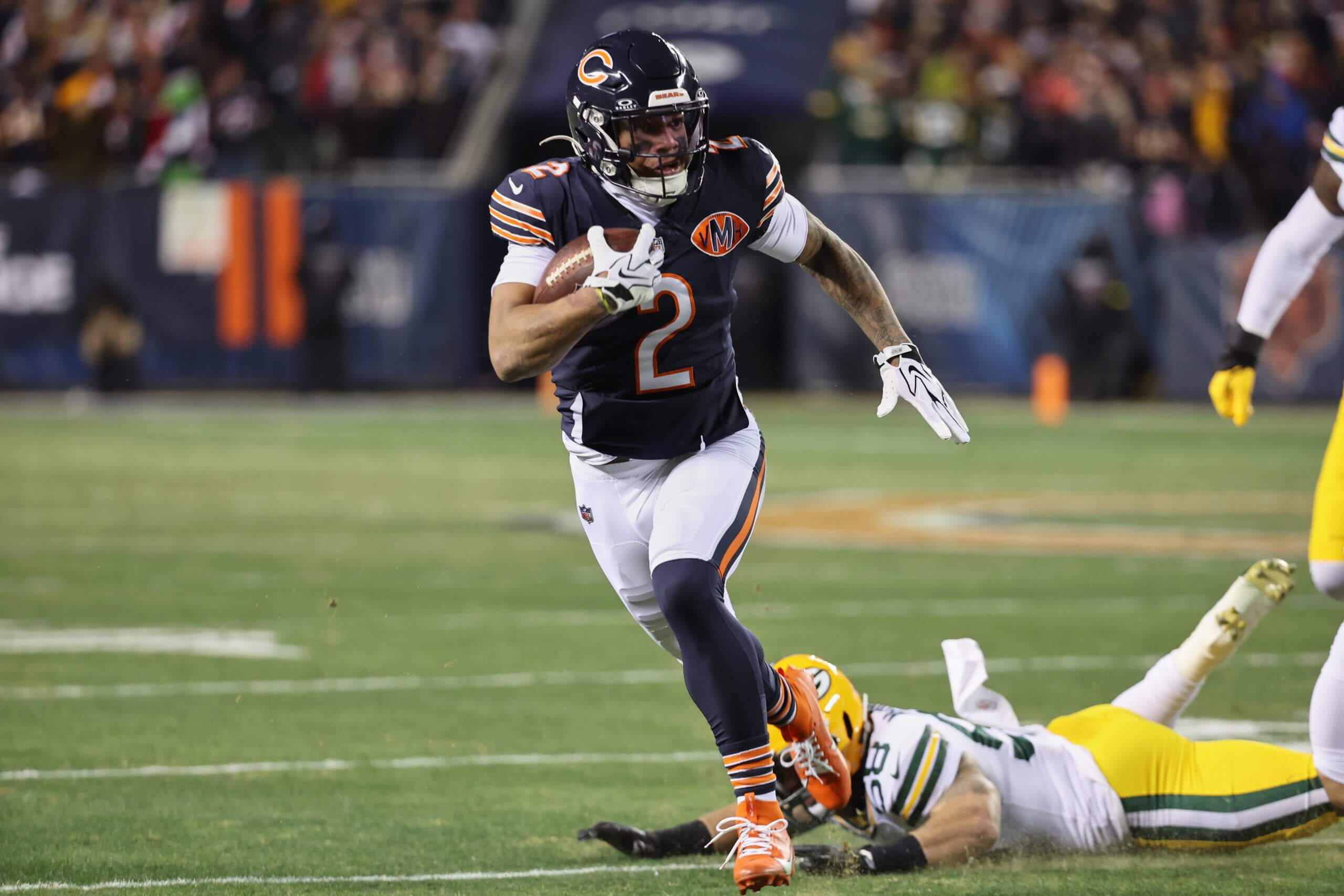
The Bills believe DJ Moore is their top wide receiver. Mike Dinovo / Imagn Images
3. How might the WR room look, and could this be a setup year?
One of the Bills’ most notable offseason moves was trading for DJ Moore to be their new top receiver. Regardless of his 2025 statistics with the Chicago Bears, the Bills are likely viewing him as the No. 1 wideout in this offense. Why does this matter? It could mean a departure from how they’ve operated over the last two seasons.The Bills have mostly handled their receiver room as a flat timeshare, which likely reflects their attempts to define the boundary group since they traded Stefon Diggs in the 2024 offseason. Over the last two years, among their regular receivers, the highest snap percentage belonged to Keon Coleman, who played 69.9 percent of snaps in the games in which he appeared in 2024. The next closest was Mack Hollins, at 65 percent in 2024. The Bills have not had a 70 percent-plus receiver since 2023, when Diggs and Gabe Davis were above 82 percent.
Why is this notable? Because the dynamic could be flipped with Moore, and the Bills could definitely benefit from a switch. Moore has routinely averaged in the 80s and 90s percent of snaps throughout his career. Given what the Bills paid for him this offseason, both with a draft pick and in guaranteed money, we could see the Bills finally have a top receiver on the field for close to every snap. Past him, the Bills can figure it out with the rest of the group, but to make the investment worthwhile, Moore should be out there plenty.
Not only is Moore the team’s best receiver and biggest investment, but his presence also creates an opportunity for the Bills to learn where this receiver group succeeds, where it falls short, and what they might need to do to improve it in the 2027 offseason. In the run-up to the draft, I mentioned a few times how this feels like a figure-it-out year at wide receiver.
By the end of the season, the team’s medium- to large-scale investments should provide some clarity. Moore will have had a full year with Allen; they’ll have their answer on Coleman in his third season; and Joshua Palmer will have had two years, too. This year, those players must prove themselves to prevent the Bills from making a big move next offseason.
If the receiver group doesn’t take a sufficient step forward, the Bills might have no choice but to act. Especially with a great receiver class projected for next year’s draft, don’t be stunned if the position becomes priority No. 1 in 2027.
4. What is the future of the offensive line?
While it’s a down-the-road question, the initial stages occur during spring and summer. Past 2026, only two of the offensive line’s five positions are nailed down for the long term. Right tackle Spencer Brown and center Connor McGovern are those clear building blocks. After them, everything is a bit in the air.We’ll begin with the obvious — left guard. The Bills will have a competition for that starting job in 2026. Whether Alec Anderson, Austin Corbett or another player emerges remains to be seen. The more significant question is whether any player on the Bills roster can be a long-term answer at left guard.
I found it interesting that GM Brandon Beane, when talking on WGR-AM shortly after the draft, mentioned that the organization thought fourth-round pick Jude Bowry has the skill set to give some reps at left guard. While that may not be a 2026 thing, it’s something to clock as the Bills make decisions moving forward, or if the team struggles at that position this season. Bowry has college experience at both left and right tackle, most recently at left.
These elements bring us to the other two pieces of the puzzle: right guard and left tackle. Right guard O’Cyrus Torrence is in the final year of his rookie deal, and given his age, dependability, and skill set, the Bills might have trouble retaining him on a long-term deal. I wouldn’t be surprised, should he make it to free agency, if he winds up on “this player might get paid more than you expect” lists. The Bills might also have a tough time investing in two interior positions before they’re confident that they’ve found their left tackle of the future. But if they can get Torrence to come back on a deal that works for everyone, they’d be glad to do it.
Dion Dawkins recently turned 32 and is under contract for two more seasons. The team could have easily restructured his $15.465 million base salary to open up cap space this offseason, but they chose not to. That’s a hint that the Bills might be thinking about what’s next at left tackle, too. It ensures a smoother off-ramp if they let his deal expire after the 2027 season to avoid adding more dead cap in 2028, or if they trade or release Dawkins one year from now to create cap space for 2027. As of now, the Bills would save $7.55 million on the cap to move on from him next offseason. Dawkins was still good in 2025, but he wasn’t as dominant as he was in 2024, which raises questions about his trajectory moving forward, given his age. Beane has previously said that he thinks Dawkins can move inside to guard if they need him to, and that could also be an option in 2027.
Regardless, the time to start paying attention to all of this is now. Can Anderson or Corbett be a multi-year answer at left guard? How NFL-ready will Bowry be in 2026, and will his performance influence the team’s decisions about the long-term openings? Will Tylan Grable, who the Bills have been high on in the past, become another option either at left tackle, left guard or right guard? Can Sedrick Van Pran-Granger or Chase Lundt push forward into future discussions? All of this is why I’ll be keeping a close eye on the offensive line throughout the summer and regular season.
Bonus question: Are there any young prospects we forgot to talk about?
Why, yes, actually, there is, and it’s a big one, if you ask me.No, not another punter.
My wife and I are expecting our second child in the next week or so, and we are ecstatic to bring the young one on board. Like the Bills, we’ll likely be playing much more man-to-man coverage this season. Jokes aside, I’ll be taking some time off as we welcome the newest baby Buscaglia.
Make no mistake, I will be back for the start of training camp in late July. As always, I wouldn’t be anywhere in this career if it weren’t for the people who subscribe, read, follow, listen, and watch. I am so appreciative of every one of you for being as faithful and supportive of my work as you are, which allows me to call this my job. Truly, thank you all. I’ll never take it for granted.
On that sappy note, I’ll talk to you all in July!