

Bills offseason checklist: Deone Walker's emergence answers key question on D-Line
"I feel like this is such a good base going into Year 2, because it shows I can do it," Walker said. "" ... That was a big question in my head coming into my rookie season. Now I’ve got the confidence to go out there and do it."
After cleaning out his locker last month, Buffalo Bills defensive tackle Deone Walker admitted that he wasn't sure where he'd train this offseason.
Arrangements had not yet been made because Walker planned for the Bills to play into February. The finality of a heartbreaking, season-ending loss forced him to reflect sooner than expected and look ahead to the next pivotal chapter in his young career.
"Just changing my body," said the 6-foot-7 rookie. "That's going to be a big emphasis for me coming into Year 2."
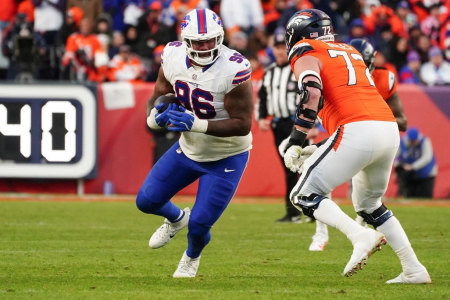
Bills defensive tackle Deone Walker intercepts a pass in the team's season-ending loss to the Denver Broncos.
Joshua Bessex, Buffalo News
A back injury that limited his impact and production at the University of Kentucky in 2024 also prevented Walker from training properly last offseason. He couldn't trim fat and gain muscle the way he and NFL teams would have liked. A proper workout regimen did not begin for Walker until he joined the Bills as a fourth-round draft pick in April.
Health is no longer an issue for Walker. After his practice reps were monitored last spring, Walker played 47% of the Bills' defensive snaps in the regular season. He started 18 games, including both playoff matchups, and his performance earned him a spot on the Pro Football Writers Association's All-Rookie Team.
The breakthrough strengthened a Bills defense that was decimated by injuries, including one to fellow defensive tackle Ed Oliver, and provided Buffalo with another building block on the side of the ball that has not performed well enough in the playoffs. The next step for Bills general manager and president of football operations, Brandon Beane, is to continue to add players like Walker who have game-wrecking potential.
Year 2 will bring different challenges. Opponents will continue to send double-team blocks at Walker, who admittedly struggled too often in that area in 2025, and he must acclimate to the 3-4 scheme that Bills defensive coordinator Jim Leonhard will implement this spring. Walker and the rest of Buffalo's linemen must learn different techniques as part of that transition.
The questions surrounding Walker's ability – including those he asked himself – were answered, however. He proved that he still possesses the talent and potential that once had scouts label him as a future first-round draft choice.
"I feel like this is such a good base going into Year 2, because it shows I can do it," Walker said. "That was a big – can I? That was a big question in my head coming into my rookie season. Now I’ve got the confidence to go out there and do it. Now I just need the consistency."
It was not a perfect debut for Walker. He wasn't always reliable against the run. His technique on double-team blocks needs work, and he needs to be better disciplined with his pad level. His combination of size, strength, and athleticism produced numerous impressive plays.
Among rookie defensive tackles who played at least 20% of their team's snaps, Walker ranked second in run-stopping tackles (25), trailing only the Cleveland Browns' Mason Graham, who got drafted fifth overall. According to Pro Football Focus, Walker was second in run-stop percentage. His pass-rush grade ranked first, and no one in the group batted down as many passes as Walker's four.
Walker was arguably the Bills' second-best defensive lineman behind Greg Rousseau, ranking second on the team in run stops. The Bills were not sure how often they'd be able to play Walker as a rookie because of the back injury. At the start of training camp, he was fourth on the depth chart behind Oliver, DaQuan Jones and fellow rookie T.J. Sanders, who got drafted in the second round. Walker didn't play more than 22 defensive snaps in any of Buffalo's three games to start the season.
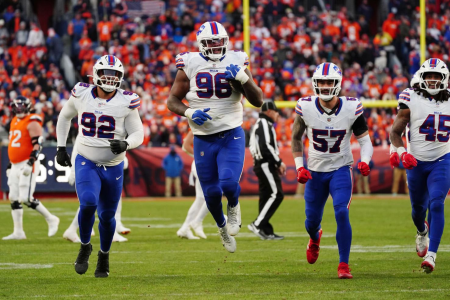
Bills defensive tackle Deone Walker, second from left, celebrates his interception against the Broncos on Jan. 17.
Joshua Bessex, Buffalo News
In the playoffs, Walker played 73.2% and 61.1% of the defensive snaps against the Jacksonville Jaguars and Denver Broncos, respectively. In the wild-card round, Walker batted down a pass. One week later, during the overtime loss in the divisional round, Walker intercepted Broncos quarterback Bo Nix. The video from those games should show Leonhard the different ways he can deploy Walker in 2026.
Nose tackle is one way Buffalo can use Walker. How many centers in the NFL can actually block him one-on-one? But it's more likely that Leonhard will move Walker around the defensive line to create matchup problems and unpredictability. His versatility is an underrated asset. The Bills aren't always going to have three down linemen on the field. There will be plenty of plays in sub-packages, like nickel and dime. Oliver's return should make everyone's job easier, as he may command the most attention of any player in Buffalo's front seven.
A prominent role cannot happen for Walker, however, unless he improves against the run. The Bills cannot afford for him to get out of position as often as he did at times in 2025. Leonhard made it clear during his introductory press conference that Buffalo's priority will be to make offenses one-dimensional.
"The number one way to control the tempo of a game is stopping the run," Leonhard said. "To force them into situations where you’re in an advantageous position as a defense, so a firm believer in stopping the run to make teams predictable. ... So that’s where it’s always going to start."
The Bills will need to use their salary-cap space or draft capital to bolster their pass rush. Joey Bosa and A.J. Epenesa are going to be free agents. Michael Hoecht and Landon Jackson are coming off season-ending injuries. Both may be better in situational roles rather than every-down players, but they're going to be useful in different ways. Though the Bills do not have someone who's considered an elite pass rusher, they have three building blocks up front: Rousseau, Oliver, and, based on his rookie season, Walker.