


How Sabres coach Lindy Ruff has become a contender for NHL’s coach of the year (again)
Buffalo Sabres coach Lindy Ruff has led the Buffalo Sabres to their ninth playoff berth in his second stint as head coach. Here's how Ruff has evolved, and what makes him a candidate for the NHL's coach of the year.
Kevin Weekes can still recall an intergenerational moment he had with Lindy Ruff during Ruff’s first year as an NHL coach.
Weekes joined the Florida Panthers as a rookie goaltender in 1996-97, which was ultimately Ruff’s third and final season there as an assistant coach.
Weekes quickly discovered that Ruff was approachable and well-schooled in the art of conversation – key qualities in a coach who needs to build a rapport with players. Weekes was also a little starstruck.
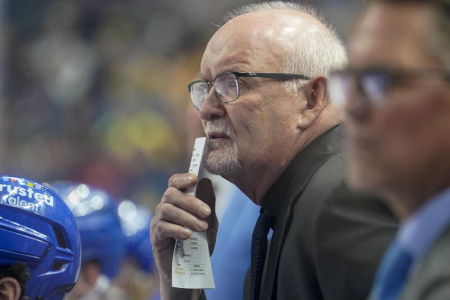
Buffalo Sabres coach Lindy Ruff looks on during a game against the Boston Bruins during the third period on March 25 at KeyBank Center.
Harry Scull Jr., Buffalo News
He grew up in Toronto and had formed a bond with the City of Buffalo, whether it was by watching news broadcasts from Western New York, by listening to WBLK-FM radio (when the frequency was clear enough), and tuning into Buffalo Sabres games.
As such, Weekes remembered Ruff, who was a Sabres defenseman from 1979-89.
“Working with him, my hockey cards came to life,” Weekes said, laughing.
Weekes, now an NHL analyst with ESPN and NHL Network, only worked with Ruff for that one season in Florida; Ruff became head coach of the Sabres in July 1997, his first head coaching job in the NHL.
Two years later, Ruff led the Sabres to the 1999 Stanley Cup Final. He coached the team to eight Stanley Cup Playoff appearances in 15 seasons, from 1996-97 to 2012-13, including berths in the Eastern Conference championship series in 1998, 1999, 2006, and 2007.
This season, Ruff has punctuated his second act with the Sabres by leading them to their first playoff berth since 2011, and to its first division championship since 2010. The Sabres open the Stanley Cup Playoffs on Sunday in Game 1 of a first-round series against the Boston Bruins.
Thanks in large part to that old familiar face, the Sabres have ended the longest playoff drought in NHL history.
Ruff, now 66, has transcended eras in hockey. He’s gone from coaching Generation X-ers, born in the 1960s and ’70s, to millennials, born in the 1980s and early to mid-’90s, and Generation Z-ers, born in the late 1990s and early 2000s.
Asked about the common denominator between all the playoff teams he’s coached in Buffalo, Ruff had a wry answer.
“We’ve won more games than the ninth-place team; that’s the common thread,” Ruff quipped. “Your goal is just to be one of those top eight teams when the year starts. Once you get in that position, you like to climb up, and you’re looking at home-ice advantage.
“But I don’t think there’s any secret. You’ve got to have a good team. You’ve got to have good players. I think I’ve been blessed with some teams that had some real good players that have put me in that position.”
In the last nine times the Sabres have made the playoffs (including this season), Ruff, the native of Warburg, Alberta, has been a common denominator.
Ruff’s steadiness has guided this year’s team, which looked at the start like more of a lock for a lottery pick than a team destined for the playoffs.
Ruff continues to evolve, but he still relies upon the principles that crafted success for the Sabres in the late 1990s and early 2000s.

Sabres coach Lindy Ruff argues a third-period penalty call during a playoff game against the Philadelphia Flyers on April 13, 2000, in Buffalo.
Harry Scull Jr., News file photo
Ruff’s enduring values
Thomas Vanek still describes Ruff as “an old-school coach.” Vanek played for the Sabres from 2005-14, scored at least 20 goals in seven of his eight seasons there and helped the Sabres make the playoffs in 2006, ’07, ’10 and ’11.After the Sabres fired Ruff in February 2013, he quickly returned to the NHL as a head coach, from 2013-17 in Dallas and from 2020-24 in New Jersey, with a stint as an assistant with the New York Rangers from 2017-20 in between. He returned to coach the Sabres in April 2024.
“Watching him now, and even when he was in Jersey, some of those guys turning pucks over, he reacted a bit differently than he did 20 years ago, but it was good,” said Vanek, who played in the NHL through the 2018-19 season. “He’s hard for a reason because he saw more potential in me. I never minded it. I grew up in Europe with my dad coaching me and coaching hard, and I don’t think any of us had an issue with that.”
Jay McKee, a defenseman for Ruff and the Sabres from 1997-2006, is now head coach of the Brantford Bulldogs of the Ontario Hockey League. He still uses what he calls “Lindy drills” to train his team, including a 2-on-2 neutral-zone drill and a one-touch drill.
“He was probably harder on me when I was younger, trying to drill in the right way to play,” McKee said. “Nine years later, you still have the player-coach relationship but a little bit more of a friendship, because you’ve been through a lot of experiences together.
“Every coach is very different. As a player who becomes a coach, I think everyone would say they learned something from every coach.”
Weekes also took note of the assorted personalities and backgrounds Ruff has coached over the course of his career. They spanned ethnicities and nationalities, and now, even generations. Luke Schenn, at 36 years old, is the oldest player on this year’s Sabres roster; Zach Benson, at 20, is the youngest.
“He’s a people person,” said Weekes, who is Black. “That goes a long way. He still has some of the old-school values, but at the same time, he can relate to people. He’s not too hard-nosed in that he’s abrasive, and he’s had different roles, and that’s allowed him to cross generations.”
Do the evolution
This year’s crop of Sabres is much more likely to own an iPhone than they are to have ever used a rotary phone, or even a dial-up modem, a staple of computer-assisted communication in the 1990s.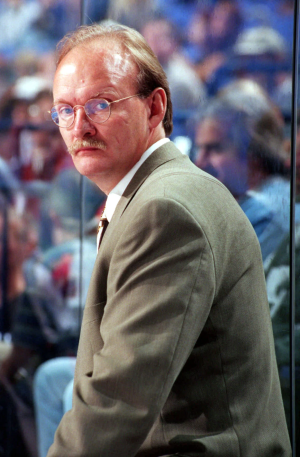
Buffalo Sabres coach Lindy Ruff watches the action from behind the bench in 1997.
Harry Scull Jr., News file photo
In fact, at least one Sabre has a parent who played against a team coached by Ruff: Josh Doan’s father, Shane, was in his second year with the Arizona Coyotes (then the Phoenix Coyotes and now the Utah Mammoth) when Ruff became coach of the Sabres in 1996-97.
Ruff, players say, has a set of guiding tenets that have outlasted changes on NHL rosters and changes in technology: be good people in the locker room, and to each other. He also keeps a cadre of coaches around him who have assorted strengths and can form connections with players, some of whom are young enough to be Ruff’s grandchildren.
“He is willing to adapt to the game,” Josh Doan said. “The game, from then to now, is quite a bit different, and he’s done a really good job of allowing the game to take its course and not trying to beat it to a pulp on, ‘This is how I used to coach,’ or ‘This is how the game should be played.’ I just don’t know if that would work anymore, with the style of players and the personalities.
“Even if you look at the mix of personalities in the league now, compared to then. It’s a different league from when he started, but he’s done an unbelievable job of maintaining what’s allowed him to have success.”
Jason Demers, now an NHL Network analyst, played for Ruff from 2014-16 when Ruff coached the Dallas Stars. It was also right when Ruff was beginning his third decade in the NHL as a coach.
Adapting to the changes in the game and evolving with those changes, Demers explained, is essential for a coach to stay in the NHL for so long. So is having the understanding of your own strengths and weaknesses, and leaning on them during important moments.
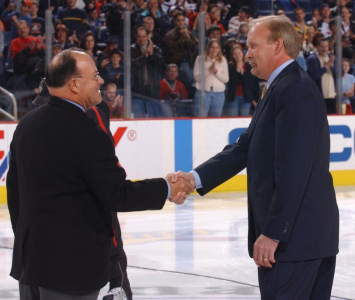
Former Sabres coach Scotty Bowman, left, shakes hands with Lindy Ruff in 2003 during a pregame ceremony honoring Ruff as the winningest coach in franchise history.
Buffalo News file photo
It’s also a matter of knowing when to be hands-on with a team, and when to take a step back and trust that team to flourish.
“As an older coach with wisdom and experience – you think about John Tortorella in Vegas – there are points where you need to step back and let guys be NHL players,” said Demers, who played in the NHL for 13 seasons. “Take the leash off. Don’t micromanage.
"Lindy has found a way to let those guys play and really nourish the creativity that this team possesses. It's very unique. They, as a locker room, the leaders in there deserve credit – but Lindy allowed those guys to be leaders. As much as people will say ‘he’s not doing anything,’ doing nothing can be the best course of action.”
Ruff, Sabres left wing Peyton Krebs said, continues to build on the passion for the sport that has guided him from a village 60 miles southwest of Edmonton across the NHL and to Western New York.
“He loves hockey,” Krebs said. “He is a hockey nerd. Guys like that love the game and will always try to get better and find new ways to learn about the game. That’s allowed him to stay in the game and excel the way he has.
“It’s a long time to be in the NHL. It can get pretty repetitive, but he’s found a way to stay, to keep getting better every year and to be a good coach.”
Jack Adams Award-worthy?
Ruff won the Jack Adams Award in 2006, given to the NHL’s top coach, as voted upon by members of the NHL Broadcasters' Association at the end of each season. A year after a lockout wiped out the entire 2004-05 season, the Sabres completed a season in which they brought a new style of play to the league and finished 52-24-6 in the regular season.“That 2006 season, the Buffalo Sabres were the hardest team to play,” Weekes said. “Skill players they had, like Brian Campbell, they were aggressive, the defense joined the rush, and activated the offensive zone. They always moved and played a high-octane European game, long before it was a thing.”
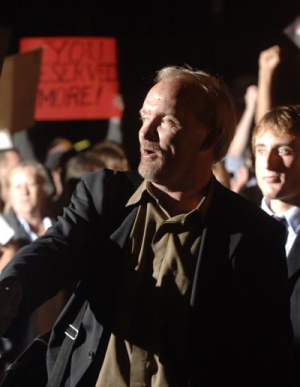
Buffalo Sabres coach Lindy Ruff walks past a crowd of fans outside Prior Aviation as the team returned
from Carolina in the wee hours after their Game 7 loss to the Hurricanes on June 2, 2006.
They were greeted by hundreds of fans who chanted, "Thank You, Sabres!"
Derek Gee, News file photo
Twenty years later, some believe he’s a legitimate candidate for the Jack Adams – perhaps the top candidate. After all, who’s the last coach to end a 14-year playoff drought in the NHL – and who’s the last coach to return to a franchise and do it?
But some, like Demers, don’t see Ruff as the front-runner. He considers the slow start the Sabres had, in spite of their talent-laden roster. He also named several other candidates for the award for the NHL’s top coach, including Pittsburgh’s Dan Muse, whose team broke a three-season playoff drought while playing at times without superstars Sidney Crosby, Evgeni Malkin, and Kris Letang; and Boston’s Marco Sturm, who coached the Bruins to a 100-point season.
Also in that mix: Anaheim’s Joel Quenneville, whose team broke a seven-season playoff drought; and, believe it or not, Colorado’s Jared Bednar and Tampa Bay’s Jon Cooper who, in spite of their teams’ sustained success, have never won the award.
But, Demers added: “Lindy is going to get votes and should be in consideration, heavily.”
Weekes, though, will gladly stump for his former coach. And he’ll add that somewhere in Weekes’ parents' house in Toronto, he still has that hockey card of his former coach.
“It’s been an incredible turnaround, finally,” Weekes said, “and I say that not as a dagger, but it’s been so long for those fans in Western New York.”
They made it back to the postseason with an old, familiar face.