

How will the Bills use their first-round pick? A post-free agency look at some options
One month away from the NFL draft in Pittsburgh, let's examine the possibilities, from the candidates at each position to the option to trade back and accumulate more picks.
After signing as many as three starters, not including center Connor McGovern, and trading for receiver DJ Moore, the Buffalo Bills still own the 26th pick in the NFL draft.
Which position will general manager and president of football operations Brandon Beane prioritize? There are several factors to consider when debating which direction the Bills should go in the first round.
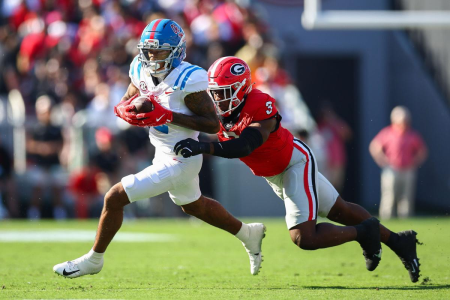
Georgia linebacker CJ Allen had 3½ sacks as a junior in 2025. Colin Hubbard, Associated Press
First, the Bills traded their second-round draft pick, 60th overall, to the Chicago Bears to acquire Moore. Which positions have enough depth where Beane can wait until the third or fourth round? Trading down is an option.
Second, there are still a few significant holes on Buffalo's defensive depth chart. Some fans are clamoring for another receiver, but would picking someone like Texas A&M's KC Concepcion be a luxury when there are a few glaring needs on the roster? Lastly, value. Beane isn't going to reach, especially not on a non-premium position, and he'll keep his options open until it's clear who will be available when the Bills are on the clock.
One month away from the NFL draft in Pittsburgh, let's examine the possibilities, from the candidates at each position to the option to trade back and accumulate more picks.
Wide receiver
Let's get this one out of the way first. The Bills' depth chart at receiver includes Moore, Khalil Shakir, Keon Coleman and Joshua Palmer. Tyrell Shavers is also expected to return during the second half of the 2026 season. If Beane is going to invest more at the position, then the player must be able to contribute on special teams, whether that's as a gunner, returner or coverage player.Coleman is the wild card. The Bills don't need a receiver if they can count on the 2024 second-round draft pick to contribute significantly this season, but there's no way for them to know if he's going to be ready for the responsibility. Is a rookie going to provide more certainty? Even if Buffalo likes a prospect enough to use pick No. 26 on a receiver, the Bills would be passing up an opportunity to add a starter or Day 1 contributor on defense.
Could the Bills select a receiver and trade Coleman later? Sure. But the acquisition cost would need to make sense. Beane isn't giving Coleman away. At minimum, the Bills would have to add a third- or fourth-round pick for any trade to make sense. One layer to consider: Palmer is probably only playing one more season in Buffalo, so the position becomes a greater need in 2027.
Without trading up, the Bills' most realistic options at receiver with the 26th pick: Concepcion, Washington's Denzel Boston and Indiana's Omar Cooper Jr. Cooper's stock has risen enough that he's probably going to be off the board. Concepcion, meanwhile, had a double-digit drop percentage in each of the last two seasons. Is he someone who can play in the bitter cold of a home playoff game? Is he a strong enough blocker? Boston is the best fit for the Bills. At 6-foot-4, he's an efficient route runner with yards-after-the-catch ability and 20 touchdowns over the past two seasons.
Outside linebacker
Bradley Chubb's arrival does not preclude the Bills from drafting an edge rusher with the 26th pick. Chubb had 8½ sacks and led the Dolphins in Next Gen Stats' pressure rate last season, but he turns 30 in June and missed all of 2024 with a torn ACL.Michael Hoecht is coming off an Achilles tear, Javon Solomon has yet to show how he fits in Buffalo's 3-4 defense and Landon Jackson is likely to play defensive end in 2026. The Bills need another talented outside linebacker, but can they wait until the third, fourth or fifth round to select someone who can contribute from Day 1?
It will depend on who's available when the Bills are on the clock. Texas A&M's Cashius Howell, Miami's Akheem Mesidor, Clemson's T.J. Parker and Missouri's Zion Young are possibilities. Each has potential drawbacks. Howell's arms are just 30¼ inches long. Mesidor is turning 25 next month and produced double-digit sacks just once in six college seasons. Parker is coming off a disappointing season. Young was exceptional in 2025, but he got charged with driving while intoxicated in December. Another option, Oklahoma's R Mason Thomas, may be a reach at 26.
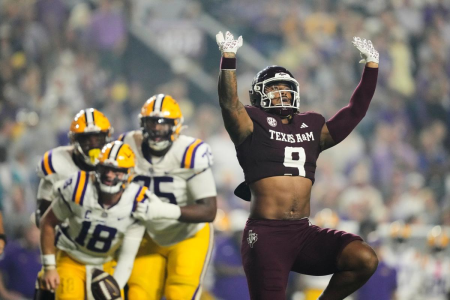
Texas A&M defensive end Cashius Howell celebrates his sack of LSU quarterback Garrett Nussmeier on Oct. 25, 2025, in Baton Rouge, La.
Gerald Herbert, Associated Press
Of the group, Howell is probably the best fit for the Bills. He had 33 tackles for a loss across the past three seasons, one at Bowling Green, and he had 13 passes defended in two years at Texas A&M. Jim Leonhard, the Bills' new defensive coordinator, has coached talented, productive players with similar arm length. Howell is an exceptional athlete who would add juice to Buffalo's front seven.
Defensive line
This is arguably the biggest need for the Bills entering the draft. Yes, they have Ed Oliver to play defensive end in Leonhard's 3-4 base defense, but who are the other starters? Deone Walker doesn't have prototypical size for a nose tackle. Jackson and T.J. Sanders are not ideal fits to 4-technique. The Bills need someone who can occupy their blocker(s) to free up the linebackers to make plays against the run. Three possibilities with the 26th pick: Clemson's Peter Woods, Florida's Caleb Banks and Ohio State's Kayden McDonald.Woods has the most upside, but does he fit Buffalo's scheme? It's a question no one outside of One Bills Drive can answer, especially during Year 1 of the team's transition to a 3-4. Banks played through a foot injury in 2025, but he has long arms and untapped potential. Though McDonald is outstanding against the run, the question is whether the value makes sense to take someone with his skill set at pick 26. At nose tackle, the Bills are better off waiting until the middle rounds to select someone like Syracuse's Domonique Orange.
Linebacker
The prices in free agency were too high for the Bills to justify adding an inside linebacker, but they also eliminated a few options in the draft by trading the 60th pick.The first round is too soon to select Texas Tech's Jacob Rodriguez or Texas' Anthony Hill Jr. But what do the Bills do if Georgia's CJ Allen is available when they are on the clock? At Georgia, Allen was a three-year starter who produced a career-high eight tackles for a loss in 2025. One question to consider: How often will Buffalo ask its inside linebackers to play man coverage? Also, could the Bills trade back and still select Allen or pivot to another player at the position?
Trade back
There are enough needs on the roster for us to assume the Bills will gauge interest in the 26th pick to see if it makes sense to trade back and acquire an extra pick in the third round.Could a team like Arizona or Cleveland want to trade back into the first round to select a quarterback like Alabama's Ty Simpson? Trading out of Round 1 would cost the Bills a fifth-year option on whomever they select, but doing so would likely give them another starter on defense. They'd still be able to select a receiver, edge rusher, defensive end or inside linebacker early in Round 2. Trading the 60th pick to acquire Moore increased the possibility of Beane moving back, but the board and trade package will need to make sense.