

Inside the Bills: Behind the scenes of the interview process that landed on Joe Brady as the team's head coach
Buffalo News sports reporter Jay Skurski goes behind the whirlwind process that led to the hire of Joe Brady as the Buffalo Bills' 21st head coach.
Pete Guelli felt the need to apologize.
The first thing the Buffalo Bills’ president of business operations did when getting back to the team facility after sitting through interviews for the team’s head coaching position in Florida was march right to Joe Brady’s office.
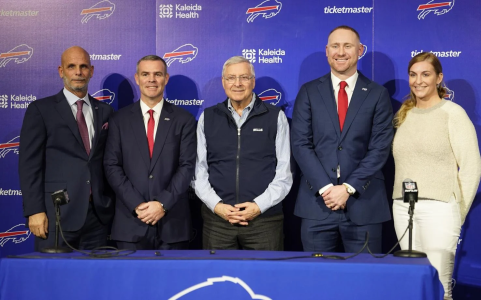
Bills new head coach Joe Brady, second from right, takes a group photo with (from left) COO Pete Guelli,
general manager Brandon Beane, owner Terry Pegula and Laura Pegula after Thursday’s press conference.
Harry Scull Jr., Buffalo News
The Bills had hired Brady as the 19th head coach in franchise history, but the process that led the team to promoting its offensive coordinator was, at times, arduous.
Guelli and president of football operations/general manager Brandon Beane sat down with The Buffalo News on Thursday after Brady’s introductory news conference to detail the process behind finding Sean McDermott’s replacement. A total of nine candidates were interviewed in six days. Brady was the first of those interviews, conducted Jan. 21 – just two days after the Bills moved on from McDermott after nine seasons.
After the initial wave of first interviews was done, the Bills reached back out to Brady to set up a follow-up Zoom call. The search committee had more questions.
“We went at him in that interview,” Guelli said. “I didn't want him to take it as we weren't interested in him as a coach, but there were questions that everybody wanted answered.
“The level of scrutiny that he was under was significant to the point where I felt kind of uncomfortable because we did know him, but we could not let him off the hook. We had to be very direct with him.”
In that call, the evolution of the Bills’ offense was a main topic, from before Brady arrived to his two-plus seasons as the offensive coordinator to where he sees it going from here.
“I would say it was just intense (in the sense) of, ‘There is no beating around the bush, at this point,’ ” Beane said. “You're not trying to win the job, say what it is and we're going to (expletive) ask you very direct. We're at the altar of, 'We're going together or we're walking away.' ”
In the end, together was the answer. This is how the team arrived at that decision.
The first wave
Brady’s first interview with the Bills on Jan. 21 lasted just about four hours at team headquarters. That was about the average length of the nine interviews. Beane said the shortest went three hours, 15 minutes.On Jan. 22, the Bills interviewed former New York Giants head coach Brian Daboll and Indianapolis Colts defensive coordinator Lou Anarumo at One Bills Drive. Daboll, of course, has familiarity with the organization from his time spent as the Bills' offensive coordinator from 2018-21.
After that, the search party shifted to team owner Terry Pegula’s property in Boca Raton, Florida.
The full interview committee for the Bills consisted of Pegula, Beane, Guelli, assistant general managers Brian Gaine and Terrance Gray and three of the owner’s children – Laura, Kelly and Matthew.
Two interviews were conducted virtually – with Denver Broncos pass game coordinator/quarterbacks coach Davis Webb and Los Angeles Rams pass game coordinator Nate Scheelhaase. Those interviews were conducted Jan. 26, a day after the season ended for both the Broncos and Rams in the AFC and NFC championship games, respectively.
Beane, who had never run point before on a head coach search, reached out to a couple of his counterparts in the league to get an idea of what worked and what didn’t in the interview process. He also shared a list of the traits he wanted in a head coach with the rest of the Bills’ search committee.
Each interview started with learning more about the candidates’ journey to interviewing for a head coaching position in the NFL – one of the 32 most coveted jobs on the planet. In the case of Brady and Daboll, known commodities, the Bills still learned plenty about each of them.
“I learned about Joe's journey even more, like going to the Air Force Academy and what he took from there," Beane said. "He told me how his parents raised him, the things he took from his mom (Jodi), the things he took from his dad (Joe). Same with Daboll.”
From there, the interview transitioned into leadership style. That sometimes led into discussions about staffing. A good deal of time was spent talking about staffing – who did candidates have in mind for offensive coordinator and defensive coordinator, and how confident were they that they could actually land those targets?
At least in the first interview, the Bills tried to create a relaxed, conversational atmosphere for those interviewing.
Everything from how the first phase of spring practices would look through going away for training camp – which Beane told all candidates the team is committed to – right up to the setting of the initial 53-man roster was covered. Beane wanted to know what the Monday after a win Sunday during the regular season would look like. He wanted to know how physical of a training camp each candidate planned to run.
About three-quarters of the way through the interview, Beane had the candidates take a break. At that point, they understandably might have been feeling a bit fried.
The next step was the game-management piece of the interview. Dennis Lock, the team’s vice president of football operations, then had a 30-minute window carved into each interview. He did that in person for the candidates who interviewed in Buffalo and virtually for those who interviewed in Florida.
The Bills wanted to get a better understanding of each candidate’s feel for game management and whether they relied more on analytics or their gut to make decisions.
Lock prepared about 15 different scenarios for each candidate, starting with this: It’s Week 1 against the New England Patriots. You just won the coin toss. Are you taking the ball, or deferring your decision? Why?
Other scenarios that were considered: You’re trailing 38-24, and just scored a touchdown with 7:54 left. Do you go for two points or kick the extra point? You’ve just scored a touchdown and the other team takes a personal foul. Do you move the ball to the 1-yard line and go for two points?
A couple of hours after each interview, Lock would email Beane and the committee a review of each candidate’s answers. That proved valuable in the interview process, because Beane and Co. could review their notes to see how they matched up with Lock’s report.
“It's funny, because some guys would say I'm aggressive, but their answers were conservative,” Beane said. “Some of them you could tell, game management, they're going to need a lot of work, and some of them were pretty natural at it.”
Brady, Beane said, ranked very highly in the analytics portion of the interview.
In addition to the game-management portion of the interview, the Bills also had each candidate meet after their interview with team sport psychologist Dr. Desaree Festa. She had about a 30-minute conversation with each candidate, then conducted a 20- to 25-minute assessment that provided insight into their leadership and personality.
The Bills purposefully did not have Festa sit in on the interviews so that the candidates' answers would not sway her thinking. Like with Lock, Festa would then share her results and comments with the search committee.
“That was really valuable,” Guelli said, “because you're meeting with these guys, and then she does this psychological profile, and then you're comparing that to your notes and what you heard these people say to see, 'Is there any deviation between what they said in this meeting versus the profile she's creating?' ”
An intriguing candidate
For the most part, there were no real surprises among the Bills’ list of candidates. All of them, in fact, have interviewed for other head coaching jobs around the league.All of them but one, that is.
When it was reported that Philip Rivers was going to interview for the job, well, let’s just say that was met with some … surprise.
“It definitely raised some eyebrows,” Guelli said.
Including in the Bills’ building. When Beane told Pegula that he wanted to interview Rivers, the owner correctly pointed out that the quarterback had just finished playing. Rivers’ three-game stint with the Colts after quarterback Daniel Jones got hurt followed a four-year retirement from the game, a remarkable return to the field at 44 years old.
Beane had heard through the grapevine that Rivers might be interested in pursuing a coaching career.
“I said, ‘Terry, at a minimum, we're going to get a football education here,’ ” Beane said.
Beane grew up in N.C. State fan, and has closely followed Rivers’ career since he was the Wolfpack’s quarterback from 2000-03. At that time, Beane was working in the Carolina Panthers front office.
Rivers’ only coaching experience was for his son’s high school team, but Beane had long been enamored with both the player and leader, who was on the field.
“I always thought he made his team better. I just never felt like the guy had a team to necessarily win it, but he was going to will them there,” he said. “What he just did (coming back to play), was all off of intelligence, not physical, to go come back and do what he did. Like dude, ‘I thought you were going to pop a calf or tear an Achilles right away. I was cringing.’ I watched every single game he played.”
Beane placed a call to Jimmy Sexton, Rivers’ agent, to see if his client had interest in interviewing. Beane got a call back the next morning that, yes, Rivers very much wanted to interview. There were only a couple of jobs that he would seriously considering taking, and the Bills was one of them.
Sexto was asked whether Rivers needed a few days to prepare, but the agent told Beane that Rivers would be there the next day.
So, Rivers flew to Florida the night of Jan. 22, and was ready for his interview the next day.
“I would still be sitting in that seat if he didn't have to go,” Beane said. “Football savant. I learned so much. Listen, if he said, ‘I want to be in,’ he would have been in the final mix – that I know.”
The Bills knew that Rivers would need to surround himself with someone who previously had head coaching experience. The team knew that scheduling would be a challenge because Rivers had only ever viewed that before from a player’s point of view.
“It would have been outside the box, but I will say this: When I told them who we were going to interview, everyone in the room was like, 'What is this about?' " Beane said. “As the interview went along, I could see every one of their heads perking up like, ‘Holy (expletive), this (expletive) guy is really good.”
After Rivers completed his interview, Beane walked him outside. He had one final question: Do you really want this job? It had been less than 48 hours since the idea was even first presented to him, so Beane wanted to make sure Rivers knew that he wasn’t going to be making a one- or two-year commitment. He had to be all in. That meant possibly moving his family – he has 10 kids with his wife, Tiffany – to Buffalo, potentially for the next 10 years. Take a couple of days and think about it, Beane told Rivers.
“I said, ‘If you have any doubt, tell me, 'No'. You did a great job, and I'll be surprised if you're not in the mix at the end,'” Beane said. “By no means do you have this job, but I think you'll be in the mix.”
Sunday afternoon, Beane got a call back. Rivers’ voice was cracking. The opportunity to work with Josh Allen was one that was hard to pass up, but Rivers told Beane that he did have some doubt as to whether he could be fully committed right now.
“I've gone around and around on this,” Rivers told Beane, “but you told me I had to be 100%, and I can't say I am.”
Allen’s role
Originally, Beane asked his star quarterback if he would like to meet one-on-one with each of the candidates outside of the official interview, just to see how the two meshed.Ultimately, however, Allen ended up sitting through nearly all of the interview process. He was unable to be fully part of the Zoom interviews with Webb and Scheelhaase because his foot surgery was scheduled that day.
“His level of commitment, professionalism and objectivity stood out to me,” Guelli said of Allen, who for the most part took notes on his tablet.
Even Brady took note of that.
“Josh Allen was stoic in it,” he said. “I didn't talk to him for a week. … I'm at edge, but he was making sure that he was removed from it. And everybody in that room, I was appreciative of the professionalism, right?”
It just so happened that two of the candidates interviewed had faced the Bills in the postseason – Webb and Jaguars offensive coordinator Grant Udinski. Additionally, Anthony Weaver had faced the Bills twice as the Dolphins defensive coordinator each of the past two seasons – and had a great deal of success in the last meeting.
Anarumo shut down the Bills’ offense during the 2022-2023 playoffs as the Bengals defensive coordinator.
That provided a valuable level of insight.
“To me, that's really an underrated aspect of the whole process,” Guelli said. “I'm assuming it was deliberate on Brandon's part, the things you could glean from these conversations that could lead to discussions with other candidates and even going back to Joe was incredibly valuable.”
There is a recency bias that comes with each candidate who is interviewed. Each one of them, in their own way, has been successful enough to even get to the interview process. Some of them will likely become head coaches one day.
Sheelhaase’s interview concluded about 10 p.m. Monday.
That same day, Brady had a second in-person interview with the Las Vegas Raiders for their head coaching job. He had previously had a second interview with the Baltimore Ravens for their job, as well, but that ultimately went to Jesse Minter. Brady was at the airport to fly back to Buffalo when the Ravens announced they had hired Minter.
Beane had told the agents of all candidates that the earliest he would make a hire was the Monday after the championship games were played, because there were members of those organizations he wanted to talk to. Because the Bills advanced to the divisional round of the playoffs, their search was scaled back some. Had they been eliminated earlier, it’s possible the team might have conducted virtual interviews with as many as 15 candidates, then whittled that list down to about six for in-person interviews. Time was not on their side, though, so they conducted just the nine.
“What was impressive about it was the commitment to the process.” Guelli said. “You have all that stuff swirling around. All this intel is coming in about this guy signing here and this guy signing there, and Brandon never deviated from the process the entire time. … We were going to get (the answers we needed), no matter what was going on, blocking out all the outside noise, so we could make a really good decision.”
About 11 p.m. Monday, Beane sent the search committee home, with instructions to report back at 7:30 the next morning
The final call
In an odd twist, Brady conducted his Zoom call from his office at One Bills Drive while the team’s search committee was still in Florida. It was then that he was peppered with questions.As that call, which lasted about 75 minutes, went on, Beane became more and more convinced the Bills had their guy.
“He understands the pulse. He understands Buffalo. He has a great vision and understanding of why he believes this program has come up short,” Beane said. “I asked every person from the outside, 'Why do you think this program has come up short, what is your viewpoint?' ”
Beane’s mind was made up, but he figured the team might still want to conduct a follow-up call with one or two other finalists.
“More and more, people were like, ‘This is the guy,’ ” Beane said. “Terry was feeling the room. He said something like, ‘I think that sounds like you should be the next head coach of the Buffalo Bills.’ Joe told me later, ‘I didn't know if he was offering me the job then.' ”
Beane excused Brady for a minute, then called back with the offer.
“I think he was surprised, because we were hitting him so hard. He didn't know what direction this was going in,” Guelli said. “We don't want anything lingering, let's get it all on the table and make sure everybody is on the same page.
“I felt highly confident coming out of it he was the right guy because of the entire process.”
The reality is, he needs to be. Although McDermott failed to get the Bills to their ultimate goal, he won more than any coach in Bills history, with the exception of Marv Levy. He helped to transform a losing organization into an annual championship contender.
Anything less than a Super Bowl will be considered a failure for the Beane-Brady era.
Beane saw a different side of Brady during the interview process. His emotion and energy were apparent in his introductory news conference. It was the same energy the search committee felt during the interview process.
“I felt like I was talking to someone that I had not been talking to before,” Beane said. “It wasn't a new person, like a fake person, but he's just never been in that seat.”
Because Brady has been here, the Bills feel that can be an advantage in the sense that he can hit the ground running, especially compared to some other candidates. The Bills have a strong locker room culture that starts with their quarterback. The key will be unlocking the secret that takes the team to the next level.
“I didn't make the decision with any more pressure than any I bring to work every day,” Beane said. “I've got a chip (on my shoulder) like no chip. Damn right. I'm mad at myself that we haven't been in the Super Bowl and won the Super Bowl.
“This was about the right person for this job at this time. Joe Brady won out. I truly mean it, that it had nothing to do with him being in these walls before.”