

Memories of The Drought, finally over as the playoffs return
The hopelessness of the drought is gone and the dreams are alive that 2026 can feel like the spring of 1999 or 2006, and even beyond them, Mike Harrington writes.
Farewell to The Drought. And good riddance.
Next weekend, after 15 long years on the outside looking in, the Buffalo Sabres return to the Stanley Cup Playoffs for the first time since April 26, 2011. The hopelessness is gone, and the dreams are alive that 2026 can feel like the spring of 1999 or 2006, and even beyond.
This doesn't feel like a one-off either. It looks and smells like the opening of a multiyear championship window, where the Sabres will get a lot of kicks at the silver can.
If you're old enough to remember, it used to be like that all the time around here.

Former Sabres GM Tim Murray was perplexed as he met reporters at KeyBank Center after not making a deal at the NHL trade deadline on March 1, 2017.
Buffalo News file photo
From their first postseason berth in 1973 until their last one in 2011, the Sabres appeared in the playoffs 29 times in 38 years. From 1975-2001, they missed just three times − including consecutive trips of 11 and eight years − and joined Montreal, Philadelphia, and Boston as the only teams with more than 1,000 regular-season wins during that 27-season span.
From their berth in 1970 until Terry Pegula purchased the franchise in 2011, they were out of the playoffs 11 times. Under Pegula, of course, it's been 14 straight misses.
This year, in fact, is the first time the Sabres are going to the playoffs in a full season under Pegula ownership. Remember, his purchase was completed in February 2011, and it gave the team a massive "owner bump" that resulted in a 16-4-4 record and a climb into the No. 7 seed in the Eastern Conference.
The Sabres lost a seven-game series to Philadelphia and haven't been back since. These 14 seasons out of the postseason were four more than the previous NHL record of 10 shared by Florida (2001-11, including 2005 lockout) and Edmonton (2007-16).
This corner has the dubious distinction of covering this team for the entirety of the drought, crisscrossing the continent each winter largely on the road to nowhere. And, in some cases, with the franchise rooting for its own failure as a means to an end. GM Tim Murray astonishingly called it "losing properly." A bizarre time indeed.
At the start of the final week before the playoffs return, it calls for one last look at the people and events we've all endured.
The coaches
Lindy Ruff I: His shelf life suddenly expired early in the 2013 lockout season, and he was gone with the team at 6-10-1 through 17 games.Ron Rolston: Darcy Regier's pet was insanely over his head as an NHL head coach. Players openly mocked his poor skating skills and the fact that he wore gardening gloves rather than hockey gloves so he could avoid constantly shifting them on and off when he wanted to write on the whiteboard. They thought he was nothing more than a college coach. Sent packing along with Regier in November of '13, a lone player yelled out "no more Hockey East, boys" and drew howls of laughter as the team stretched during its first practice after his dismissal.
Ted Nolan: This was the coach of the 2014-15 version GM Tim Murray built to lose, and not the beloved figure from the 1996-97 "Hardest Working Team in Hockey." Nolan never had a chance during his second tour and quickly figured that out during a 1-7 start that included a hideous 5-1 home loss to Anaheim on Columbus Day. Said Nolan after his team was outshot by the Ducks, 44-12: "That was like an NHL team playing against a Pee-Wee team."
Dan Bylsma: He won a Stanley Cup in Pittsburgh in 2009 and, as the story goes, drove guys crazy during his two seasons here, showing video of Sidney Crosby to get his points across. The players also got annoyed when Bylsma, a fourth-line plugger during his career with Los Angeles and Anaheim, would jump into the lines and join drills. The players got fed up after two years, and the Pegulas decided it was time for a change. Murray wouldn't do the deed, and he got fired, too, on April 20, 2017.
Phil Housley: When the former Sabres standout took over for the 2017-18 season, the joke was that the Hockey Hall of Famer was still the best passer on the team at age 53, even though he had been out of the league for 15 years. As a head coach, he made a great assistant. Two years and out at 58-84-22.
Ralph Krueger: Ruff wanted another chance, but GM Jason Botterill, one of his former players, wouldn't give it to him. During an interview at the World Championships in Slovakia, Botterill became so entranced by the former English Premier League club president that he recommended him to Pegula for the job. It worked about as well as Rex Ryan did with the Bills. Players got as tired of hearing about "principles" and "synergies" as the media did. Mercifully got fired in March 2021 in the midst of an 18-game losing streak.
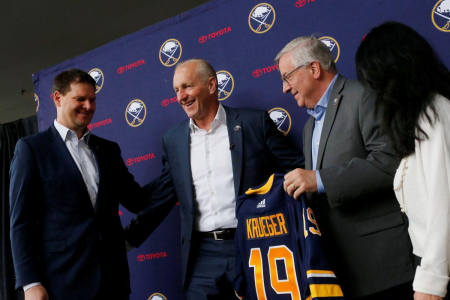
Buffalo Sabres GM Jason Botterill, left, and owners Terry and Kim Pegula, right, introduce new coach Ralph Krueger on June 5, 2019.
Derek Gee/News file photo
Don Granato: The start of the turnaround. It was under Granato that the confidence and bravado of today started to build. Rasmus Dahlin played through his youthful mistakes to become a star, Tage Thompson became a 40-goal center, and several others found their footing as NHL players. Granato didn't seem to have that next level of coaching to push players into career maturity, but there's little chance the Sabres are where they are today without the foundation he helped many of them create.
Lindy Ruff II: The triumphant return of a Pegula favorite, now into his 60s, didn't start well with last year's 79-point season, and things were bleak into December this year. But Ruff never strayed from his beliefs as the old cliche of "forecheck, backcheck, paycheck" applies here. So does the Ruff tradition of getting lots of saves in the goal crease.
Words of the GMs
Darcy Regier: "It may require some suffering." − April 29, 2013, on what it might take to win. The all-time drought quote. It sure did.Tim Murray: “I watch him too much, and I think too much about him. I wish I could help myself.” − swooning over Connor McDavid to the New York Times on March 28, 2015. Explains all you need to know about why the Sabres were tanking hard for two seasons.
Jason Botterill: "I'm going to trust the players." − His rationale for no big moves at the trade deadline for a reeling team during a meeting with reporters in Tampa on Feb. 19, 2019. A team that had a 10-game winning streak in November endured a 2-15-2 collapse through February and March as another season went down the drain.
Kevyn Adams: "We don’t have palm trees. We have taxes in New York. Those are real, and those are things you deal with." − Dec. 6, 2024, three days after blowing a 4-0 lead in a 5-4 home loss to Colorado. I'd say perennial losing makes it tougher to attract free agents and guys with no-trade clauses. Impossible to recover from that quote. Pegula was a year late in firing him.
The moments
The lowest one was unquestionably the 4-3 overtime loss to the Arizona Coyotes on March 26, 2015, where most of the fans in the then-First Niagara Center cheered Arizona goals, topped by Sam Gagner's overtime winner, and many fans openly groaned at Brian Gionta's tying tally with 3:37 left. Said defenseman Mike Weber: "It’s tough to get momentum when your fans are rooting against you. That’s the unfortunate part. I’ve never seen that before."The Sabres went 0-12-0 in January 2015, at the height of The Tank. Said forward Chris Stewart when he was traded to Minnesota on March 2, 2015, while in Tampa: "Everybody keeps talking about the ‘Tank Nation’ and all that and tanking for McDavid. ... It’s kind of insulting to the guys in the dressing room who go out there, block shots, get their faces punched in and play the right way.”
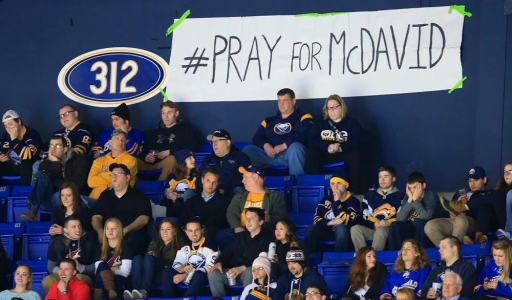
Fans offer their hopes for the Sabres during a game against the Arizona Coyotes on March 26, 2015.
Harry Scull Jr./News file photo
Tanking didn't end well. "I'm disappointed for our fans," Murray said in Toronto on April 18, 2015, after the Edmonton Oilers won the draft lottery and the right to select McDavid. The GM had some mea culpas to do with the family of Jack Eichel.
Tanking was the biggest theme of the drought, but there was plenty of weirdness, too. It's easy to recall the "turdburger" third jersey, coined and banned that way by team president Ted Black on live radio. Or Ville Leino getting a six-year, $27 million contract from the Pegulas in free agency in 2011 and getting bought out three years later after a goal-less season. And the 18-game losing streak during the 2021 Covid season, which started after the Sabres had not played a game for nearly 10 months.
And, of course, there was the neck injury saga that ultimately led to the trade of Eichel to Vegas in the early morning hours of Nov. 4, 2021, with the Sabres sleeping in Seattle. The return was Alex Tuch, Peyton Krebs, a first-round pick that became Noah Ostlund, and a second-rounder that went to Minnesota for Jordan Greenway.
The Golden Knights won a Stanley Cup in 2023. Can the Sabres get one of their own someday soon?
Numbers games
- At one point in the drought, the Sabres went 458 consecutive games and more than 5½ years without having more wins than losses in a season (combining regulation defeats with those in overtime/shootout). They were 2-1-0 on Jan. 25, 2013, early in the lockout season, and weren't on the good side again until they were 2-1-0 on Oct. 8, 2018.
- Buffalo's record during the above stretch was 158-241-59, and the Sabres had a tidy goal differential of minus-359.
- It used to get late awfully early around here. The Sabres' records when they got their second win in each season from 2013-14 through 2017-18: 1-9-1, 1-7-0, 1-4-0, 1-3-2, and 1-5-2.
- Most games played during the drought were the 688 of Zemgus Girgensons. Eight skaters and three goalies (Jason Kasdorf, Andrey Makarov, and Adam Wilcox) played just one game.
- Tage Thompson (211) and Jeff Skinner (153) are the only players above 150 goals. The only ones above 300 points are Dahlin (432), Thompson (395), Eichel (355), and Tuch (306).
- Worst plus-minus during the drought was Rasmus Ristolainen's minus-163. And he was a runaway leader. The next worst was Sam Reinhart at a mere minus-97.