Jay Skurski: NFL's lack of officiating transparency will eventually leave fans questioning 'why am I doing this?'
The National Football League has an officiating crisis on its hands. The Bills-Broncos game on Saturday made that clear, Jay Skurski writes.
The National Football League has an officiating crisis on its hands.
Coming from Buffalo the day after the Bills saw their season go up in smoke due in large part to a controversial call not going their way, that might seem like sour grapes.
Perhaps there is some truth in that, but if the situation were reversed and it was the Bills, not the Denver Broncos, preparing for the AFC championship game, it would still be a big problem.
The NFL is the richest sports league in the world, with a reported revenue of $23 billion in the 2024 season. That’s Billion, with a capital B.
Despite that, the state of officiating in the league continues to get worse every year. Somehow, the league still doesn’t have full-time officials. The majority of the 121 officials working on 17 crews have day jobs. Referee Carl Cheffers, who worked Saturday’s game, is in his 18th season. He works a day job as a sales manager. Members of Cheffers’ crew work as financial advisers, real estate agents, and middle school teachers, among other professions.
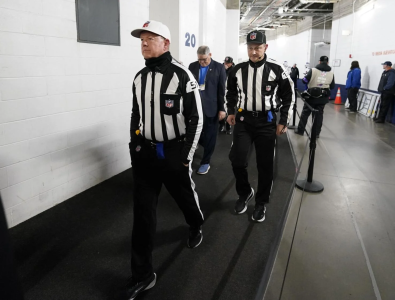
Referee Carl Cheffers walks to the field prior to overseeing Saturday's playoff game between the Bills and Broncos in Denver.
A key issue for the NFL is very little accountability for its officials. Harry Scull Jr., Buffalo News
Again, this is the richest sports league in the world. Fans of the sport deserve better. Bills head coach Sean McDermott, a member of the NFL’s powerful competition committee, surely knows that.
Mistakes happen. Officials are human. They’re trying to keep up with a fast-paced sport played by some of the strongest, fastest athletes on the planet.
The credibility of the league, however, depends on a trust factor. Fans have to believe that every effort will be made by the league to get every call right, or else they’ll start wondering, “What am I doing this for?”
Of course, what happened to the Bills on Saturday is top of mind, but tune into basically any game, and it won’t take long to watch a screw-up. They happen routinely around the league.
Against Jacksonville in the wild-card round, the Bills watched as the Jaguars seemingly ran a play with no time on the clock at the end of the second quarter. The ball was in the center’s hand with 0:00 on the clock, but officials huddled and penalized Bills edge rusher Joey Bosa for being offside.
No explanation given.
That’s one of the biggest problems facing the league. There is very little accountability for officials, who are not required to talk to the media and who rarely explain to fans during games why certain calls are made.
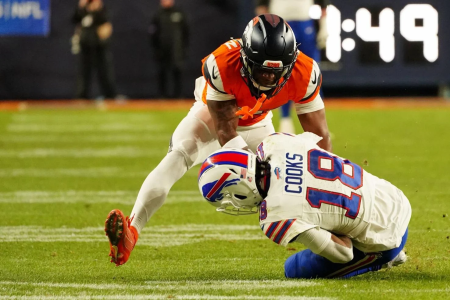
Broncos cornerback Ja'Quan McMillian wrestles the ball away from Bills receiver Brandin Cooks on a controversial play in overtime
during Denver's 33-30 victory on Saturday that eliminated Buffalo from the playoffs. Joshua Bessex, Buffalo News
The play in question Saturday came in overtime. Facing 3rd-and-11 from their 36-yard line, Bills quarterback Josh Allen threw deep intended for receiver Brandin Cooks at the Denver 20-yard line. A completion in that spot would have put the Bills in position to attempt a game-winning field goal. Cooks appeared to secure the ball with both hands before his knee touched the ground, which would have meant he was down by contact because Broncos cornerback Ja’Quan McMillian was trailing the play closely. As they went to the ground, McMillian rolled over Cooks and ripped the ball away.
Officials ruled the play an interception, and appeared set on quickly moving on. Coaches do not get to throw their challenge flag – all replay reviews must be initiated by either the on-field officials or the league office in New York – so Bills head coach Sean McDermott used a timeout in a desperate attempt to at least get Cheffers to review the play.
After the game, Cheffers conducted a pool report with Denver-based reporter Jeff Legwold of ESPN. The referee was asked what he saw on the play.
“The receiver has to complete the process of a catch,” Cheffers said. “He was going to the ground as part of the process of the catch, and he lost possession of the ball when he hit the ground. The defender gained possession of it at that point. The defender is the one who completed the process of the catch, so the defender was awarded the ball.”
Someone must have told Cheffers that, because he didn’t personally review the play on the field.
That brings us to another problem: Consistency.
During a Week 14 game in December between Pittsburgh and Baltimore, Steelers quarterback Aaron Rodgers was initially ruled to have been intercepted after a tipped pass deflected back into his arms, but was wrestled away by Ravens linebacker Teddye Buchanan. Because it was ruled a turnover, the play was automatically reviewed, and it was determined that Rodgers actually caught his own deflected pass.
Mark Butterworth, the NFL’s vice president of instant replay, described the play as follows in a pool report after the game:
“The offensive player had control of the ball, and as he was going to the ground, there was a hand in there, but he never lost control of the ball, and then his knees hit the ground in control,” Butterworth said. “So therefore, by rule, he is down by contact with control of the ball.”
By that explanation, Cooks caught the ball.
For Cheffers to say after the game that he didn’t, when the referee neither personally made nor reviewed the call, was wrong. The NFL should have made whoever reviewed the play and determined that an interception was the correct interpretation of the rule available to explain why and how two similar plays, a little more than a month apart, could arrive at such different conclusions.
Walt Anderson, the NFL’s officiating spokesman, appeared on the league-owned NFL Network pregame show Sunday and offered a similar explanation to that of Cheffers, saying the ball moved when Cooks hit the ground, thus meaning the act of completing a catch was not finished.
Anderson was asked who exactly made that determination, but did not provide a direct answer. He said that there is a staff of instant-replay officials at the league office in New York, meaning multiple people are involved in reviewing every play.
Then came the quote that should rile all Bills fans.
“If you can confirm the ruling on the field was correct, they want to move the game along,” Anderson said.
So, let’s get this straight. The league can spend minutes conducting “virtual measurements” of second-and-1 plays in the second quarter of a Week 5 game between the Browns and Bengals, for example, but can’t take another 45 seconds to make sure that a team’s season isn’t ended by a blown call?
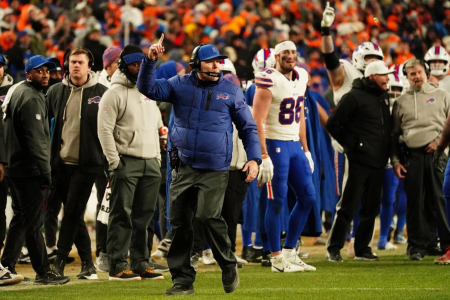
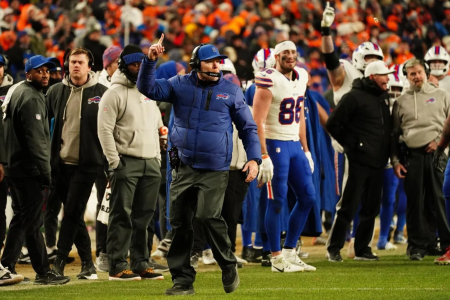
Bills head coach Sean McDermott calls to the refs after an interception during overtime.
Joshua Bessex, Buffalo News
That was McDermott’s initial beef after the game. What’s the hurry? Why does the whole sequence feel so rushed, which subsequently made it feel fishy?
“Definitely thought I caught it,” Cooks said Sunday as players cleaned out their lockers at One Bills Drive. “It’s one of those things that you’ve seen examples throughout the league this year, over the years.”
The league lacked transparency in giving a straight answer as to why he didn't. Cheffers’ response is clear as mud. For what it’s worth, here is what the NFL’s Operations website defines as a catch:
(a) Secures control of the ball in his hands or arms prior to the ball touching the ground; and
(b) touches the ground inbounds with both feet or with any part of his body other than his hands; and
(c) after (a) and (b) have been fulfilled, clearly performs any act common to the game (e.g., extend the ball forward, take an additional step, tuck the ball away and turn upfield, or avoid or ward off an opponent), or he maintains control of the ball long enough to do so.
There is little doubt Cooks performed the first two, so the question then becomes about whether he completed the third part. The league decided he didn’t.
How that decision was made, and who made it, should not be such a mystery.
As it is, the Bills are left to wonder, again: What could have been?