

How Cole Bishop's breakthrough will shape Bills' plan at safety
Cole Bishop’s healthy, productive 2025 proved to Beane and the Bills’ top decision-makers that he has a skill set the team has lacked since the prime years of Jordan Poyer and Micah Hyde.
As the Buffalo Bills met with safeties this week at the NFL scouting combine, general manager and president of football operations Brandon Beane did not have to worry about whether the prospect would fit next to Cole Bishop.
Bishop’s healthy, productive 2025 proved to Beane and the Bills’ top decision-makers that he has a skill set the team has lacked since the prime years of Jordan Poyer and Micah Hyde.
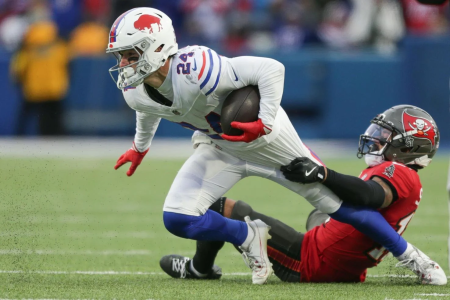
Bills safety Cole Bishop had three interceptions and 85 tackles in 2025. Joshua Bessex, Buffalo News
“We went for a number of years with Micah and Jordan, and they had that interchangeable skill set,” Beane told reporters Tuesday in Indianapolis. “I don't think there's a coach that's going to turn down an interchangeable skill set. … If we find a traditional box safety, then (Cole will) probably end up in more free opportunities. But if we find more of a free-ranging post guy, then Cole's going to find himself closer to the box.”
Bishop’s breakthrough, combined with the addition of defensive coordinator Jim Leonhard, allows the Bills to evaluate a wide array of safeties as their personnel department prepares for free agency and the NFL draft. Leonhard communicated his vision for each position, but he is going to build the defense around his roster.
A skill set such as Bishop’s is difficult to find. You either need to draft a safety with a high pick or sign one to a lucrative long-term contract. The Bills are too cash-strapped to pay a top-of-the-market free agent, and the top three prospects may be gone when they are on the clock with the 26th pick of the first round. The challenge has not stopped Beane from casting a wide net, and there are several different ways for him to fill the hole on his roster.
Ohio State’s Caleb Downs, the top safety in the 2026 class, is expected to be a top-10 pick.
The second-best prospect, Oregon’s Dillon Thieneman, met with Leonhard and the rest of the Bills’ decision-makers this week in Indianapolis. Thieneman had consecutive seasons with 100 tackles – including six interceptions as a freshman – at Purdue, before he transferred in 2025 to the Ducks. In three seasons, he totaled 306 tackles and eight interceptions. His well-rounded skill set will help him move up draft boards.
Emmanuel McNeil-Warren, a lanky safety from Toledo, is likely to be the third safety drafted in late April. The Associated Press All-American had 77 tackles as a senior and ranked among the best in the nation with three forced fumbles. He moves like a velociraptor and immediately would improve the Bills’ run defense, but does Bishop’s development make safety a lesser need?
“I’m versatile,” said McNeill-Warren, describing a trait the Bills covet from every player on defense. “I played in the box. I played up high. I can play anywhere on the field and make plays.”
The free-agent market includes some cost-effective, experienced safeties who would not face a steep learning curve as the Bills transition to Leonhard’s 3-4 base defense. Jalen Thompson (Cardinals), Reed Blankenship (Eagles), Nick Cross (Colts), Kyle Duggar (Steelers) and P.J. Locke (Broncos) are each projected to sign a contract with an average annual value under $10 million, according to Spotrac.
Beane could sign a stopgap option – Blankenship is a Super Bowl champion coming off a disappointing season – and draft someone in the mid-to-late rounds, an area of the draft where Buffalo has unearthed hidden gems such as Christian Benford and Jackson Hawes, among others.
Another intriguing option emerged in the wake of Leonhard’s hiring. Taron Johnson, a nickel cornerback by trade, may be able to switch to safety.
The Bills will continue to use nickel personnel with Leonhard as the play-caller, but are they going to do so often enough to justify Johnson’s $11.4 million cap hit? He has enough range and tackling ability to play in the box. His usage changed in 2025, with 112 fewer snaps in the box than 2024, a trend that may have led to some inconsistent moments throughout last season. It’s fair to wonder, however, if Johnson can cover well enough in space for Buffalo to gamble on such an experiment. The position is too important – remember, Leonhard was an NFL safety – for a Super Bowl contender to rely on a position change.
"Nothing’s off the table,” Beane said of Bishop. “We'll look at anything and everything as we make these decisions and he's a good football player. You never want to rule anything out if you think that’s the best position.”
There’s an impressive second wave of safeties following Thieneman and McNeill-Warren. One option, Oklahoma’s Robert Spears-Jennings, learned from Bills cornerbacks coach Jay Valai, who left the Sooners to accept a role on Leonhard’s staff. Spears-Jennings met with Buffalo’s staff this week at the combine and, according to CBS Sports’ rankings, he could be available on Day 3 of the draft. He’s familiar with the scheme and technique that will be taught by Valai.
“Coach Valai, he’s helped me so much on and off the field. We had so many real conversations and good talks," Spears-Jennings said. "On the field, he helped me prepare for games. Him and coach (Brandon) Hall got my footwork right and a different type of mindset.”
Penn State’s Zakee Wheatley could be an option in the second or third round.
“My toughness and ball skills help me stand out,” he said.
A.J. Haulcy (LSU), Genesis Smith (Arizona) and Keionte Scott (Miami) are expected to go within the top 100 picks. Haulcy can line up in the box or deep in the secondary. Smith is talented in coverage, but he was an inconsistent tackler in college. Scott is more of an undersized box safety whose toughness and tackling should help him carve out a role as a rookie. In 2025, according to Pro Football Focus, Bishop spent more time at free safety (515 snaps) than in the box (311), in large part because Poyer was the other half of Buffalo’s tandem when Taylor Rapp underwent season-ending knee surgery in late October. Bishop was credited with 16 missed tackles, but he had three interceptions and 85 tackles during his second NFL season.
Bishop needs to continue to develop. The Bills are going to need more out of him in 2026 – especially as a leader and communicator – and he’ll need to adjust to a new scheme. Though both safety spots are among the most important within their defense, Bishop's emergence gives Beane freedom to use more of his cap space and his highest draft capital elsewhere.