

NFL draft position preview: Do the Bills need to add another tight end? Who may fit?
On paper, the Bills appear to be set at tight end. Do not be surprised, however, if they select one in the middle or late rounds of the NFL draft.
Nobody at One Bills Drive wanted to lose Dawson Knox this offseason.
Knox isn't the Buffalo Bills' best pass-catching tight end. He's not going to produce like an All-Pro. But the seven-year pro is a starting-caliber tight end who's an excellent blocker and leader inside their locker room.
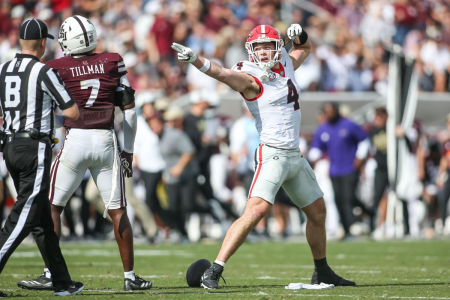
Georgia tight end Oscar Delp started 34 games across the past three seasons.
James Pugh, Associated Press
The Bills convinced Knox to take less money to stick around for 2026. He can re-earn some of that cash through incentives, but he accepted a pay cut to stay with Josh Allen and Joe Brady.
Dalton Kincaid will also be back in 2026, and he's under contract for two more seasons following the Bills' decision to pick up his fifth-year option. Kincaid is arguably one of the most talented tight ends in the NFL, but he's had trouble staying healthy. Additionally, the team found a late-round gem in the 2025 draft in Jackson Hawes, who's already one of the best blockers at his position.
On paper, the Bills appear to be set at tight end. Do not be surprised, however, if they select one in the middle or late rounds of the NFL draft, which will be held April 23-25. For one, Buffalo needs to prepare for Knox's eventual departure. It seems unlikely the Bills will be able to keep him around long-term, plus he turns 30 years old in November. Two, they may want to add insurance in case Kincaid's knee issue causes him to miss more time. And, finally, consider how Brady may build his offense with fullback Reggie Gilliam gone?
Would the Bills have Hawes occasionally line up as a fullback? Doing so would maximize their game-day roster. Brady may also lean more into 13 personnel – three tight ends with a running back – and the draft is well-stocked at the position.
Bills' need ranking: 1/10. They have too many other needs to take a tight end high, but why not add late-round depth to a position that's vitally important to Brady's offense?
Best in class: Oregon's Kenyon Sadiq will be the first tight end drafted, and he may be taken somewhere in the top 15. Last season, Sadiq caught 51 passes for 560 yards and eight touchdowns. He dropped six passes, though, and he may be more of a slot weapon than an in-line tight end.
After Sadiq is selected, the next two tight ends off the board are expected to be Vanderbilt's Eli Stowers, who some teams view as a wide receiver, and Ohio State's Max Klare.
Realistic targets
Oscar Delp, Georgia: Delp's production in college was underwhelming. The 6-foot-4, 245-pound tight end had just 41 catches and five touchdowns over the past two seasons. Who cares if the guy can play? Delp, 22, has the chops as a blocker to play in the Bills' offense, plus he's a yards-after-the-catch threat. The only potential issue is that he's expected to be drafted before Buffalo is on the clock in the third round.Justin Joly, NC State: The Bills have shown interest in Joly, and don't be surprised that he's the type of tight end they're evaluating. Joly could play the Kincaid role in Brady's offense. Joly spent most of his time lined up in the slot (47.4% of his snaps), and he may be the best playmaker among this group of mid-round tight ends. During the 2025 season, Joly caught seven touchdown passes while gaining 661 receiving yards on a team-high 43 catches. The type of quarterback-friendly target that fits with Allen.
Sam Roush, Stanford: Bills outside linebackers coach Bobby April III served as Stanford's defensive coordinator while Roush played for the Cardinal, so Buffalo knows about his character and work ethic. Roush, a three-year starter, is a big (6-6), physical blocker who played 529 snaps on special teams in college while starting 34 games over the past three seasons. The former rugby player could be a long-term replacement for Knox.
Will Kacmarek, Ohio State: Kacmarek saw just 27 targets in two seasons with the Buckeyes and caught 23 passes during that span. Don't draft him for college production, though. Kacmarek is an outstanding blocker who's a project as a receiver. He's not the best athlete, and it's curious how someone with his frame and playing time had just one red-zone touchdown in two years at Ohio State. Still, he's the type of mid-round tight end who will be in demand as NFL offenses move toward more heavier personnel groupings.
Marlin Klein, Michigan: Born and raised in Germany, Klein relocated to the United States as a high school sophomore to pursue football. He started 12 games over the past two seasons at Michigan, but he caught just 27 passes for 356 yards and one touchdown. An NFL team will draft him based on projection. Klein has the athleticism and intangibles to develop into a starter. He's a willing blocker who will need time and patience to sharpen his technique in every area.
Sleeper
Dae'Quan Wright, Ole Miss: One of the most intriguing tight end prospects in this class because of his upside. Wright had 1,029 receiving yards in two seasons at Ole Miss. He had 12 catches of 20-plus yards in 2025 despite playing through a shoulder injury. Wright is a late-round prospect who can play as an inline tight end or slot weapon. If the Bills are going to use draft capital at the position, then why not select someone later who they can develop into a versatile weapon?Top 10
Rk.;Player, school;Ht.;Wt.1.;Kenyon Sadiq, Oregon;6-3;241
2.;Eli Stowers, Vanderbilt;6-3;239
3.;Max Klare, Ohio State;6-4;246
4.;Oscar Delp, Georgia;6-5;245
5.;Justin Joly, NC State;6-3;241
6.;Sam Roush, Stanford6;-6;267
7.;Will Kacmarek, Ohio State;6-5;261
8.;Nate Boerkircher, Texas A&M;6-5;245
9.;Eli Raridon, Notre Dame;6-6;245
10.;Marlin Klein, Michigan;6-6;248

