
After the main wave of free agency concluded last month, Buffalo Bills general manager and president of football operations Brandon Beane echoed a thought we've heard from draft analysts since the Senior Bowl.
This draft class is well-stocked with talented inside linebackers. The best of the group, Ohio State's Sonny Styles, will be gone long before the Bills are on the clock with the 26th pick of the first round, but the second, third, and fourth waves of prospects at the position may include Day 1 starters.
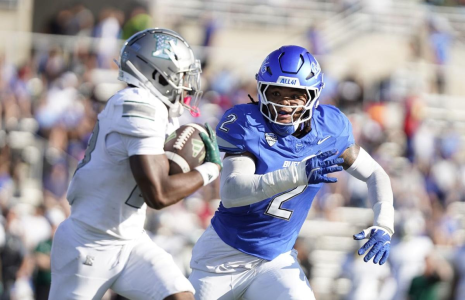
University at Buffalo linebacker Red Murdock, right, set an FBS record with 17 forced fumbles.
Harry Scull Jr., Buffalo News
UB's Red Murdock is among that group. The injury Murdock played through in 2025 − torn ligaments in his right ankle − and a fracture in his right heel may cause him to fall further in Day 3 of the draft than initially expected. But he has enough fans around the NFL that he'll hear his name called when the draft is held in Pittsburgh from April 23-25.
Murdock needed just 34 games to set the FBS record with 17 forced fumbles. The player who previously held the mark: former UB edge rusher Khalil Mack. Across the past two seasons, Murdock totaled 298 tackles. The next closest player had 254. He was seemingly always around the football, displaying a mature understanding of how to take the best angle and the violence with which a linebacker needs to finish a tackle. Murdock didn't miss a game over the past three seasons, so the injury talk is overplayed.
The main question is: Which type of defense will fit him best? Murdock doesn't have the prototypical size for a linebacker in the 3-4 base defense the Bills will use in 2026, but he can thrive in the scheme if he's next to a bigger linebacker like Dorian Williams.
How much do the Bills need an inside linebacker? Who are the top prospects and realistic options? Is there a sleeper to watch?
Bills' need ranking: 8/10. The Bills have Williams, Terrel Bernard, Joe Andreessen and Keonta Jenkins. Bernard played in a 3-4 defense at Baylor, but he lacks prototypical size. Though Williams may not be an every-down player yet, he's going to have a significant role on defense. Buffalo needs to add at least one inside linebacker who can compete for the starting role. The depth chart is thin behind Andreessen, as Jenkins was a better fit for Sean McDermott's defense.
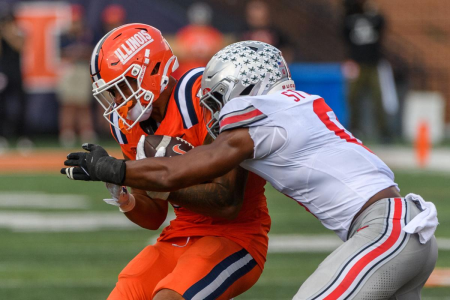
Ohio State linebacker Sonny Styles wraps up Illinois tight end Jordan Anderson during a game on Oct. 11, 2025, in Champaign, Ill.
Craig Pessman, Associated Press
Best in class: Styles may be the best athlete in the draft. He's 6-foot-5, 244 pounds with a 4.4-second 40-yard dash. He missed only two tackles in 2025 despite transitioning from safety to linebacker. It's a position that's not typically selected in the Top 5, but Styles has as much upside as anyone in the class. His father, Lorenzo Sr., played linebacker at Ohio State and won the Super Bowl with the Rams during his six-season NFL career. Teams may view Styles as a chess piece who can be moved around the defense to create mismatches. Following Styles, Georgia's CJ Allen and Texas Tech's Jacob Rodriguez are expected to be the next inside linebackers off the board.
Realistic targets
How early will the Bills take an inside linebacker? If they're willing to select on as high as the 26th pick, then Allen is the top option. He was a three-year starter at Georgia, and the responsibility that he shouldered as a younger player in the Bulldogs' defense prepared him to be a green dot player from Day 1 in the NFL. If the plan is to trade out of the first round, Rodriguez should be available early in the second. Few players in this draft class are better at taking the ball away − Rodriguez led the FBS with seven forced fumbles in 2025 − and the two-time team captain totaled at least 126 tackles in consecutive seasons. His shorter arms may concern teams, but he's ready to contribute as a rookie.In Round 2, where the Bills don't currently own a pick, three other inside linebackers are expected to be selected: Cincinnati's Jake Golday, Texas' Anthony Hill Jr. and Missouri's Josiah Trotter. Among the group, Trotter may be the best fit for Buffalo. He's excellent at stopping the run, which helped him earn All-Southeastern Conference honors during his lone season with the Tigers. He's a hard-hitting linebacker like his father, Jeremiah, an All-Pro with the Philadelphia Eagles. Pass coverage may be an issue, but Josiah is a prospect who can develop into an every-down player.
Don't expect the Bills to select Pittsburgh's Kyle Louis, who may play safety in the NFL. Louis would have fit perfectly in McDermott's defense, but he's too small to play in a 3-4 base. The next wave inside linebackers includes a few intriguing options, most notably TCU's Kaleb Elarms-Orr, who was one of nine FBS players with at least 130 tackles in 2025. Oregon's Bryce Boettcher originally signed with the Ducks to play baseball, but he eventually walked onto the football team as a defensive back and switched to linebacker. Boettcher, who's Pop Warner team was called the Buffalo Bills, totaled 136 tackles in 2025.
Sleeper
Harold Perkins, LSU: You may hear chatter about USC's Eric Gentry because he's a 6-7 linebacker who looks more like an NBA small forward, but Perkins' versatility is a better fit for the Bills. Perkins had an exceptional start to his college career, totaling 26 tackles for a loss and 13 sacks during his first two seasons. He missed all but four games in 2024 because of a torn right ACL, and he struggled in 2025 while playing more as an overhang defender and big slot.Where do NFL teams see him contributing? He had the smallest hands at the combine and may not have the strength to play edge rusher. His cover skills are not advanced enough to be an inside linebacker. Someone will take Perkins in the sixth or seventh round, then figure out his role later. Perhaps he can help on special teams and eventually develop into a contributor on defense. The upside is high enough for someone to give him a chance.
Top 10
Rank; Player; School; Ht.; Wt.1. Sonny Styles, Ohio State; 6-5; 244
2. CJ Allen, Georgia; 6; 230
3. Jacob Rodriguez, Texas Tech; 6-1; 231
4. Anthony Hill Jr., Texas; 6-2; 238
5. Jake Golday, Cincinnati; 6-4; 239
6. Kyle Louis, Pittsburgh; 6; 220
7. Josiah Trotter, Missouri; 6-2; 237
8. Bryce Boettcher, Oregon; 6-1; 233
9. Jimmy Rolder, Michigan; 6-2; 238
10. Jack Kelly, BYU; 6-2; 240