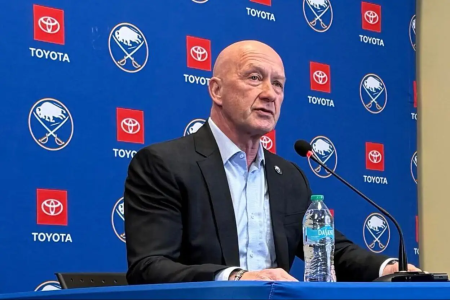
Six trade-deadline takeaways from Sabres GM Jarmo Kekalainen
Here are six takeaways from Buffalo Sabres general manager Jarmo Kekalainen’s post-trade deadline media availability, and how moves and non-moves will impact the Sabres as they pursue a playoff berth.
Jarmo Kekalainen entered his first trade deadline week as general manager of the Buffalo Sabres with a strategy.
Reward the team for its successes so far, but add components that will help this team reach the playoffs for the first time in 14 years. That meant improving roster depth to prepare for the final weeks of the regular season, bringing in size and experience on defense and addressing the Sabres’ inconsistency on faceoffs.
The Sabres made three trades at this year’s deadline:
- Acquired defensemen Logan Stanley and Luke Schenn from the Winnipeg Jets for defenseman Jacob Bryson and left wing Isak Rosen. The Jets also receive a fourth-round pick in this year’s NHL draft and a second-round pick in 2027;
- Acquired center Sam Carrick from the New York Rangers for a third-round pick and a sixth-round pick in this year's draft;
- Acquired left wing Tanner Pearson from Winnipeg for a seventh-round pick in this year’s NHL draft.
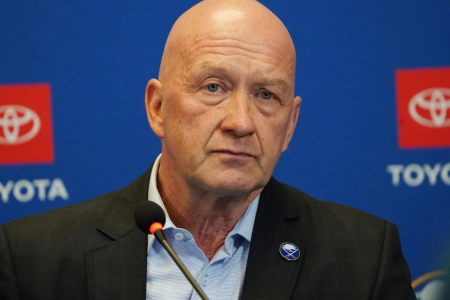
Jarmo Kekalainen made three trades before the deadline on Friday. In the process, he added depth on defense and helped the team in the faceoff circle.
Derek Gee, Buffalo News
“We addressed those needs, and we’re a stronger team because of it,” Kekalainen said Friday at KeyBank Center.
Here are six takeaways from Kekalainen’s post-trade deadline media availability, and how moves and non-moves will impact the Sabres as they pursue a playoff berth.
Building depth
Kekalainen was mindful of the fact that the Sabres are playing at least three games a week through the final six weeks of the regular season, which ends April 15. Injuries, from general wear-and-tear to possible season-enders, are a risk with such a condensed schedule.The Sabres open the final 20 regular-season games Saturday against Nashville at KeyBank Center and Kekalainen’s goal was to stock his roster with reserves, given that the NHL lifted its 23-man roster cap at the trade deadline for the remainder of the regular season.
“The schedule is very dense right now because of the Olympics,” Kekalainen said. “We’re playing every other day. The deeper you get into the spring, you know the schedule there, it’s every other day. You need depth. Players are going to get banged up. It’s very, very important to have depth, especially on the ‘D’ side. That’s probably the most crucial position to have depth in.”
Defense is one area where the Sabres stocked up on players with the acquisitions of Stanley and Schenn. They further deepen an already tall and physical defensive corps – Stanley is now the tallest player on the roster at 6-foot-7, an inch taller than Tage Thompson – and Stanley and Schenn have combined to block 123 shots this season.
Rentals on defense
Stanley is in the second year of a two-year contract that has an average annual value of $1.25 million. Schenn is also in the final year of his three-year contract, with an average annual value of $2.75 million. They’re rentals but could audition for roster spots with the Sabres in 2026-27.“This is really where you find out about the guys, how hard they compete in the most important part of the season,” Kekalainen said. “We’re open. We’re looking at every guy on our team and making the future plans, looking at the future team that we’re going to have, and how the pieces fit, obviously, how they fit under the cap and the structure of that.
“All the options are open right now, and this is the best part of the season, to earn the right to be on this team, further into the future.”
Improving in faceoff circle
Acquiring Carrick from the Rangers wasn’t just to provide depth at center, but also to improve the Sabres proficiency on faceoffs.
Carrick is a 10-year NHL veteran who has a career faceoff percentage of 52, including a faceoff percentage of 53.9 this season (214/183). Carrick has a right-handed shot and can take faceoffs in any situation, whether it’s at even strength or on special teams.
“Faceoffs is an area where we haven’t been very good,” Kekalainen said.
The Sabres are last in the NHL in faceoff percentage (45%) after a 5-1 win Thursday at Pittsburgh. They’ve been at or above 50% on faceoffs in only 13 of 62 games this season.
No comment on St. Louis
The trade involving Stanley and Schenn for Bryson and Rosen was the first successful NHL deal Kekalainen has made with the Sabres, and it followed a week in which the Sabres couldn’t complete separate trades with St. Louis for center Robert Thomas and defenseman Colton Parayko.A reported trade that would have sent Thomas to the Sabres for as many as four first-round draft pick did not materialize. The Sabres and Blues also reportedly agreed to a deal that would bring Parayko to the Sabres for defenseman Radim Mrtka and a future first-round pick, but Parayko declined to waive his no-trade clause.
Kekalainen declined to discuss the deals that fell through. It’s his personal policy.
“I don’t comment on any unfinished business,” Kekalainen said. “There’s a lot of talk around. Every time that somebody calls me and 31 other GMs call me and they mention names, sometimes that name comes out in public, as a rumor. Even if I had no intention of trading that player, it somehow gets into the rumor.
“I’m going to keep my way of not talking about it, speculations and possible trades, and we’re just going to concentrate on what we have here.”
Conversely, Blues general manager Doug Armstrong told reporters Friday in St. Louis that the organization checked phone and email records of staff members to find the possible source of the Parayko trade leak.
Tuch’s contract
Alex Tuch is still with the Sabres. There was no possibility the Sabres would deal the left wing at the deadline, given the team is making a legitimate playoff push.However, there’s the matter of his contract. Tuch is in the final year of a seven-year deal with an average annual value of $4.75 million. He is set to become a free agent July 1, less than four months away from the trade deadline. AFP Analytics projects Tuch’s next contract to be an eight-year deal with a projected annual cap hit of $10.6 million.
Kekalainen isn’t concerned about the fact that Tuch and the Sabres still don’t have a new deal in place.
“We’ve had some productive talks with him and have expressed our desire to sign him, and we’ll continue doing that. I told his agent (Brian Bartlett) that we’re not going to make our team weaker if we don’t get a deal done by the trade deadline.
“We’re not trading him. We want to strengthen our team and not make it weaker, and Alex is, obviously, a huge part of it. Now, we’re going to continue those talks and hopefully get a deal done before July 1.”
Injury updates
Kekalainen said center Jiri Kulich (blood clots) “most likely” will be out for the remainder of the season, but he continues to get treatment for the condition. Kulich’s absence for the rest of the season lends to the acquisition of Carrick.“Our main concern, obviously, is his well-being and long-term health and second, when can he be back as a hockey player?” Kekalainen said of Kulich, who hasn’t played since Nov. 1. “He’s progressing but most likely he will be out for the season.”
Kulich has been skating in full gear, but only in noncontact situations, and has not skated with the team during his absence. Kekalainen wouldn’t forecast if this would impact Kulich’s availability next season.
Kekalainen said left wing Jordan Greenway (sports hernia) and Justin Danforth (broken kneecap) are both “progressing slowly, and there is a chance that they could be back this season, but there’s no guarantee. We’re hopeful.”