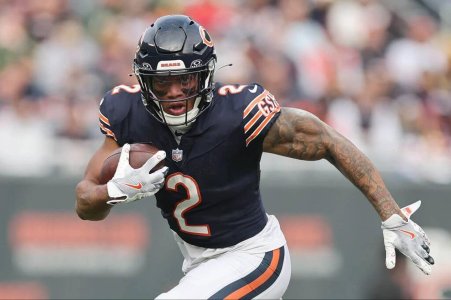
The Athletic: Bears trading wide receiver DJ Moore to the Bills: Sources


1772743495464.jpeg
DJ Moore moves to the third team of his career, teaming up with Josh Allen in Buffalo.
Michael Reaves / Getty Images


The Chicago Bears are trading veteran wide receiver DJ Moore to the Buffalo Bills, according to league sources. The Bills are sending a 2026 second-round pick to the Bears in exchange for Moore and a 2026 fifth-round pick.

Moore, 28, had 244 receptions, 3,012 yards and 20 touchdowns across his three seasons with the Bears. His 50 catches and 682 yards in 2025, however, were both career lows.

Moore represents much of what the Bills had been certainly lacking in the 2025 season, and for much of the 2024 season, too. The Bills had tried to fill the Z receiver void ever since they traded away Stefon Diggs ahead of the 2025 season. They signed Curtis Samuel as a free agent, but it didn’t work out. Then they traded for Amari Cooper, which also was a miss, as he couldn’t get on the field for over 50 percent of snaps when he played. In 2025, the Bills signed Joshua Palmer to try to fill that void, but he was also inconsistent and couldn’t stay on the field because of injuries. The Bills knew something had to be done to improve their passing game to open it up, and that’s just what they’re getting with Moore.

The newest Bills receiver will provide separation abilities and can uncover in the intermediate and deep areas, mostly from the Z receiver position. Moore hasn’t had a passing quarterback quite like Josh Allen before, and given that receivers who major in separation have thrived with Allen in the past, this could be an outstanding pairing.

Despite his receiving numbers having gone down in 2025, this move represented a chance for the Bills to get a good-to-great receiver still in his prime. Moore’s age meshes with Allen’s timeline, as the quarterback turns 30 this offseason. In terms of overall impact and getting a known commodity who could walk in and become an instant impact type, it made sense for the Bills to utilize their limited offseason resources in that way for a receiver in a win-now year in 2026.

Moore became the subject of trade buzz this offseason as the Bears sought ways to create salary-cap space. General manager Ryan Poles expressed during last week’s NFL Scouting Combine a desire to keep Moore but left the door open to dealing him.

“He’s a guy we want here,” Poles said. “But we have to look at all the different scenarios.”

Moore is under contract through 2029, with a cap hit of $28.5 million for 2026. With that cap space cleared, the Bears can use the resources to attack their offseason needs, which only became greater with the news this week that Pro Bowl center Drew Dalman plans to retire.

That includes a likely effort to upgrade the defensive line and stabilize the secondary, in addition to seeking offensive line starters at center and left tackle.

Moore spent five seasons with the Carolina Panthers before being traded to the Bears during the offseason in 2023 as part of a blockbuster trade. Chicago sent the No. 1 pick to Carolina in exchange for a large gift basket of compensation, including the Panthers’ 2024 first-round pick, which wound up being the No. 1 selection the Bears used on quarterback Caleb Williams.

Moore’s first season with the Bears was his best, with 96 receptions for 1,364 yards and nine total touchdowns. That production came primarily with Justin Fields throwing him the football. His chemistry with Williams wasn’t nearly as strong in their two seasons together.

Overdue move by the Bills​

Big Baller Beane is attempting a comeback. The Bills’ general manager has taken a beating from fans and the media over his inability or unwillingness to bolster his wideouts. His infamous, condescending post-draft rant against flagship radio station WGR 550-AM and its morning co-hosts, who were pushing for Beane to add receivers in free agency or the draft, backfired mightily. Beane barely addressed the position last offseason and then mocked any notion that Allen, the reigning MVP, needed any such help. The 2025 Bills struggled to generate any substantive offense through their wideouts, especially downfield.

Beane all but admitted his miscalculation at the trade deadline, divulging that he pursued wideouts but couldn’t lock down a deal.

“Unfortunately, it takes two to tango, and we tried on quite a few,” Beane said at the time. “We ran into a couple teams in our division that were trading and couldn’t get a lot of interest there.”

Dolphins receiver Jaylen Waddle was heavily reported as a player Beane coveted, but coming up empty made the void feel deeper.

Keon Coleman, Curtis Samuel and Elijah Moore all were healthy scratches at some point. Beane’s biggest free-agent signing, Palmer, showed a flash or two but missed seven games, including both in the postseason. Shakir was Allen’s leading target with 72 receptions for 719 yards and four TDs — numbers that wouldn’t lead a contender in the pre-Super Bowl era. — Tim Graham, Bills writer
 
Okay people what are your thoughts. Personally I like this trade. Big money but that can be massaged like a lipoma on Robert Krafts thigh.

1 he is a number 1 and instantly our best receiver by a mile.

2. He’s proven and separates extremely well. Dude gets open or just plain IS open. That was what everyone complained about “lack of separation “.

3. He knows how to best established NFL corners.

4. Not a diva like Diggs. Not a head case.
 
Okay people what are your thoughts. Personally I like this trade. Big money but that can be massaged like a lipoma on Robert Krafts thigh.

1 he is a number 1 and instantly our best receiver by a mile.

2. He’s proven and separates extremely well. Dude gets open or just plain IS open. That was what everyone complained about “lack of separation “.

3. He knows how to best established NFL corners.

4. Not a diva like Diggs. Not a head case.
...hopefully
 

The Athletic: Bears moving on without DJ Moore, but memories of his biggest moments will last​


Chicago Bears wide receiver DJ Moore celebrates his winning touchdown catch against the Green Bay Packers on Dec. 20, 2025.

Bears fans will never forget DJ Moore's winning touchdown catch against the Packers in Week 16. Michael Reaves / Getty Images

For those who want the snapshot of DJ Moore reaching for one of the coldest throws of Caleb Williams’ life, it’s available. That December moment is forever frozen in time. What an image that is and forever will be. Moore — with his vision smothered and Green Bay Packers defensive back Keisean Nixon’s arms wrapped around his neck — kept his concentration and completed an unthinkable comeback with a 46-yard overtime touchdown catch to beat Green Bay.

The videos of that sequence are even better, from any angle. Moore, on his 61st snap of an exhausting night, creates just enough separation, darts toward eternal renown and makes that grab as he crashes into Soldier Field’s north end zone. Then he lies there for a bit. Euphoric. Spent. Stunned. With bedlam erupting around him.

After trailing by 10 points with less than three minutes remaining in regulation, Moore — with plenty of Williams’ help — provided the kill shot on the Chicago Bears’ 22-16 win over their rival in Week 16 of an unforgettable season.

When the organization gets around to finally building its next stadium — and assuming that venue includes some “Bear-adise” museum on the periphery — that Moore photo, those videos of his catch deserve a small exhibit.

It’s hard to downplay the significance of that moment — not just a walk-off defeat of the pesky Packers, but the win that ultimately clinched the NFC North. Which, of course, set up a playoff rematch three weeks later and yet another ridiculous comeback victory at Soldier Field that was punctuated by Moore’s go-ahead 25-yard TD catch with 1:43 remaining.

Say anything you want about Moore’s three seasons and 53 games as a Bear. Yet, one truth is undeniable. Those two touchdowns and those two wins will never be forgotten in Chicago, particularly because of what, in that moment, they seem to symbolize: an emergence as the Bears throw open their window of contention and push to squeeze the most out of the Williams-Ben Johnson era.

However, Moore is no longer part of the championship pursuit, out of the plans and soon headed to Buffalo along with a fifth-round pick in a trade agreed to Thursday that will net the Bears the No. 60 selection in the draft in April.

Just like that, it’s over.


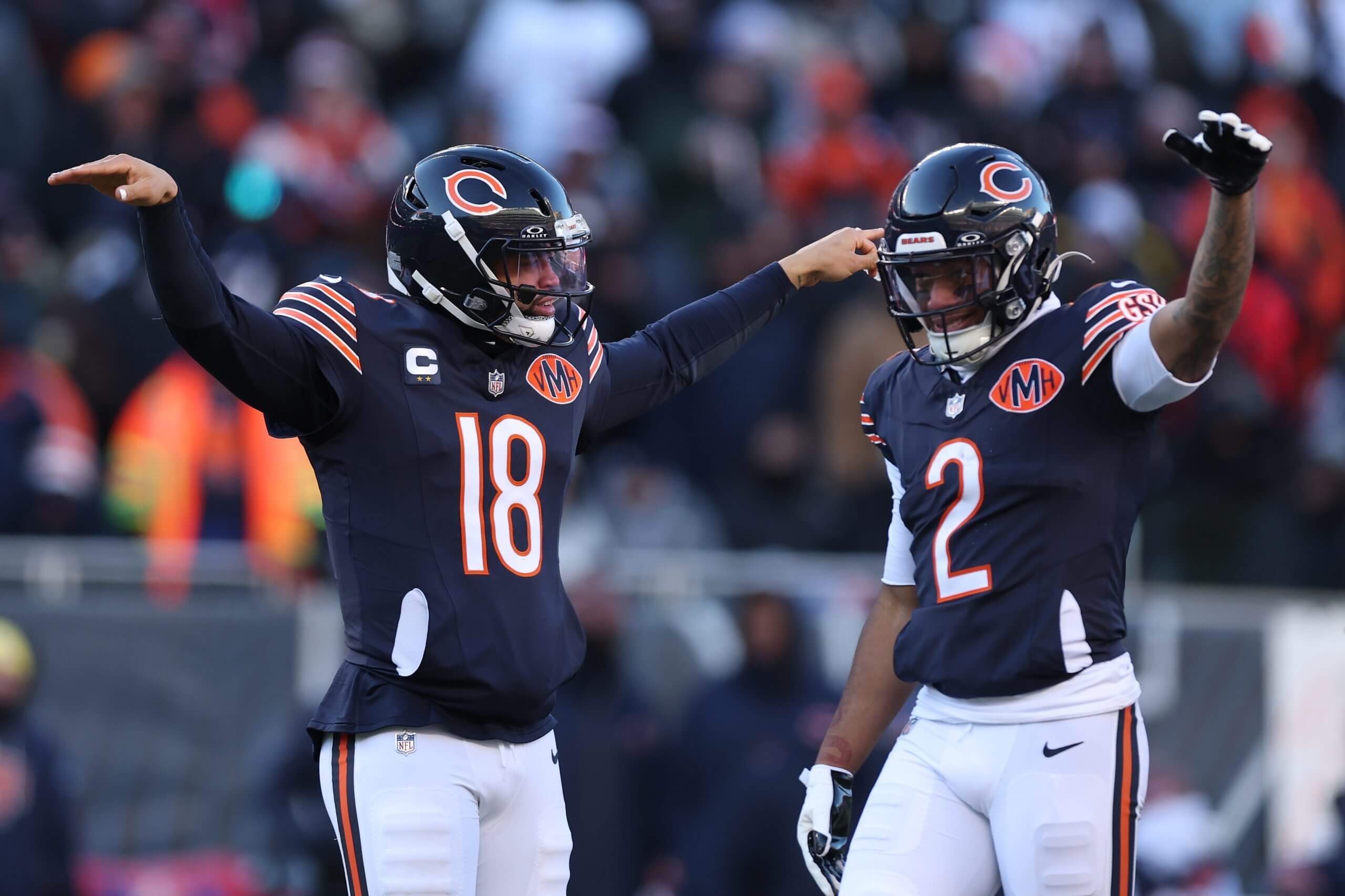
CHICAGO, ILLINOIS - DECEMBER 14: Caleb Williams #18 and DJ Moore #2 of the Chicago Bears react after the play during the third quarter against the Cleveland Browns at Soldier Field on December 14, 2025 in Chicago, Illinois.

Bears quarterback Caleb Williams and wide receiver DJ Moore had their moments, but their connection was never consistent enough.
Michael Reaves / Getty Images


The veteran receiver’s sudden exit registered as significant, though not surprising. The winds seemed to be blowing in that direction over the past month as the Bears face salary-cap constraints in plotting their future. And to be quite frank, Thursday’s deal initially feels like a win for all parties.

The Bills not only add a proven playmaker for MVP quarterback Josh Allen, but Moore reunites with Joe Brady, Buffalo’s new head coach, who was the Panthers’ offensive coordinator in 2020 and 2021 as Moore was ascending in Carolina. There’s history there. Chemistry. Built-in knowledge. Opportunity.

Perhaps Moore, coming off a season with career lows in receptions (50) and yards (682), will bounce back in Buffalo in a big way.

The Bears, meanwhile? With a deep arsenal of pass-catching weapons that includes Colston Loveland, Rome Odunze and Luther Burden III, they grabbed a solid return for Moore, snagging a late Round 2 pick they can use to add another important building block.

Plus, the cap space freed up with Moore’s departure — $16.5 million for 2026 according to Over the Cap — should embolden Johnson and general manager Ryan Poles to be aggressive heading into free agency (and perhaps deeper into other trade talks) in the coming hours and days.

Will a push for Las Vegas Raiders star edge rusher Maxx Crosby intensify?

Is a record-setting contract for All-Pro center Tyler Linderbaum within the Bears’ desired spending parameters?

What other major opportunities might now be worth exploring more seriously?

No matter what else transpires during the NFL’s version of March madness, bet on the Bears’ pushing the gas pedal. With purpose but not recklessness. That’s been a defining characteristic of life at Halas Hall since Johnson’s arrival. And it’s a trait that will be needed to stabilize and strengthen a roster that has been depleted in recent days.


In the first week of March, the Bears have so far made their biggest headlines with roster subtractions. First was Pro Bowl center Drew Dalman announcing his retirement plans. Now it’s Moore’s departure.

Replacements are needed. Other roster holes have been glaring for some time — safety, left tackle, defensive line, etc.

The Bears’ action plan to upgrade across the board must be implemented soon.

Moore, meanwhile, exits as another “Life comes at you fast” reminder in a league that continually causes whiplash.

He was part of a massive trade package three years ago, which the Bears received from Carolina for the 2023 No. 1 pick, and his arrival was celebrated appropriately. Moore was a proven playmaker preparing to unite with a talented young Bears quarterback, Justin Fields. And he wasted little time making an impact.

Moore’s first preseason catch in Chicago was a 62-yard touchdown. His first huge game, in Week 5 of that season, included eight catches, 230 yards and three touchdowns in a prime-time win over the Washington Commanders. His first season as a Bear? Top 10 in the NFL in receiving yards (sixth, 1,364) and touchdown catches (eighth, eight).

Still, for whatever reason — and it’s a head-scratcher in many league circles — Moore’s productivity fell off with Williams at quarterback. Even with a flurry of unforgettable moments between the two — feel free to Google their 22-yard TD against Cleveland from Dec. 14 — Moore’s click with Caleb was never consistent enough.

That unforgettable night in December? Well, just four weeks later, under the same lights at Soldier Field, Moore ran his final route as a Bear. In overtime of an NFC divisional-round playoff game against the Los Angeles Rams, he and Williams weren’t on the same page as the Bears pushed forward on a sudden-death possession.

Moore, running his designed route on the backside of a play that featured Burden as the initial read and a safety valve option in the flat, didn’t alter his pattern the way Williams believed he might.

Williams saw a leverage opportunity, a big-play possibility and threw with hope. Yet, instead of Moore re-routing, safety Kam Curl dived to catch the football. The Rams turned that takeaway into a field goal drive that ended the Bears’ season — and, as it turns out, Moore’s time in Chicago.

(That moment is not likely to receive consideration for the museum.)

The Bears have felt content in publicly labeling that sequence a miscommunication, albeit with massive stakes.

Instead of a trip to Seattle for the NFC Championship Game, the Bears tumbled back to a harsh reality. So it goes sometimes. Glory replaced by pronounced pain.

And so off goes Moore, on to Buffalo as the Bears march forward without him. The separation feels a bit awkward and yet maybe less painful than it should be. Nonetheless, in the best-case scenario, maybe it works out for everyone. And, hey, there will always be those peak memories, right?
 

The Athletic: Bills new receiver: What are they getting in DJ Moore and what should they expect?​


DJ Moore of the Chicago Bears scores a touchdown against the Green Bay Packers.

DJ Moore will play with the best quarterback of his career in Buffalo. Patrick McDermott / Getty Images

The Buffalo Bills took their biggest swing at wide receiver since 2020, acquiring DJ Moore from the Chicago Bears.

As the dust has settled on the trade just ahead of the beginning of free agency, what exactly are the Bills getting in Moore, and what should we make of the deal and the message it sends?

After reviewing all 637 routes that Moore ran during the 2025 season, and taking in the trade details from that lens, here’s a deep dive into the Bills’ newest receiver and how it could go in 2026 and beyond.

Understanding DJ Moore’s 2025 season in Chicago​

On the surface, you see that Moore had only 682 yards in 2025 and the lowest single-season total of his eight-year career, and the inclination is to assume that it’s the beginning of his natural age-induced career downslide. Moore turns 29 in April, and, as is the case with most positions in the NFL, turning 30 is seen as the age cliff. That’s why digging hard into the film to let that tell the story is extremely important in this case. It would be unwise to try to explain all the negatives away, but to ignore any additional context would be just as unwise.

It really begins with Moore’s playing style and how it meshed with the quarterback. Bears quarterback Caleb Williams is a fascinating study. He can make some truly jaw-dropping throws, and those are all over the tape. However, he makes it harder on himself at times with his penchant for freelancing, which, in turn, makes it harder on his receivers at times. When it was good, and they were on the same page, it was very good between Moore and Williams. But there was a clear disconnect in the early stages of the season, which seemed to lead to a difference in how they used him later in the year.

Early in the season, there were a lot of routes that yielded what looked like real opportunities for Moore. There were plenty of zone-beating routes in which he found the empty space with a window for Williams to throw to him, only to not yield a target. The same went for some in-breaking routes, and a few post-corner routes that uncovered for a sideline shot perfect against the opponent’s Cover 2. Moore’s film shows someone who thrives with on-time throws and running his routes to get where he’s supposed to be to exploit the defense. Because of Williams’ unpredictability and missing some throwing windows despite having the time to get them there, it likely led to some frustration.

As the year went along, those opportunities lessened, and Moore became a decoy running clearout routes quite a bit. Teams have to respect Moore’s speed, athleticism and downfield reception ability, and that certainly helped to better the overall passing environment. Though it was clear near the second half of the season, he was no longer an emphasis or major priority in their passing attack. He still made massive plays in clutch moments down the stretch, but his early-season usage was quite different.

Now, Moore isn’t perfect in this scenario. There were times when he loafed near the end of his routes, and that’s been a talking point about him since the trade occurred. There are a handful of less-than-stellar examples; however, I feel that when you look at the whole of his season, some of it is slightly exaggerated. You can’t be in someone’s head, but because they weren’t on the same page, if it gets to a certain time of the route and it’s not a scramble drill scenario, the natural inclination is to think the ball isn’t coming his way. To his credit, he didn’t gear down on his clearout routes and ran most of them hard to take defenders with him.

Regardless, because of his likely role, Moore continuing any sign of that in Buffalo is a non-starter, and some of it could be cleaned up with a more predictable in-pocket decision-maker like Allen. For what it’s worth, since the trade, I’ve heard from multiple people about Moore’s professionalism, ability, toughness to play through injuries and strong fit within a locker room. The best-case scenario for the Bills is a change of scenery, and a change of quarterback is just what the doctor ordered.

Moore’s strengths on film​

The receiving yield may be the lowest of his career, though the film shows a player who can still win at all three levels. Moore’s speed and athleticism are his calling card, and they help to set up most of how he wins on the field. The Bills desperately needed a multi-level threat to add to their receiving room, and that’s just what Moore is.

He can win short, with quick in-breaking routes standing out as one of his best. He can win to the intermediate, as in coverage defenders have to respect Moore’s speed, allowing the receiver to separate on curl, comeback and dig routes. He packs speed into each of his buildup steps that can freeze a defender, and there are more than a few occasions he gets the cornerback to turn and has to spin back toward Moore to get back in the rep. When he needs to settle into a zone in the intermediate, he shows a clear understanding of depths and distance to facilitate potential throwing windows for the quarterback. And then there’s the deep route work. According to TruMedia, Moore ran more routes of 20-plus yards (78) than any other receiver in the league. He brought in nine receptions of 20 or more yards. All nine Bills wide receivers from 2025 had 15 between them.

This is something Bills fans probably won’t want to read after the 2025 season, but Moore can be a really effective and impactful player on low-yardage screens, which he got a fair amount of last year. Part of Moore’s allure is his ability after the catch, so, potentially, having someone other than Khalil Shakir line up for those, even in a decoy role, can help open up Shakir’s game a bit more. The run after catch is evident in some of Moore’s deeper targets, too, with his speed and contact balance standing out. Because of that contact balance, he can often deal with physicality from cornerbacks, fight through it and not get rerouted. For a smaller receiver (6 feet), he’s got strong hands, makes tough catches and can even rope in some highlight-reel one-handed grabs, too. Lastly, he can handle a heavy workload. Since 2019, his snap percentages have been 87.3, 86.5, 86.3, 96.3, 90.4, 93.8 and 84.8.

Any potential limitations?​

While there are many very good things about Moore’s game, this is not the same type of player as the Bills’ last great receiver, Stefon Diggs. Diggs was a route technician in every sense, setting up his separation with his footwork and often making the defender look foolish. Moore is not that, and there are times when his lack of breakdown or setup steps keeps the defender in his hip pocket as Moore breaks on his route. He is still a very good receiver, though this is the part of his game that seems to be the most significant factor in why he’s not mentioned among the game’s elite.

You would like to see more urgency when plays break down and get into a scramble drill. Granted that it happened a lot in Chicago with Williams, but Allen does his fair share of scrambling to move the pocket and keep a play alive. Moore can still read and get himself into position occasionally, though he doesn’t consistently find himself in realistic space relative to where the quarterback is, getting into the thrower’s line of sight and into a spot on the field to facilitate a target. Moore is also susceptible to occasional concentration drops and is just an average blocker.

Perhaps the biggest concern is how Moore will age with how he wins. What made Diggs less susceptible to the age curve was his elite route-running. It’s why, even at 32 years old and coming off a torn ACL, he was still an impactful player in 2025. In the NFL, when the speed and athleticism start to lessen for a receiver who wins most often with it, it can be a fast fall, and that’s the worry with Moore. To be clear, there were no signs of that from Moore in 2025. He’ll very likely be fine for the next two seasons, as well. Though it could get a little questionable in 2028 for his age-31 season, which is what made the 2028 guarantee a slight risk.

USATSI_27862962-scaled-e1766305172237.jpg

Acquiring DJ Moore was a costly transaction for the Bills. David Banks / Imagn Images

What to make of the trade and contract, and what the Bills were thinking​

With all the context and his pros and cons in mind, let’s tackle the compensation piece, which comes in two forms: the contract manipulation to commit to Moore and the trade cost to acquire. We’ll start with the contract. As part of the trade, it’s widely reported that the Bills have guaranteed all of Moore’s 2027 (age-30) base salary, and $15.5 million of his 2028 (age-31) base salary. Because the Bills are very likely to do a contract restructure of Moore’s deal in 2026 to lessen his cap hit, it means the dead cap to release him in the 2028 offseason (projected ~$27.4 million) would come very close to his 2028 cap hit (projected ~$30.4 million). They would still have an off-ramp in 2028 for slight savings if it goes sour, but that is only if they do not restructure Moore’s deal in 2027 for cap relief and leave it at its currently projected $30.4 million. More than likely, this is a three-year commitment.

The trade cost is a big one. The Bills gave up the No. 60 pick while also getting a fifth-round pick with Moore. They have had extreme success drafting from that late-second range over the past four years. Star running back James Cook (No. 60 in 2022), right guard O’Cyrus Torrence (No. 59 in 2023) and safety Cole Bishop (No. 60 in 2024) are all likely franchise building blocks moving forward. Though the Bills are probably viewing it as Moore being that core building block. At receiver in this year’s draft, it would probably have been tough to find someone to have as quick an impact in 2026 and 2027, given that this is generally perceived as a down draft year.

Could the Bills have held out, called the Bears’ bluff and tried to get them down to a third-round pick? Certainly, they could have, though after being told no, and their receiver issue being something they haven’t solved for the last two offseasons, it likely pushed the envelope in this case to seal the deal. You can see why they did it from their perspective. However, if it were a true buy-low scenario, they would have held out for a better deal after Moore’s worst output as a pro. Even if he hits in a big way, it’s the age-old process versus results debate, and there’s certainly a fair argument to question the process in this instance. Right or wrong, it comes down to how the Bills view Moore as a player, and this is likely the center of the gap between public perception of Moore and the internal perception of what he can be in their offense.

The cost to acquire screams that the Bills view Moore as a No. 1 wide receiver in the NFL, as much as there is debate as to what is and isn’t a No. 1 wideout. While Moore certainly isn’t in the same conversation as the truly elite wide receiver talents in the game, both the trade cost and the effective three-year guarantee scream that they feel like Moore is at least in the No. 1 tier just below the truly elite players. How much they utilize Moore, and whether they step away from their flattened receiver playing-time percentages in the last two seasons, will ultimately dictate whether the higher costs are worth it.

What are fair expectations of Moore in Buffalo?​

Regardless of Moore’s stats in 2025, this is the most talented boundary receiver they’ve had on the roster since Diggs. With the motivation of the trade cost, the long-term commitment and surrounding Allen with the most talented pass catchers at all times, my expectation is for the Bills to have a receiver hit at least 80 percent of offensive snaps for the first time since the 2023 season. If they try to do more of what they were as a passing offense in 2025 and don’t open things up with Moore, it could make for some frustrating moments.

However, Allen is the best quarterback Moore has ever had, which is part of what makes this seem like the Bills could be on to something here with Moore, at least for the next couple of seasons. Allen’s ability to mold himself to how his receivers run their routes is one of his more underrated qualities, and his post-snap processing for on-time delivery should fit well with Moore. Moore’s presence should help unlock more intermediate and deep targets both for him and others, and in turn, a more explosive passing offense than the muted one they had in 2025. That, paired with the James Cook-led running game, could help return the Bills to the dynamic offense of past years. They just have to be intentional and commit to Moore during games the way they did in the trade.

 
Back
Top