

Bills 2026 NFL Draft big board: Players who could be key starters or depth pieces
The Bills might need to make some trades to acquire more draft capital to use on these players.
 www.nytimes.com

Defensive back Dillon Thieneman could be of interest to the Bills because of his versatility. Ben Lonergan / Imagn Images
The 2026 NFL Draft is almost here, and the Buffalo Bills head into it with some of the lowest total draft capital in the league. It stems from their trade to acquire wide receiver DJ Moore, a deal that sent their second-round pick to the Bears for the player and a fifth-round pick.
General manager Brandon Beane will either have to be patient with the sporadic early picks they do have or manufacture some trades to add to or improve their current selections. Either way, they’ll have some opportunities to add critical starters and depth to their team.
To prepare, it’s time to take a long look at who the Bills could be eyeing on their draft board with a board of our own. It’s important to note that Buffalo is likely interested in more than just this list, but these are some of the prospects who stand out for what the Bills could be looking for in this year’s draft based on their current roster situation.
We’ll keep the unlikely players — those who seem locked into a Top 10 to 15 selection — out of the exercise. The players are listed either by their Top 100 ranking by The Athletic draft expert Dane Brugler or by their projected draft range if outside the Top 100.
Let’s get to it.
Day 1
(The Bills have one pick in the first round at No. 26)Keldric Faulk, DE, Auburn (No. 15): Faulk is listed at edge rusher, but in the Bills’ scheme, given his skill set, size and strength, I think they would look at him more as a five-technique or 4i defender for their interior defensive line in their odd-man front. Either way, should he be on the board, I think the Bills would have a ton of interest.
Dillon Thieneman, S, Oregon (No. 18): Even though he plays a non-premium position, what makes him a potential target is his multiple position versatility. They love that in players, and he can make an immediate impact.
Thieneman can play both safety spots, nickel, and would give them a potential difference-maker in dime personnel, a package the Broncos used frequently in 2025. Then he’d be a potential long-term starting partner with Bishop at safety, while maintaining his versatility for other defensive looks. When it makes sense, they likely want to add multi-position players like this one for Jim Leonhard’s scheme.
KC Concepcion, WR, Texas A&M (No. 21): Concepcion is more of a complementary fit to the receiver room than some other first-round receiver prospects who have starting potential. He would also take over the punt returner spot, adding some explosiveness. However, the closer we get, the less likely it seems Concepcion will be available at No. 26.
Denzel Boston, WR, Washington (No. 26): Some others like the fit more than I do. However, Boston’s role in the offense would likely be too similar to how the team wants to utilize 2024 second-round pick Keon Coleman. The Bills have continued to praise Coleman and are genuinely excited about what he can do in 2026. Getting someone to play a similar role to what they envision for him might be a bit too far-fetched, especially with a first-round pick.
Akheem Mesidor, Edge, Miami (No. 28): Mesidor is not as explosive as some other options and is 25 years old, but he comes with a lot of production and would likely be a trusted commodity in the rotation immediately. If the Bills are chasing a higher ceiling player, or one with a longer runway due to age, they may opt for the next handful of names.
T.J. Parker, Edge, Clemson (No. 31): Parker has above-average explosiveness, the size and length they usually look for at the position and has the type of game that could translate to the defensive scheme. Where he may lack in speed as opposed to others, he provides an all-around skill set that would keep him on the field for all three downs were he to ascend to the starting lineup.
Kayden McDonald, DT, Ohio State (No. 32): The positional value of a nose tackle getting selected early in the draft is always in question if he doesn’t have an ascending pass-rushing component to his game, and McDonald has some questions in that phase. However, if the Bills feel he is a truly dominant run defender who could immediately upgrade their early-down looks, they’d consider it. Generally speaking, the Bills have gone for premium positions with their top 45 selections.
Peter Woods, IDL, Clemson (No. 35): Woods could have some appeal as someone who could help out their rotation at five-technique and 4i. Although he lacks some arm length, he has a knack for keeping himself clean off blocks and being disruptive. Woods may wind up being more of a trade-down idea than anything.
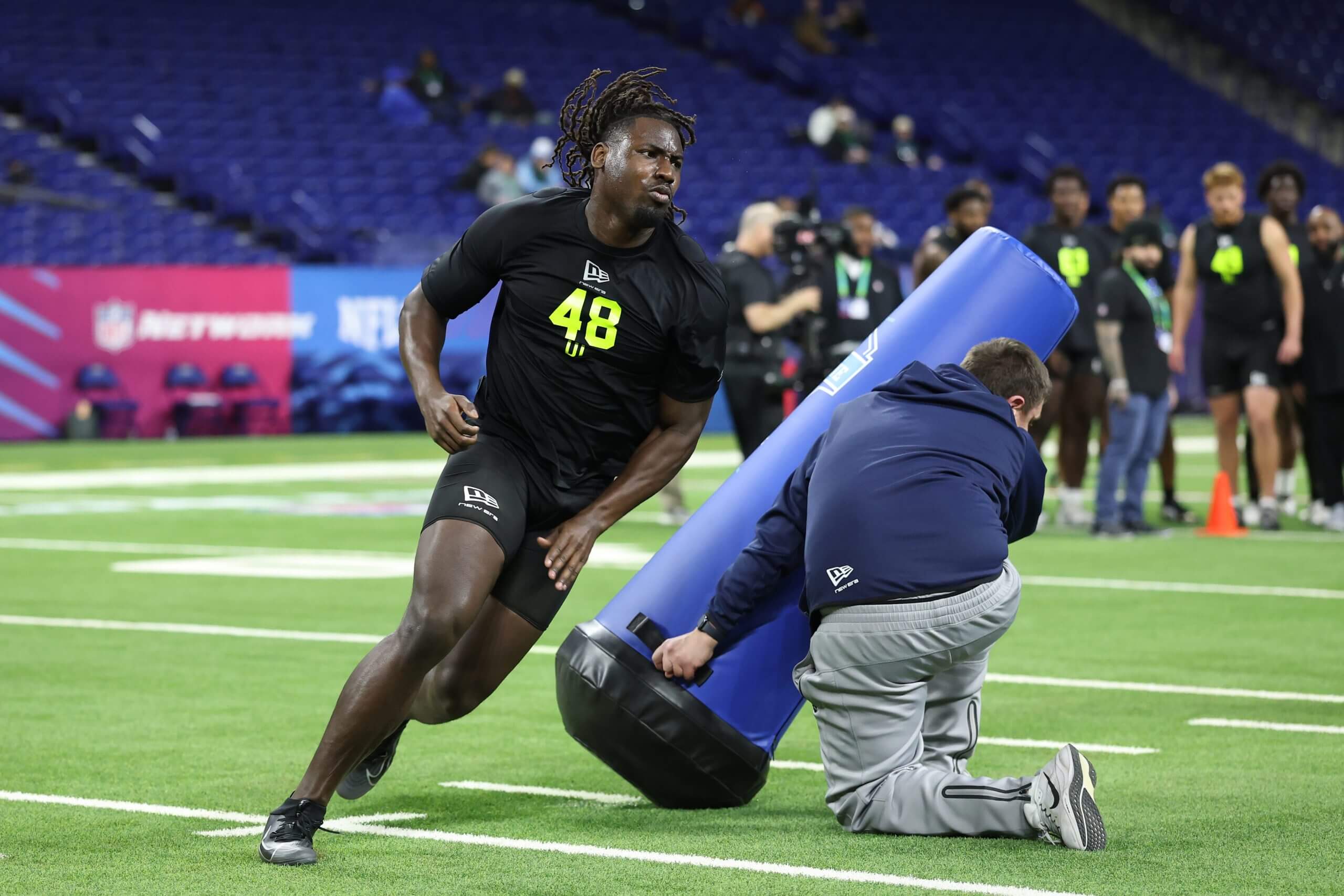
Malachi Lawrence is a potential long-term starter for the Bills. Stacy Revere / Getty Images
Malachi Lawrence, Edge, UCF (No. 36): Lawrence has been a late-process riser as the draft community catches up to what the NFL thinks, and there is a lot to like here. He is an outstanding athlete at edge rusher who would provide them with the speed and explosiveness they just don’t have at outside linebacker. He also passes the normal wingspan and size thresholds that Buffalo breaks ties with. Although he isn’t as natural in bending around the edge, he counters that with being a good run-defender. Lawrence would be a potential long-term starter, and is the player I had the Bills selecting in my final mock draft.
Cashius Howell, Edge, Texas A&M (No. 39): Howell is absolutely in the first-round conversation for the Bills. He’s explosive and has the natural bend around the edge that cannot be taught, which helps provide him plenty of disruption opportunities. On the downside, his wingspan (74.25 inches) is, by far, the smallest of the edge rusher class, and that could really impact how effective he is against offensive tackles. But sometimes, the player is superior to the measurables. It’s a matter of whether the Bills think all of Howell’s other traits can counteract his shortcomings.
Jacob Rodriguez, ILB, Texas Tech (No. 40): Rodriguez has a lot of what the Bills would be looking for in a potential every-snap linebacker. His size is good enough to fit the scheme, and particularly his coverage, instincts and athleticism are all major green flags. He forced 10 fumbles and had five interceptions over the past two seasons, showing he’s a playmaker at the position. Rodriguez will be 24 by the start of the season, however.
R Mason Thomas, Edge, Oklahoma (No. 44): Thomas provides excellent speed, can really pack a punch to offensive linemen and is a quality run defender. However, there are size constraints with him, as his arms are below the Bills’ usual threshold and he is 12 pounds lighter than Howell. Thomas is likelier to go in the second round, but when speed and pocket disruption are involved, never say never on this pairing, maybe even in the first round.
C.J. Allen, ILB, Georgia (No. 46): He is certainly one of the best blends of run-defending instincts and athleticism to access every area of the field. His block-shedding and tackling abilities are also excellent, and he’s still only 21, giving him a much longer runway to help a franchise. On the downside, Allen doesn’t thread the needle of being an all-around inside linebacker as well as some others available. The biggest areas of concern are in coverage and as a blitzer, and if he’s unable to overcome that, it takes away from his potential to be a three-down player.
Day 2
(The Bills have one pick in the third round at No. 91)Christen Miller, IDL, Georgia (No. 43): Miller has impressive size (321 pounds) and moves well, projecting into several roles within the interior defensive line, including at nose tackle and possibly at the 4i position. His strength is as a run defender, and he could potentially become a starter in base formations.
Jake Golday, ILB, Cincinnati (No. 48): Golday reads as more of a ‘tweener type of player the Bills could utilize in several situations if they want to invest in a player who could play both inside and outside linebacker. That’s a type of skill set they don’t have on the roster. If he were available at No. 91, it’s a real possibility, but the investment of an early-to-mid second might be too rich with some uncertainty on his profile. Even still, he’s worth keeping an eye on if they opt for a two-in-one.
Gabe Jacas, Edge, Illinois (No. 49): If the Bills make a big move down into the second round, Jacas would enter the equation with a quick first step (1.59 10-yard split) and a non-stop motor. Jacas would be a rotational rusher as they bring him along in the background behind Greg Rousseau and Bradley Chubb.
Anthony Hill Jr., ILB, Texas (No. 50): As an elite athlete with terrific size and length, Hill may be worth a bet that he can improve in the inconsistent areas where he shows flashes in run defense and coverage. He’s still only 21, too, which certainly helps his projection on the profile side. Even still, he sparks a debate about whether Buffalo could hold off and find a player with similar starting potential in the third or fourth round, but maybe without the prototypical height-weight-speed package.
Keyron Crawford, Edge, Auburn (No. 54): Along the same lines as Jacas, Crawford would be a mid-to-late-second-round type of prospect. He has good speed off the edge and has shown well dropping into coverage when asked, making him a potentially strong fit for what the Bills would look for in a rotational pass rusher with potential.
Lee Hunter, IDL, Texas Tech (No. 55): Several nose tackle types could positively impact the Bills defensive line rotation in a couple of roles, and Hunter is firmly on that list. The 318-pounder has good quickness, but he is at his best when defending the run, which the Bills are looking to vastly improve with their switch to a new defensive scheme. Hunter would have eventual starting consideration in base formations.
Domonique Orange, IDL, USC (No. 64): If the Bills are looking for a run-stuffing nose tackle for those early-down and short-yardage situations, Orange is a good fit. However, his lack of pass-rush abilities would likely confine him to a relatively small role. It is worth wondering how early of a pick the team is willing to spend on a nose tackle only. If he’s available at No. 91, it could make the price point worth it.
Josiah Trotter, ILB, Missouri (No. 73): Trotter is a classic run-defending linebacker who excels in all facets of that role, with instincts, block-shedding and solid tackling. He also provides a team plus-ability as a blitzer. Although his coverage abilities and comparative athleticism are lacking, Trotter checks every other box and is still so young. Being an excellent run defender could give him a very quick path to playing time. Trotter is one of my favorite fits for the Bills at No. 91, or in a small move up the board in the third round.
Romello Height, Edge, Texas Tech (No. 80): Height is 25 and very undersized for the position at 239 pounds, but in terms of speed and explosiveness, he would bring that. There hasn’t been any projection on Height being a hybrid OLB/ILB type of player just yet, and he may just be a rotational edge rusher in the NFL. Even still, should he be available at No. 91 and the Bills haven’t gone for an edge yet, you can’t rule it out.
Keyshaun Elliott, ILB, Arizona State (No. 83): Even if he doesn’t quite major in anything and isn’t quite as athletic as some other prospects, he has good enough size, tackling, blitzing and coverage skills to be a trusted asset on the field. His best attribute is his instinct. The team should have a legitimate interest in him for his all-around game, even if he’s taken after the next name on the list.
Malik Muhammad, CB, Texas (No. 87): The Bills certainly need some cornerback depth and Muhammad would be an interesting blend of length and speed to add to the program. The defense is likely to feature more man coverage than in previous seasons, so adding a developmental cornerback with that skill set and the speed to make up ground is potentially worthwhile. Muhammad is a tough cornerback who is versatile in both man and zone.
Jaishawn Barham, Edge/ILB, Michigan (No. 100): Unlike some other smaller edge rushers, Barham does possess the ability to switch between outside and inside linebacker, which certainly raises his stock when considering what the Bills are looking for. He began as an edge rusher only a few games into the 2025 season after spending most of his time as an off-ball linebacker. If the team craves some multi-position players on defense, Barham should be a name to remember at No. 91.
Ted Hurst, WR, Georgia State (3rd): With the Bills likely looking for a skill set they don’t have in their receiving room, speed will go a long way, and Hurst has plenty of it. He projects as a potential boundary receiver who has some starting upside down the line. The 6-foot-3, 207-pound Hurst can play either the X or Z positions, meaning the Bills would be able to find a role for him if they selected him.
Kaleb Elarms-Orr, TCU (3rd-4th): Elarms-Orr isn’t quite the playmaker and lacks the length of some other inside linebacker prospects, but he shows translatable traits across the three major categories of run defense, coverage and blitzing. On top of that, he has special teams experience if he doesn’t earn a starting job in 2026.
Chris Brazzell, WR, Tennessee (3rd-4th): Like most Tennessee receivers due to the Volunteers’ offensive scheme, there is quite a bit of projection involved. However, Brazzell’s pure speed (4.37 40-yard dash) at 6-4 cannot be ignored. If the Bills were looking for an additional over-the-top type to strain defenses when they put him on the field, that role seems perfectly suited for Brazzell while they develop him in the background.
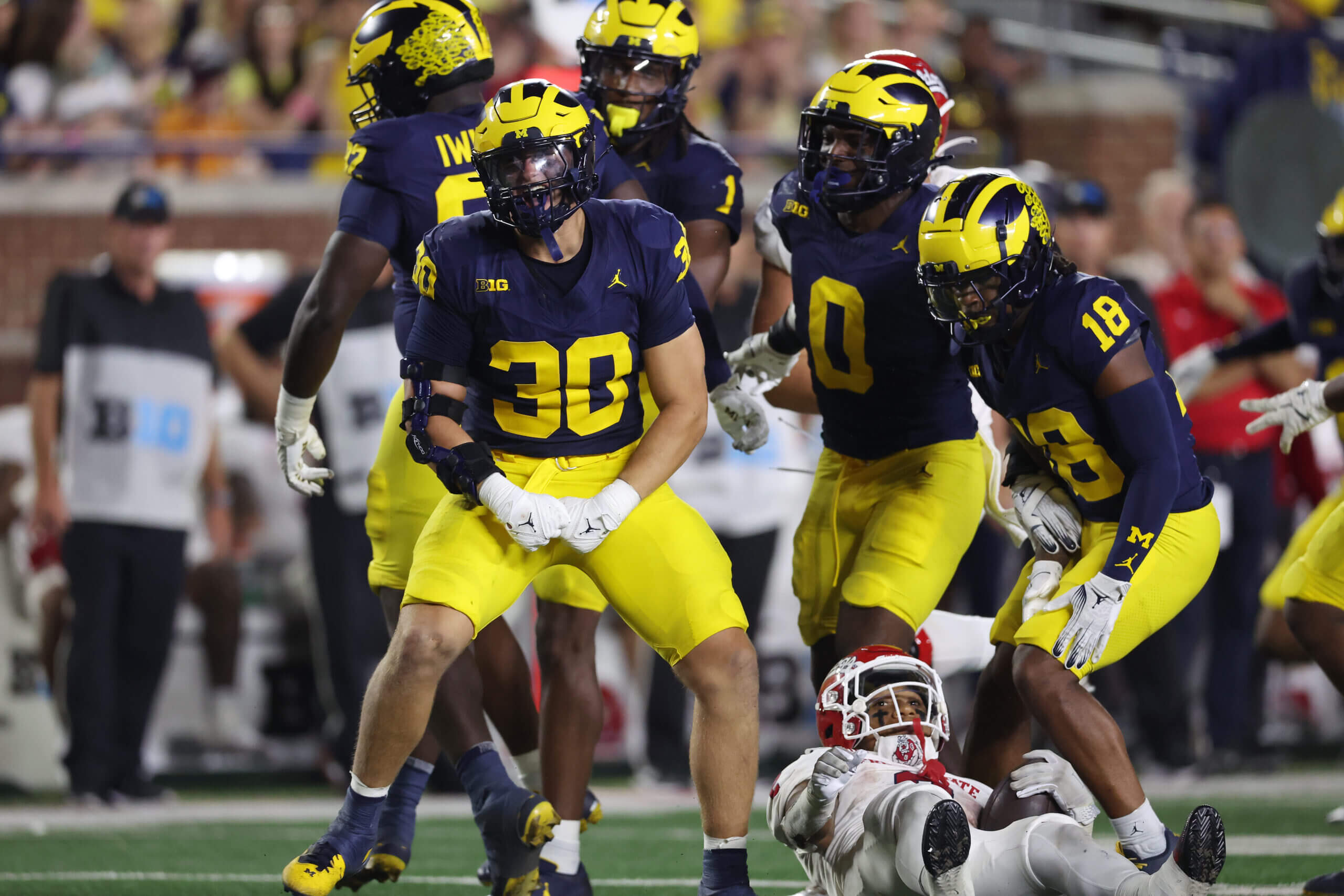
Inside linebacker Jimmy Rolder could be a good fit in Buffalo’s new defense. Gregory Shamus / Getty Images
Day 3
(The Bills have one pick in the fourth round at No. 126, two picks in the fifth round at Nos. 165 and 168, one pick in the sixth round at No. 182 and one pick in the seventh round at No. 220)Jimmy Rolder, ILB, Michigan (4th): Although Rolder’s short arm length could give him some trouble with block-shedding, several workable pieces on his profile likely speak to what Buffalo would go for in its new defense at a reduced cost. Especially with a 238-pound frame, Rolder’s athleticism is an intriguing fit for the inside linebacker room. His tackling ability and workable traits in all other phases give him some starter potential. And even if he isn’t ready in 2026, special teams experience will more than warrant a roster spot.
Julian Neal, CB, Arkansas (4th): Neal has great size (6-2, 203 pounds), experience as both a man and zone corner, and is noted for his physicality. That can translate well to special teams, which will be an integral part of being up on game days as a backup cornerback.
Darrell Jackson Jr., IDL, Florida State (4th): A massive 6-5, 315-pound player who could give the Bills some reps potentially all across the line while majoring at nose tackle. Brugler wrote, “he has larger-than-life traits to do the dirty work at nose and occasionally pressure the quarterback.”
Skyler Bell, WR, UConn (4th): A highly productive yet slightly undersized receiver, Bell has enough speed to provide some inside-outside versatility. He is noted for his route savvy.
Bryce Boettcher, ILB, Oregon (4th): Boettcher is a ferocious tackler and shows some real ability in coverage. On top of that, he is a high-level special teams piece with 584 snaps in that phase at Oregon, and should contribute there immediately in the NFL. However, Boettcher is a bit on the smaller side compared to the other available prospects, which could hinder him in getting off block attempts. There is also the age piece, with Boettcher turning 24 before the season begins.
LT Overton, IDL, Alabama (4th): He’s listed as an edge player, but his size (287 pounds at his pro day) makes him a far better fit as an interior defensive lineman at five-technique or 4i. He should be firmly on the radar in the third or fourth round as someone who can provide depth along the interior defensive line.
Gracen Halton, IDL, Oklahoma (4th-5th): Halton is a 293-pound high-energy rotational defensive end in the Bills’ upcoming odd-man front, who would battle for some snaps as early as the first year at both the five-technique and 4i positions. His draft stock gets dinged for his below-average arm length (31.125 inches).
Malik Benson, WR, Oregon (4th-5th): Benson would carry immediate game-day function as a sparingly-used boundary receiver to help take the top off the defense, while doubling as the team’s primary punt returner. He has excellent speed for his 6-foot, 187-pound frame. Still with some room for development on underneath routes, Benson could easily outplay his draft position. But even if he doesn’t, having a speedy depth receiver who will be the locked-in punt returner is a solid return on Day 3.
Red Murdock, ILB, Buffalo (4th-5th): Where Murdock thrived in college was with playmaking, with 17 forced fumbles over the last three years. He’s also a no-doubt-about-it tackler who also shows well as a blitzer. However, Murdock needs improvement in block shedding and in coverage, and it seems like the Bills need to have at least one of those checked off if they’re looking at someone as a potential down-the-road starter.
Kage Casey, OL, Boise State (4th-5th): Casey has plenty of experience at offensive tackle, but might ultimately project inside to guard. Finding someone with that specific versatility is important if the Bills are going to use a draft resource on an offensive lineman. It might be tricky, though, because they have 10 offensive linemen they like and only keep, at most, 10 on the 53-man roster.
Jadon Canady, NCB, Oregon (4th-5th): Buffalo brought in Dee Alford to play nickel, but doesn’t have anyone behind him at the moment, unless the team thinks that’s where Jordan Hancock winds up. Canady is undersized, but shows some real toughness in both man coverage and run defending, which are important as the Bills scout for the position.
Cole Payton, QB, North Dakota State (4th-5th): A strong-armed prospect with great speed who would make a terrific understudy for Josh Allen. It all depends on price point, but finding a possible long-term backup for Allen would be intriguing in the fifth round.
Nick Barrett, IDL, South Carolina (5th): Barrett is a solid run defender who could line up at a couple of spots along the defensive line, and still carries some underdeveloped pass-rush potential. The Bills likely know all about Barrett, considering his former teammate at the same position was Buffalo’s second-round pick in 2025, T.J. Sanders.
Reggie Virgil, WR, Texas Tech (5th): Virgil didn’t test extraordinarily well, but his 6-2 frame and plus route-running put him on the radar for a boundary receiver. Plus, he’d provide immediate special teams function on coverage units.
Trey Moore, Edge/ILB Texas (5th-6th): Moore is another ‘tweener type who could carry some outside and inside linebacker versatility, and played that role at Texas. A few times this offseason, the Bills have mentioned linebackers who could have multiple homes in their defense as an example for positional versatility, but don’t have anyone on their roster to do it. On Day 3, Moore could be a quality two-in-one investment.
Jeff Caldwell, WR, Cincinnati (5th-6th): At this point in the draft, finding a 6-5, 216-pound player with long arms and 4.31 speed is a take-it-and-figure-it-out situation, if they haven’t addressed receiver before it. Special teams, for someone with that combination of size and speed, seems like a fair expectation.
Thaddeus Dixon, CB, North Carolina (5th-6th): A physical tackler who can play in either a man or a zone scheme, Dixon projects as a potential special teams contributor and fourth cornerback on a roster.
Cade Klubnik, QB, Clemson (5th-6th): A disappointing 2025 season has pushed Klubnik’s draft stock down, but there are some pieces of a potential dual-threat, long-term backup solution with a strong enough arm for Buffalo.
Ryan Eckley, P, Michigan State (6th): The Bills have shown in the past that they are willing to use a Day 3 selection on a punter. Whether it’s in the draft or free agency, expect them to bring in competition for incumbent Mitch Wishnowsky.
J.C. Davis, OL, Illinois (6th-7th): Davis plays tackle but could also project inside to guard, giving the Bills some options if they kept him on the 53-man roster.
Andre Fuller, DB, Toledo (6th-7th): Although it isn’t immediately clear which position Fuller would play between boundary cornerback and safety, the real draw is his special teams ability as he figures the defensive piece of it out. Fuller could easily be a game-day active player because of those special teams abilities.
Jack Stonehouse, P, Syracuse (7th): If the Bills are still at pick No. 220 or potentially land a pick later than that due to a draft-day deal, keep an eye on Stonehouse for them to round out the class. The Bills have done some homework on him in the pre-draft process and need a long-term punter.

