Bills mock draft: A post-free agency reset with attention turning to remaining roster needs
The Bills are still looking for valuable pieces to add for the upcoming season.
 www.nytimes.com

Texas A&M's Cashius Howell may be a player the Bills target with the No. 26 overall pick. Joe Buvid / Getty Images
With the height of free agency now an increasingly distant memory, the majority of NFL offseason attention shifts to the 2026 NFL Draft. The Buffalo Bills hold seven picks in April’s annual event, including the No. 26.
Earlier this week, The Athletic conducted its second beat writer mock draft of the offseason — this version being the first since every team made their free agency moves last week.
I controlled the Bills in the exercise, though, that mock draft was only the first round. Using how that round unfolded, what might the rest of the draft look like?
With my pick in the beat writer draft as the starting point, here is my newest mock draft.
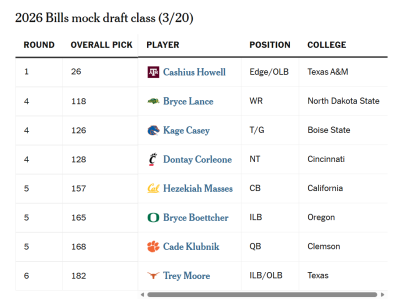
Round 1, No. 26 — Cashius Howell, Edge/OLB, Texas A&M
The Bills went into the offseason with the mindset of building a defense that dictates to the offense. Some of that can be instituted through a scheme using existing pieces, but additions can help the scheme. It would go a long way for the Bills to have a stand-up edge rushing presence who brings speed, explosiveness and bend around the edge — everything the Bills lack at that position. That’s why I targeted Howell with the Bills’ first-round pick.Howell is the exact opposite of the type of pass rusher the Bills targeted during the Sean McDermott era in the vast majority of cases. In those years, they favored measurables and an all-around skill set, as edge containment was a core part of the job. What Howell lacks in size (6-foot-2, 253 pounds) and arm length, he makes up for with speed, pass-rushing prowess and a natural athletic ability to bend around the edge that isn’t easily developed. His skill set is more difficult to come by, which is why, despite his shorter arms (30.25 inches), it’s more than worth the investment for the Bills to try something different with this new scheme. Howell’s first step is part of what makes him such an intriguing asset, as he tied for the top 10-yard split time of edge rushers during this year’s NFL Combine. It’s a stacked edge rusher class, which is an ideal scenario for the Bills picking late in the first round.
In Year 1, Howell would join an edge rusher room with Greg Rousseau, Bradley Chubb, Michael Hoecht and Landon Jackson. There wouldn’t be an immediate pressure for Howell to be a locked-in starter, as they could mix and match pieces depending on the situation. His nearly split-down-the-middle experience rushing from either side will accommodate whatever rusher he’s paired with on a given play. Additionally, Howell’s addition would allow the Bills to utilize Rousseau in a bevy of roles in their multiple-scheme defense — as a stand-up rushing outside linebacker, an even-man front defensive end and a five-technique defensive end in an odd-man front. Long term, the latter two roles seem like more of an ideal setup for Rousseau’s skill set. Chubb is more of a short-term solution than anything, while the Bills likely don’t know what they’ll get out of Hoecht in his first year back from a torn Achilles, and Jackson, whose fit in the scheme is questionable. If all goes well, Howell could emerge as the best pass rusher on the roster within the next two seasons.
Round 3, No. 91 — Trade!
Buffalo trades Nos. 91 and 220 to Detroit for Nos. 118, 128 and 157Trading down at some point, whether at No. 26 or at No. 91, seems like a distinct possibility after the Bills traded away No. 60 in the DJ Moore deal. Since I didn’t execute a trade at No. 26 in the beat writer mock draft, I’ll project one here at No. 91 just to get more value into their 2026 draft class without sacrificing too much. The deal on the Rich Hill Trade Value Chart favors the Lions slightly, yielding a value of 138.6 to Buffalo’s 130.6. Regardless, getting an extra fourth-round pick and improving a seventh-round pick to a fifth-round pick heightens the odds of coming away with real contributors in this year’s draft.
Round 4, No. 118 — Bryce Lance, WR, North Dakota State
It’s all about filling needs and finding value, and the Bills have a roster spot open for a developmental wide receiver. Lance has good size (6-foot-3, 204 pounds) and athleticism (4.34 40-yard dash), and projects best to the X receiver role in the Bills’ offense. There, he would compete with Keon Coleman, Joshua Palmer and, when healthy enough to return from a January torn ACL, Tyrell Shavers. Even if Lance never pans out as a top-three receiver, he has the speed to contribute a handful of snaps each game as a rotational player, and there is special teams value to warrant his game day roster spot. A fourth-round pick isn’t such an over-the-top investment that if the Bills wanted to spend an early pick on a wide receiver next year, they wouldn’t hesitate to do so.Round 4, No. 126 — Kage Casey, G/T, Boise State
The Ryan Van Demark offer sheet doesn’t have a conclusion as of the time of this posting, though even if he stays, there is still a potential roster spot open for a 10th offensive lineman. Casey’s versatility gives the Bills several options moving forward. Casey was a three-year starter at left tackle and could probably give a team reps at offensive tackle in the NFL, but his arms are a bit short for the position (32.75 inches). Casey’s best home might be inside at guard, giving him a shot to win a job at left guard either as a rookie or in his second season. There are multiple outs here for Casey, with the worst case being that he’s merely a long-term backup with versatility to chip in at multiple positions.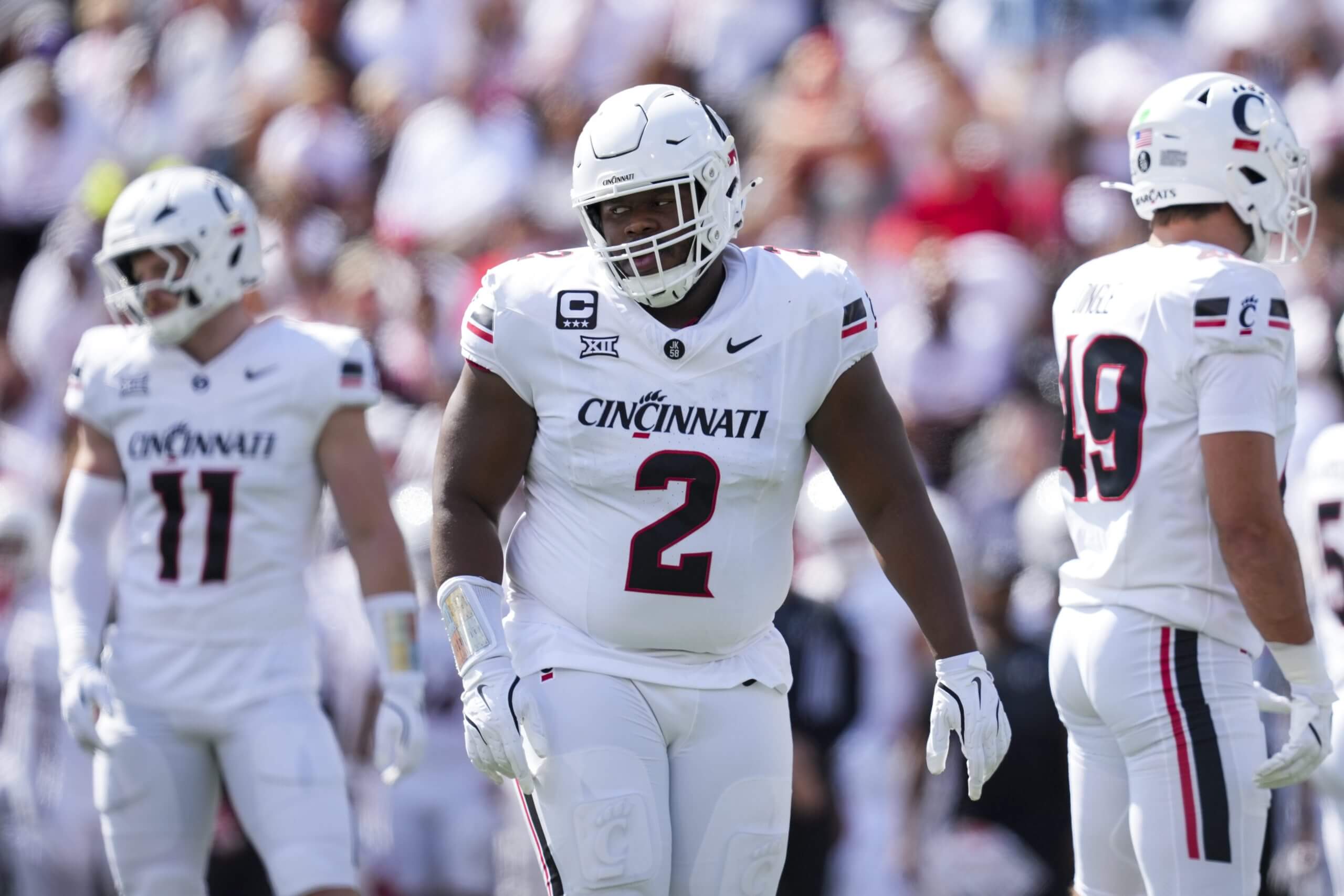
Dontay Corleone would be a hit in Buffalo for his name alone.Aaron Doster / Imagn Images
Round 4, No. 128 — Dontay Corleone, NT, Cincinnati
Regardless of how often they are in their base 3-4 defense, the Bills lack depth at nose tackle, and using a late-fourth-round pick is where the value of the role and position meet the pick itself. Deone Walker is the likely starter at nose tackle, but having someone with enough run-stuffing and block-occupying abilities to give some rotational reps and allow Walker to move around the formation. It would enable Walker to use all his abilities, most notably his pocket-penetration skills, rather than just the more static nose tackle role. Corleone is a massive 341 pounds, providing the precise rotational skills they’d be looking for out of the position. Also, his nickname is “The Godfather.” I’m not sure there could be a more appropriate pairing for “Bills Mafia.”Round 5, No. 157 — Hezekiah Masses, CB, California
The Bills still need to add an experienced veteran cornerback as their No. 3, but with 2025 sixth-round pick Dorian Strong’s future still up in the air due to a neck injury, a fourth developmental cornerback is also a potential need. Masses picked off five passes last season for Cal and is a fit for a scheme that plays a good amount of man coverage, like the Bills are expected to do in 2025. Although he’s got some work to do as a run defender, the playmaking from a boundary cornerback position will be tough to ignore as they look to build out their depth over time.Round 5, No. 165 — Bryce Boettcher, LB, Oregon
The Bills have enough room to add one or two more inside linebackers through the rest of the offseason, and finding one with some hope that they could eventually start is something they need. Terrel Bernard is undersized and struggled with block shedding in 2025, while Dorian Williams has never ascended to the starting lineup without injury in his first three seasons and is in the final year of his rookie deal. There is a path for a new player to claim a starting job as early as 2025. Boettcher’s age (24 in the summer) and lack of speed are reasons he’d still be around at this point in the draft. Still, in terms of mentality and tenacity, Boettcher ticks a lot of boxes in what the Bills would be looking for as a developmental linebacker, with some blitzing ability to boot. He would instantly help improve the depth and provide weekly special teams value if he didn’t challenge for a starting job. He’s the same height as Bernard, but is 10 pounds heavier, and the Bills could use a bit more size in a long-term linebacker for Jim Leonhard’s defensive scheme. Boettcher is a former MLB draft pick and walked on to the Oregon football team.Round 5, No. 168 — Cade Klubnik, QB, Clemson
The recent addition of Kyle Allen, the Bills’ only backup quarterback, suggests there’s a distinct possibility they use a Day 3 selection on a potential long-term backup. Klubnik would enter the equation, perhaps not as the backup in 2026, but as one they would work with all year to be ready for the job in 2027 if all goes well. Klubnik, although undersized, has good enough arm strength for Buffalo, but has very good mobility that would be able to keep much of the Bills’ normal game plan with Josh Allen in place. There’s no guarantee that he’ll be their long-term backup, as quarterback picks are volatile. But using a selection on one is always good business, because if they happen to turn into something, there is potential trade value that could yield a better pick than the one originally used on the player.Round 6, No. 182 — Trey Moore, ILB/OLB, Texas
If there’s one thing the Bills have echoed as hopes for their new defense under Leonhard, it’s being able to line up in multiple formations and have players who can fill multiple roles. That’s the draw with Moore, who shows versatility between outside and inside linebacker roles in the Bills’ defensive scheme. It’s an early sixth-round pick, so his carving out a starting role would be a long shot. However, if they could have a rotational linebacker across the board to build out their depth, along with special-teams abilities given his size and speed, that’s an ideal use of a late pick as the Bills transition to this new defensive scheme.