

Frank Reich is the master of the comeback. The Jets might be his biggest challenge yet
After getting fired midseason two years in a row, Reich thought his NFL coaching career was over, then his old friend Aaron Glenn called.
 www.nytimes.com
On the drive from North Carolina to New Jersey, Frank Reich called Andrew Luck.
When Reich was head coach of the Indianapolis Colts, he coached Luck for one season. Luck later became general manager of Stanford’s football team, and last year Luck had asked Reich for a favor — he wanted him to serve as his interim head football coach for one season after an unexpected vacancy. Reich went along to help a friend.
But now Reich was returning to the NFL as offensive coordinator of the New York Jets under his old teammate Aaron Glenn, and it was Reich who had a favor to ask.
“Andrew, I’m in a bind,” Reich told him. “I need your help. Will you be my interim quarterback?”
They laughed hard because they both knew there was no possibility that Luck would resume his playing career. They also laughed hard because it wasn’t that long ago when it seemed there was no possibility of Reich resuming his coaching career.
On the morning of Nov. 27, 2023, Carolina Panthers owner David Tepper came into Reich’s office and told him he was out. A member of the security staff escorted Reich to the parking lot. He was not allowed to clear out his office or say goodbye to the people he had been charged with leading.
Reich had played quarterback for the Panthers, settled in the area and thought he would be their head coach for years.
He was given 11 games.
It was the second time he had been fired in a little more than a year, as the Colts let him go during the previous season. After starting his coaching career with a 37-25 record, Reich was the first coach in NFL history to be fired midseason in back-to-back years.
It was time, he figured, to retire, and he said so publicly.
In 2024, he worked on a book, gave speeches and evaluated quarterbacks as a consultant. He helped his wife, Linda, with their “kNot Today” Foundation, which works to protect children from sexual abuse, exploitation and trafficking. The couple remained in the Charlotte area, began building a home in Greensboro, N.C., spent time at a lake house in Southern Virginia, took golf lessons in Phoenix and vacationed in the Turks and Caicos. There were grandchildren’s basketball games and swim lessons.
And he still was getting paid by the Panthers. In fact, he’s still getting paid by the Panthers because, the year before the Colts fired him, he signed an extension that the Panthers picked up. They owe him through 2026.
After the season at Stanford, Reich, at 64, could have lived the good life and cashed his checks. He could have been an adviser to one of his coaching friends, such as Philadelphia Eagles coach Nick Sirianni, with whom he discussed the possibility a couple of months ago.
But the Jets presented an opportunity for a comeback.
And Reich is all about the comeback.
On a Saturday morning 54 years ago in southern Pennsylvania, Reich was getting ready to play with friends when his father told him he had a job for him. He took him to the backyard and showed him a pile of dirt that, to a 10-year-old, might have well been an Appalachian mountain.
“There’s the shovel, and there’s the wheelbarrow,” Frank Sr. said. “I want you to move all the dirt to the other side of the yard, 20 yards away.”
Frank Reich Sr. was one of the last of the two-way players at Penn State, a captain who had no use for a face mask. He served in the United States Marines in Korea and spent most of his working life as a high school football coach. When he told his son he had a job to do, there would be no negotiating.
Still, young Frank tried. After a couple of hours, he complained and asked for help.
“One shovelful at a time,” his father said. “One wheelbarrow at a time.”
He worked until he became discouraged again, then came back with another plea.
“One shovelful at a time,” his father said again. “One wheelbarrow at a time.”
Young Frank moved all the dirt. More importantly, he learned he could do almost anything if he just focused on one shovelful at a time.
Thirteen years later, Reich was a quarterback at Maryland. In a game against Miami, he came off the bench to relieve struggling Stan Gelbaugh at the start of the second half while trailing 31-0. Then he led six straight scoring drives for a 42-40 victory.
Eight years after that, Reich started for the Buffalo Bills against the Houston Oilers in the wild-card round of the playoffs because Jim Kelly was injured. After Reich threw a third-quarter pick six, the Bills trailed 35-3. Then, with future Hall of Fame running back Thurman Thomas injured and unable to return, the comeback began. On a fourth-and-5 with the Oilers leading by 9, Reich chose the play — Bull 65 — came off his primary read because of the coverage and threw an 18-yard touchdown to Andre Reed. It was one of five straight drives led by Reich that resulted in touchdowns. In overtime, the Bills won on a field goal.

Frank Reich led the Bills to what was then the greatest comeback in NFL history against the Houston Oilers in a playoff game in January 1993.
Rick Stewart / Allsport
At the time, the Bills’ comeback over the Oilers was the greatest in NFL history, just as the Maryland victory over Miami had been the greatest in major college football history.
Reich led both with the same approach that he moved that dirt, one shovelful at a time.
The comebacks changed Reich’s life, if not many others’. By his estimate, he has given thousands of speeches — to church groups, men’s clubs, corporate leaders, salespeople, school children, anti-drug crusaders, people struggling with addictions and, yes, football players — about overcoming seemingly insurmountable odds.
“The comeback didn’t happen because I deserved it,” Reich says. “It was because God needed someone to take this mantle because there are people all over the world facing obstacles who need encouragement, whether it’s a family issue, a personal issue or a business issue. It has been an opportunity to help people.”
Reich’s performance the following week against the Pittsburgh Steelers put the Bills in the AFC Championship Game. Kelly returned to beat the Miami Dolphins and set up a Super Bowl matchup against the Dallas Cowboys but was injured in the second quarter. With an opportunity to be the hero again, Reich fumbled three times, which tied a Super Bowl record, and threw two interceptions in a 52-17 loss.
That’s part of his speeches, too — the highest of highs, the lowest of lows. His objective is to blend supreme confidence with supreme humility.
“How do you think it felt losing 52-17, the second-worst defeat in Super Bowl history?” he says. “It sucked. But you can’t keep me down.”
Reich played another season in Buffalo and was part of four AFC championship teams before spending one season with the Panthers, another with the Jets and two with the Detroit Lions.
Hall of Fame general manager Bill Polian was part of the Bills front office that selected Reich in the third round of the 1985 draft and then signed him as a free agent in Carolina. He used Reich as a template for his scouts.
“He was talented, but his work ethic, character, humility, leadership and ability to get guys to play for him were second to none,” Polian says. “He was the epitome of what you want in terms of makeup.”
Polian once called Reich the league’s greatest backup quarterback. Reich believes no one would have called him that if he wasn’t enveloped by the greatness of the 1990s Bills. He says he had “zero mobility,” and the arm that enabled him to throw passes of more than 70 yards in his first few years in the league lost significant power before he ever started an NFL game — most likely from overwork.
Reich, in his quest to improve, threw year-round, never allowing his arm to rest. It was difficult for him to do nothing.
After playing, though, Reich wanted to be a present father and husband, so he put the NFL on hold, rejecting an offer from Polian to be the quarterbacks coach of the Colts for Peyton Manning’s rookie season, in 1998. Instead, Reich earned a Master of Divinity degree and served as a pastor and itinerant preacher.
In 2006, Reich began his coaching journey with the Colts and spent 12 years as an assistant. What was clear then and remains so now is that Reich has a way of bringing out the best in quarterbacks.
Boomer Esiason hosted Reich on Reich’s recruiting visit to Maryland, became his roommate, and they were best men for each other’s weddings. Esiason says Reich pushed him to be better, and Reich also was “an angel on my shoulder” who inspired Esiason to do the right things. The dynamic was similar with Kelly, for whom Reich was a grounding force.
Reich was the quarterbacks coach for the Colts during one of Manning’s MVP seasons. Philip Rivers tied his career high for passer rating when Reich was his offensive coordinator, and later, after a 5-11 season with the Chargers, was revitalized when he joined Reich on the Colts, going 11-5.
Reich was the offensive coordinator for Carson Wentz’s only All-Pro season (the same season Nick Foles won Super Bowl MVP). After Reich left Philadelphia, Wentz bottomed out as a starter and then joined Reich in Indianapolis, where he improved his passer rating from 72.8 the year before to 94.6.
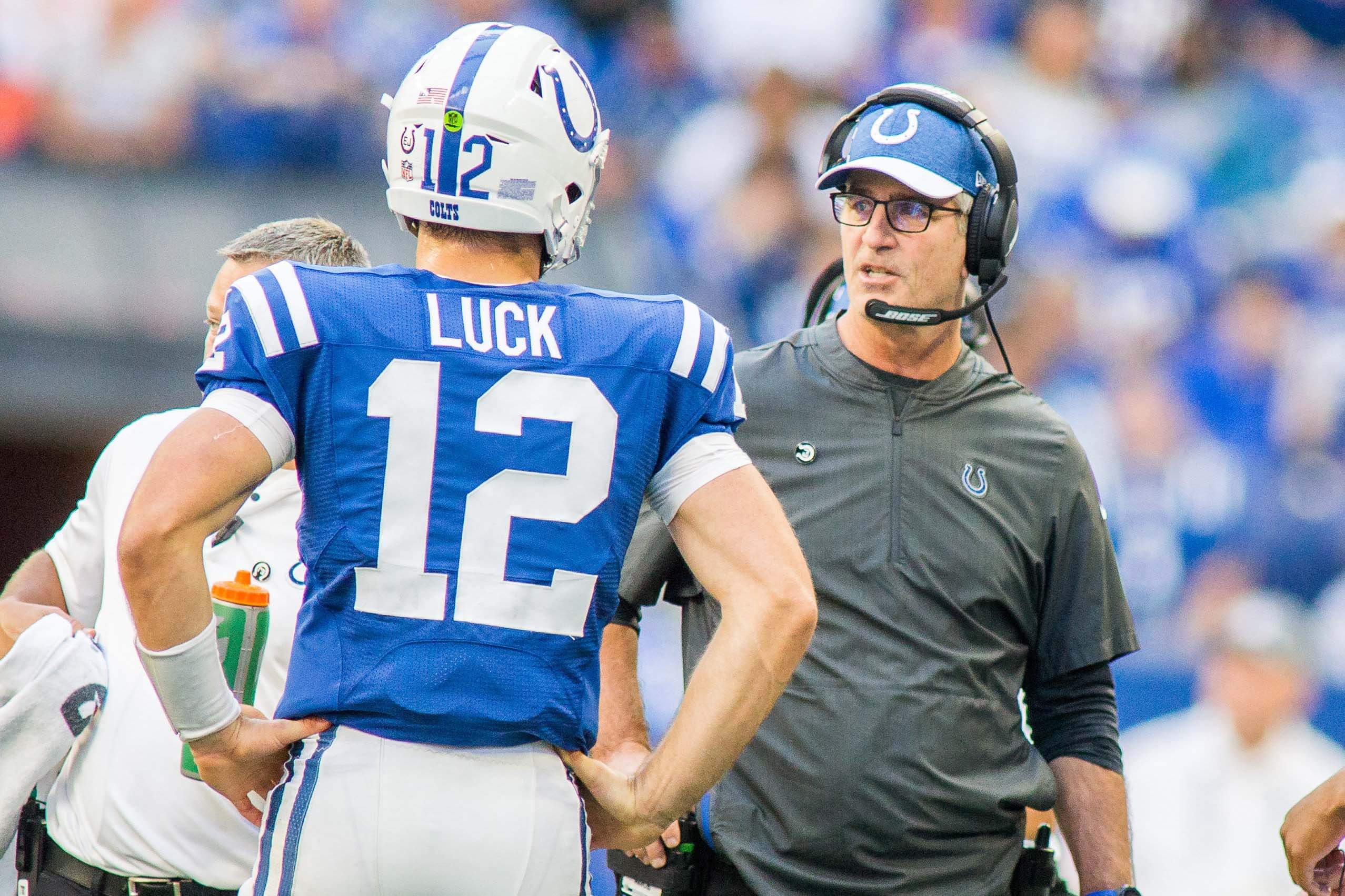
Colts quarterback Andrew Luck, left, loved working under then-head coach Frank Reich in Indianapolis and hired him as interim head coach last season at Stanford.
Trevor Ruszkowski / USA Today
After sitting out the 2017 season with a shoulder injury, Luck had a career-high passer rating in his lone season with Reich.
“I absolutely loved working with Frank as a player,” Luck says. “I very much felt like a partner in the offense with him. He has a very collaborative spirit and ethos that embodies a lot of humility.”
Reich is confident he could have elevated Bryce Young with the Panthers if he had more time. He says he was a believer in Young, despite murmurs that he preferred the team draft C.J. Stroud. Reich says he liked both.
“Frank sees the game through a quarterback’s eyes and also through a coach’s eyes, as the son of a coach,” Polian says. “His temperament, preparation and ability to separate the wheat from the chaff with quarterbacks is probably as good as it gets.”
Luck wanted Reich as his interim head coach for reasons beyond his ability to enhance quarterbacks. “Our team needed to learn to believe in itself again,” Luck says. “With his approach of looking at it as almost a version of ministry, he was perfect.”
Reich and Luck led the Cardinal to a 4-8 record, which was “miraculous” in Polian’s estimation, given they were 3-9 in each of the previous four seasons and Reich inherited the team too late to make significant changes.
“He helped us turn negative momentum into positive momentum, and I thought he brought the joy for football back to Stanford University,” Luck says. “And he helped us beat Cal.”
Staying at Stanford wasn’t possible from Reich’s perspective because his heart was with his family, far away. But staying in coaching somewhere closer to home was possible because he was re-energized.
On gray February days, Reich meets with offensive assistants at One Jets Drive. Together, they envision a system that will take the best of what he has done and blend it with the best of what they have done. There will also be fresh concepts like more passing off wide zone, he says, but that probably will depend on which quarterback the Jets settle on.
Calling plays turns him on. He gave up play calling with the Panthers for three games but went back to doing it when the offense was struggling. He also called plays as head coach of the Colts and as offensive coordinator of the Chargers. He even called plays for Kelly on critical downs in the K-Gun no-huddle for the Bills.
He plans to dial up wide receiver Garrett Wilson’s number frequently. Reich says he’s looking for ways to get him lined up at X, F and Z, depending on the formation and play concept.
“This,” he says, “is my sweet spot.”
His sweet spot is working for a team that hasn’t been to the playoffs in 15 years, finished 3-14 and had the fourth-worst offense in the league last season and has no clear solution to its quarterback problem. Oh, and the head coach is on the hot seat.
Reich knows what Jets pain feels like.
As a player with the 1-15 Jets in 1996, Reich started a career-high seven games in place of injured Neil O’Donnell, including the only game the Jets won. Reich says his back was injured so badly that season that the only way he could sleep was on a hospital bed, and he needed weekly injections.
But he also has pleasant memories of his Jets tenure because of relationships he developed, especially with O’Donnell, Wayne Chrebet, Keyshawn Johnson, Kyle Brady and Glenn, then the best cornerback he had ever competed against, now his boss.
Once before, there was a path for Reich to come back to the Jets. He interviewed for the head coaching job 11 years ago. Esiason picked up Reich from the team facility after Reich was told he wasn’t going to be the Jets’ head coach. Esiason let his friend know he was thrilled he didn’t get the job.
“It’s a tough job, tough fan base,” says Esiason, who grew up in New York, played for the Jets, hosts the “Boomer and Gio” radio show on WFAN in New York and understands the landscape as well as anyone. “They’ve been losing and they look bad losing. The ownership has been extremely inconsistent. This is a make-or-break year, I think, for Aaron and, of course, Frank. So he took this job for the challenge, which is going to be enormous. But he likes a fight.”
The book Reich is writing is titled “Created To Compete,” and he believes he was. He considers the book a biblical worldview on competition, based on the dominion mandate in Genesis, in which God tells Adam to take dominion over all the earth.
During Reich’s year off, Linda says he was “like a caged lion.” She had to remind him that neither she nor their three daughters were his assistant coaches. An environment in which he can push and be pushed to excellence is essential for Reich.
He is confident he can lift his players. And they can lift him, because this is an opportunity for healing. Reich acknowledges he felt “personally beat up” after being fired by the Panthers.
“Nobody likes to be disrespected,” Esiason says. “I went on a golf trip with him last year and I could tell there was a cut that was left open.”
The way Esiason sees it, Reich has an opportunity to do something completely unexpected. And he can reinforce that any comeback is possible.
Luck can’t remember ever seeing Reich flinch. And Reich isn’t flinching now, even with a massive pile of dirt in front of him.
“One shovelful at a time,” Frank Reich says.