

The NFL hired zero Black head coaches. That tells you everything
With 10 head-coaching vacancies this offseason, the hiring cycle echoed decades past as owners defaulted to their superficial practices.
 www.nytimes.com
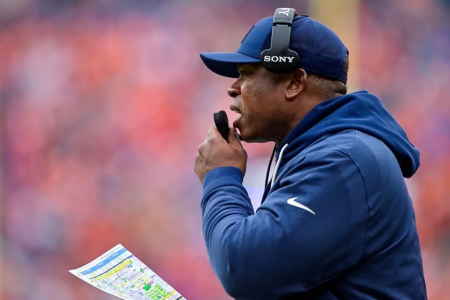
Considering all the past missteps, how risky is it really to try something different and hire a coach such as Vance Joseph,
whose defense powered the Denver Broncos' run to the AFC title game? Dustin Bradford / Icon Sportswire via Getty Images
It’s never good when NFL owners become the story of the coaching carousel. Yet they were unavoidable during this cycle, flashing their eccentricities and wealth-skewed logic, running their mega-billion-dollar sports toys like children crashing remote-control cars into a wall.
They operate these franchises with the befuddling sophistication of a little family-owned convenience store. Then, when a precious few dare to exit their cloistered compounds and step in front of a microphone, they provide cringeworthy entertainment. In Buffalo, watch Terry Pegula insert those puppies — socks, loafers, everything — into his mouth. In Cleveland, see Jimmy Haslam scare off quality candidates and then pooh-pooh fresh faces brave enough to want to work for him.
As the camera pans across the league, wince and cover your eyes. It was alarming enough that, for the second time in four years, the NFL had 10 head-coaching vacancies to begin this offseason. However, the really disturbing part is what teams have done with these opportunities to reset.
The results are in. Nine of those jobs have been filled. The last one is all but closed; the Las Vegas Raiders are expected to finalize a deal with Seattle Seahawks offensive coordinator Klint Kubiak after the Super Bowl. Aside from the New York Giants’ capitalizing on John Harbaugh’s sudden availability, the most memorable parts of this period will be owners behaving like amateurs in public and then defaulting to their callow and superficial hiring practices.
Most of these franchises didn’t reset. Their owners reverted to predictable dysfunction. The NFL is trapped in this loop because the people with ultimate authority have little desire to evolve. Over and over again, the owners opt for organizational stagnation and attempt to disguise it as prudence.
That’s how you end up with the damning statistic that will define this carousel: 0-for-10. In a league that still recites diversity statements and upholds Rooney Rule interview requirements, no Black head coaches were hired. Zero. About one-third of the NFL was looking for new leaders. Roughly 70 percent of the players are African American. But zero. Robert Saleh, who is Lebanese American, was the only minority coach deemed worthy of an opportunity.
This hiring cycle became a monochrome echo of decades past. Not just in race, but also in imagination. It’s encouraging to see six first-time head coaches in the Class of 2026. Five of them are under 50. Three are under 40. On the other hand, new Buffalo Bills coach Joe Brady is the only one whose pedigree doesn’t trace back to one of these three coaches: Harbaugh, Kyle Shanahan and Sean McVay.
On Sundays, the NFL markets innovation; the best teams boast clever schemes and reimagined methods of coaching and motivating players. And on Mondays, owners of franchises desperate to catch up continue to prize familiarity, mistaking their comfort for competence, trusting that stubborn repetition will somehow produce stability.
In a nation backing away from previous diversity commitments, there is little societal pressure for NFL owners to be better. The problem isn’t confined to minority coaches being passed over. It’s much bigger. It’s about an industry unwilling to challenge its own narrow vision of leadership — what it looks and sounds like, who sets the standard, and who gets otherized. Without sustained pressure, NFL teams are as lax as ever in honoring even their own stated intentions.
I’m not one to declare any hire a success or failure before the coach even addresses his entire squad. Instead, the focus should be on the process that led to each selection and whether the new person fits a franchise’s ethos (assuming it’s not a shiftless organization). Viewing the choices this way, it’s easy to identify which teams are on task and which are flailing.
The Giants, who needed credibility after their last four full-time hires flopped, made a textbook decision in nabbing Harbaugh. They won the first impression, even though Harbaugh has plenty to prove now that he’s away from a stable Baltimore Ravens organization. After 18 seasons with Harbaugh, the Ravens stayed true to their identity in picking Jesse Minter, who had previously worked for the organization. The Atlanta Falcons made a solid, safe decision by bringing in Kevin Stefanski, who can add toughness and discipline while also upgrading the team’s offensive system. And even though he couldn’t lift the hapless New York Jets, Saleh is a good second-chance hire with the Tennessee Titans.
As for the other six hires, well, the rationale is shaky. The Pittsburgh Steelers went for an accomplished coach with local ties in Mike McCarthy, but they abandoned a formula — a young, defensive coach with CEO potential who can stick around for a long time — in what seems to be a desperate attempt to develop a quarterback to be identified later. For a team that has had three head coaches since 1969 (and won six Super Bowls), it’s a short-term decision that warrants a red flag.
Then there are the Bills, who Pegula said hit the “proverbial playoff wall” after he fired Sean McDermott. He sounded like an owner anxious about maximizing Josh Allen’s prime. And so, in an extreme win-now situation, the franchise promoted 36-year-old offensive coordinator Joe Brady.
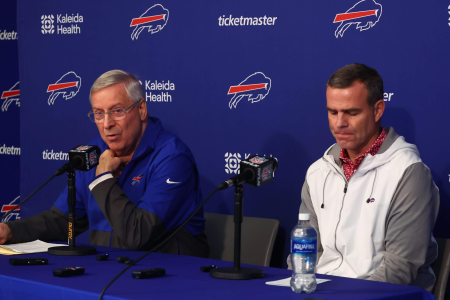
Bills owner Terry Pegula, left, and general manager Brandon Beane speak at a news conference after the firing of coach Sean McDermott.
Jeffrey T. Barnes / Associated Press
The remaining four teams made questionable decisions, but let’s focus on Cleveland, which is calling upon Todd Monken to rebuild a putrid offense. He might have to do so without the services of defensive coordinator Jim Schwartz, who was a finalist for the top job for a second time and is reportedly upset. Monken, 59, is a good offensive mind. He’s also coming off a season in which his underperformance as offensive coordinator contributed to the unraveling of the Harbaugh era in Baltimore. Normally, assistant coaches on the rise get these opportunities. Monken arrives immediately seeking redemption. If any franchise should’ve taken a big swing, it’s the Browns. Instead, they just swung. Unless Monken can overcome their chaos, they will be swinging again soon.
This all explains how the league, as a collective, can be so bad at hiring. The last time the NFL had 10 head-coaching openings in one offseason was 2022. Eight of those coaches have been fired already. From 2020 to 2022, 22 coaches were hired. Four of those men remain employed by those teams: Detroit’s Dan Campbell, Philadelphia’s Nick Sirianni, Minnesota’s Kevin O’Connell and Tampa Bay’s Todd Bowles.
Considering all the missteps, how risky is it really to try something different? Anthony Weaver. Nate Scheelhaase. Ejiro Evero. How about a second job for Vance Joseph, whose defense powered the Denver Broncos’ run to the AFC title game? Care to prove Brian Flores, who is still suing for racial discrimination, wrong? When the Miami Dolphins were deep into rebuilding, Flores had a 24-25 record, including winning records in his last two seasons. He’s gruff, but he’s a winner. Plenty of White coaches have been appreciated for that style.
The 2025 season began with five Black head coaches. Three remain. The Harbaugh and LaFleur brothers outnumber them. It’s an old, sad and inevitable reality.
On Sunday, NFL teams spammed social media with their Black History Month posts. A few hours later, this hiring cycle ended, and a number spoke louder than any of their virtue signaling: zero.
The results are in. Those posts mean nothing.