Some players on the roster would be great fits for a new scheme.

www.nytimes.com
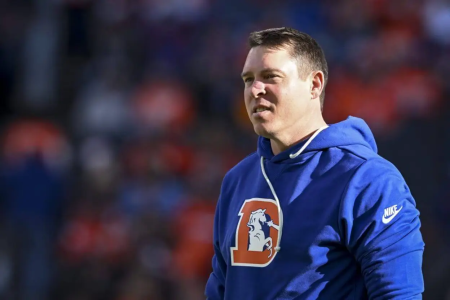 Based on what the Broncos did when Jim Leonhard was in Denver, the Bills appear likely to blitz more frequently with him as the defensive coordinator.
AAron Ontiveroz / Getty Images
The Buffalo Bills are more than a week into the Joe Brady era. With the team moving on from former head coach Sean McDermott and promoting Brady from offensive coordinator, there was a risk that things would feel more the same than different if there weren’t enough changes to their operation.
However, significant changes are coming to Orchard Park, and you need not look any further than the Bills’ hire to lead the defense. The team announced
Jim Leonhard as the new defensive coordinator, and with him will likely come substantial changes.
For the last nine years with McDermott, the Bills have run a 4-3 base defense that emphasizes zone coverage, pre-snap disguises and a lower blitz rate, with a heavy emphasis on the front four defensive linemen getting to the quarterback while allowing the back seven to win in coverage. In McDermott’s nine seasons, the Bills had only a 14 percent blitz rate, according to TruMedia, and over the last four seasons, they didn’t hit 13.5 percent. The team ranked 23rd in blitz rate over nine seasons, and 28th in the previous four.
Brady said during his introductory news conference that he wants to challenge the opposing quarterback pre-snap and post-snap. While that can be taken in many ways, given the context of what the Bills were on defense, it certainly suggests the Bills want to be much more pressure- and blitz-heavy.
Along with those comments, the Bills have hired two linebacker coaches, a team source confirmed. The team hired Bobby April III to be the outside linebackers coach and John Egorugwu to be the inside linebackers coach. Those context clues, along with the system Leonhard comes from, likely point to a different base alignment and principles for each position than we’ve seen from the Bills.
Let’s take a deep dive into how the defensive players can acclimate to such stark differences and what the potential changes mean.
What system might Jim Leonhard bring to Buffalo?
When you look at the system Leonhard comes from in Denver, three things stand out as potential differences from how the Bills operated under McDermott. The first is their base look, a 3-4 scheme that creates some key scouting differences, which we’ll get into. The second is the Broncos’ blitz rate, which, at 20.9 percent, was second highest in the NFL in 2025. Lastly, the Broncos’ man coverage rate was 31.3 percent, the fourth highest in the NFL.
As for the scouting differences, it will mainly impact the front seven. Along the defensive line in those base sets, they would need a bigger-bodied, space-occupying nose tackle who could plug the “A” gap. At defensive end, the general thought is to have players somewhere in the 280- to 300-pound range who also have good arm length.
The linebackers would have key differences, too. Outside linebackers are the generally accepted edge rushers but are usually different body types than what the Bills had scouted previously in a 4-3. These players are twitchier, with a more fluid range of motion to help with coverage, and are more explosive. They can be lighter. Inside linebackers need to be able to win their one-on-one block and shed to make the tackle, so a bit more size is a general lean.
But in today’s NFL, there is such an emphasis on matching personnel to what the offense brings on the field, meaning the amount of times the Bills would actually be in a base 3-4 front isn’t as prevalent as you might think. A lot of it will depend on which member of the front seven they want to come off the field when they bring in a fifth defensive back.
There are several options, depending on what look an offense gives them. However, more than likely, it would wind up being either the nose tackle, a defensive end or an outside linebacker, though any of those options would likely yield more of a four-man front, with different skill sets than a base 4-3, depending on the situation.
How difficult will the transition be with the current defensive personnel?
For a team like the Bills, who have been so entrenched in a four-man front for nearly a decade, on the surface, it seems as if the transition would be difficult. But the good news for them is that it won’t be as bad as you’d think. Some of that has to do with some players they have under contract who have the skill sets to make the scheme switch.
But much more of that has to do with the natural turnover from expiring contracts. Linebacker Matt Milano, cornerback Tre’Davious White, defensive end Joey Bosa, defensive tackle DaQuan Jones, safety Jordan Poyer, linebacker Shaq Thompson and defensive end A.J. Epenesa are free agents. Most of those players are better suited to McDermott’s outgoing defensive scheme, and the Bills may turn the page on most, if not all, of them.
Another piece who will help the transition is safety Cole Bishop. With a more attacking, aggressive style, having an explosive, high-IQ, instinctive safety will help them in several ways as they go through a transitional offseason.
What might become difficult this year is with the entire linebacker room. The Bills don’t have a perfect fit as a starting option at outside linebacker with pass-rushing upside, though they do have some options to help them get by in 2026. Then, at inside linebacker, they have two free agents and one very clear question about someone they invested in.
There will be some hiccups along the way, but the Bills are in a better position this offseason to switch defensive schemes than they were in previous years.
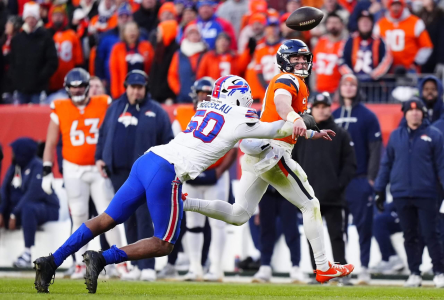 Greg Rousseau could be an asset if the Bills change up their defense under Jim Leonhard.
Ron Chenoy / Imagn Images
Who fits what the Bills may look to do?
DE Greg Rousseau
Rousseau has long been a good player for the Bills. He controls the edge well and provides excellent run support, though his pass rushing has run hot and cold. Rousseau isn’t a quick-twitch player and mainly relies on power and strength to win, which is a fascinating blend of skills for what could be on the way in Buffalo. What makes him such a compelling fit for this style is that his style of play and length are a potentially great fit as a defensive end in an odd-man front. Rousseau is 266 pounds and underweight by that position’s standards, but he does have the frame to add weight. He also shouldn’t be ruled out as being a stand-up rusher in some situations, either. And when the Bills reduce to a four-man front against specific personnel packages, he can easily play defensive end. As a base defensive end in an odd-man front, it could be a perfect fit for both Rousseau and the Bills, with some wiggle room to fill other roles, too.
DT Deone Walker
When the Bills drafted Walker in the fourth round, there was some hesitation about whether he, despite a massive 6-foot-7, 345-pound frame, would be a fit at one-technique defensive tackle. Walker quickly dispelled any doubts when the regular season arrived and played a crucial role as a starter almost the entire season. He was the only defensive tackle who did not miss a game. Now, if the Bills go to the odd-man front, Walker will need to prove he can be the block-occupying nose tackle the Bills need him to be in running situations. He certainly has the frame to do it. Given his success last year, Walker likely has the Bills feeling good about a scheme switch.
DL T.J. Sanders
Upon Sanders’ return from his stint on injured reserve, the Bills used him at defensive end, out of roster necessity, more often than not. They eventually returned him to defensive tackle, but when a trustworthy fourth defensive end never emerged, Sanders played that role in their divisional round exit in Denver. That experience could wind up being a blessing in disguise for the Bills now with their new defense. Sanders’ arm length and frame (297 pounds) bode well for a role as a 3-4 defensive end. As long as he can show similar progress to hold up at the point of attack, as he did near the end of the year, it could be a solid transition.
DE Michael Hoecht
Once Hoecht is cleared from a torn Achilles, the Bills have to be excited about his fit into this scheme. Hoecht can play multiple roles, as he demonstrated with the Los Angeles Rams before coming to Buffalo. When he’s back to full speed, both the outside linebacker and defensive end roles are in play for him. He’s a highly switchable asset, and when he was healthy in 2025, he was an impact player in a rotational role. Hoecht suffered the season-ending injury in early November, and his timeline has yet to be disclosed.
CBs Christian Benford and Maxwell Hairston
Benford can fit any scheme at this point, so this isn’t necessarily a surprise. The way he’s developed in man coverage since arriving in Buffalo has shown he can be a do-it-all type of player. Hairston can do a bit of both, but from what he showed as a rookie, he looked a bit more comfortable in man coverage. This boundary cornerback duo shouldn’t be a problem in the scheme shift.
LB Dorian Williams
There’s a potential for Williams to get a big boost from the scheme shift. Williams plays with speed and strength, often described by his teammates as “all gas, no brakes.” With both Milano and Thompson as free agents, and some questions about Terrel Bernard, Williams looks like the best fit of the linebackers from 2025 for Leonhard’s defense. It’s a contract year for Williams, so this could be a massive development for him.
Which notable defenders could be the biggest question marks?
DT Ed Oliver
Oliver is undersized in any scheme, but there’s little argument that he’s better suited to the three-technique role from McDermott’s scheme than what the Bills could be switching to in 2026. Oliver played nose tackle in an odd-man front in college, so he has experience in that scheme. He wouldn’t play nose tackle in Buffalo, with his best fit probably being as a defensive end, though he lacks the length teams usually look for in that role. However, it’s best not to count out Oliver in any assignment, and the Bills won’t be locked into three defensive linemen on every snap. If they don’t want to try to force the issue, the Bills could likely get a nice haul on the trade market for an in-prime defensive tackle on a really manageable contract. They would also get some cap savings.
LB Terrel Bernard
This is a tough one for the Bills, considering the contract he signed just a year ago. Though his 2025 season did not go according to plan, both from an injury and consistency standpoint, the team invested in him, thinking he would be a key piece of the Bills’ future. Now, all of that is up in the air with a new defense potentially on the way. Typically, an odd-man front needs linebackers with a little more size, as they need to control their gaps. Block-shedding is also very important with fewer defensive linemen muddying up the line in front of them. Bernard is undersized, and he struggled shedding blocks in 2025. On paper, he isn’t a fit for that scheme, but the Bills can’t get cap relief by cutting him and would get only a minimal amount of cap space by trading him. It could be one to keep an eye on this offseason. However, they could also make it work for one year and reassess in the 2027 offseason, when the Bills can save over $7 million to move on from Bernard.
NCB Taron Johnson
The longtime Bills nickel will enter his age-30 season in 2026. Johnson’s 2025 season wasn’t quite up to his standard, and at this stage of his career, he’s likely a better fit for a defense that plays a high percentage of zone rather than a heavier man-coverage scheme week in and out. There are some injury concerns with Johnson, too, considering his fearless playing style in a smaller frame. Those factors, plus the Bills’ potential to save $8.67 million by making Johnson a post-June 1 cut, might put it into consideration this offseason.


