

What we learned from Jim Leonhard and the Bills’ new coordinators
Joe Brady's top assistants met with the media for the first time Thursday.
 www.nytimes.com
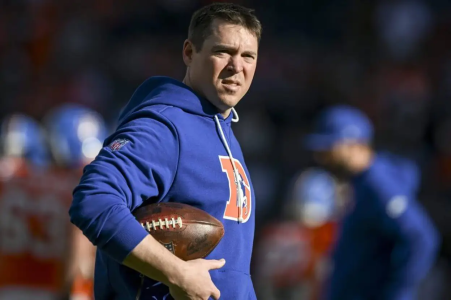
Jim Leonhard spoke about his core philosophies at his introductory newss conference.
AAron Ontiveroz / Getty Images
After a topsy-turvy couple of weeks that included a dramatic playoff exit, a coach firing and a coach hiring, the Buffalo Bills’ offseason will return to business as usual in the next several weeks. New head coach Joe Brady assembled the key pieces of his first coaching staff, and while they’re still putting the final pieces together, their new identity has been established.
Brady’s top assistants were introduced Thursday, with the trio of defensive coordinator Jim Leonhard, offensive coordinator Pete Carmichael and special teams coordinator Jeff Rodgers meeting with the media for the first time and sharing some of their thought processes.
Here’s what we learned from the most important members of Brady’s coaching staff for the 2026 season.
Jim Leonhard’s core philosophies
With due respect to Carmichael and Rodgers, the most intriguing conversation of the day happened with Leonhard. Brady is an offensive-minded head coach, and while he’ll have input in the defense, Leonhard is critical to the team’s ultimate success. This is Leonhard’s third stint in Buffalo, the first two as a player and now as the Bills’ defensive coordinator.Leonhard has been an NFL coach since only 2024, spending the last two seasons with the Denver Broncos. Before that, he spent eight seasons coaching in the college ranks, including six as Wisconsin’s defensive coordinator and a stint as the Badgers’ interim head coach in 2022. That overall polish, having been in the seat — just at a different level — shone through during his first day, as Leonhard was impressive and altogether logical in how he discussed his approach to the job. He discussed empowering people around him, acknowledging that micro-managing from his role can bury a coach. He came across as calm and composed.
Although he didn’t include schematic specifics, Leonhard did confirm that there will be differences, saying, “There’s gonna be change.”
“It’s been the same system for a long time here,” Leonhard said, speaking about Sean McDermott’s defense, which held similar principles for nine seasons. “It wasn’t all broken. It doesn’t all need to be thrown out. There’s elements that we’ll be able to build off of. There’s a comfort level from players that you want to maintain. And this is something that will continue to evolve. It might look a lot different in year two than year one, and that’s OK.”
Leonhard mentioned that what they want out of the defense will be a change for the defenders still in Buffalo, but that one of his core philosophies is to create a defense that best suits the skill sets of the players. If Leonhard follows through with that line of thinking, it will go a long way toward the overall transition the Bills have to make on that side of the ball.
The base defense is likely leaning toward a 3-4, given that the Bills hired an outside linebackers coach and an inside linebackers coach. And the outside linebackers coach, Bobby April III, has worked exclusively with pass-rushing outside linebackers for the majority of his career. But in today’s NFL, it’s more of a chess match to fit their personnel to best defend the offense.
“It is much more fluid than it used to be,” Leonhard said of the differences between 3-4 to 4-3. “I think the evolution of spread offense throughout high school, college football, it’s very similar to the NBA where it’s created a little bit more positionless type of player. There are unique skill sets all around the NFL where guys don’t quite fit in your traditional box of edge defender, defensive tackle, nickel, safety, and that’s where I’ve had the most success in my career as a coach was finding those guys that fit in a little bit of a different role. You have to be more creative in order to play to their strengths a little bit more often."
The Bills will likely utilize odd- and even-man fronts under Leonhard, given his history, with a lean toward odd-man fronts and the skill sets that better fit those positions. As he pointed out, though, the way he calls things in 2026 may differ from 2027 as they start to get the players who best fit their vision as a defense.
As for his approach to calling defense, Leonhard said stopping the run is vital to making an offense more one-dimensional and predictable. He also said the Bills were going to be aggressive, but not reckless, with how they call the game.
“It is team defense, but we’re going to cause issues for offense and we’re going to force them to react to us. I don’t want to counterpunch. We want to be a defense that is constantly evolving and growing throughout a game and throughout a season,” Leonhard said. “I’m big on flexibility and being able to play to your best players and force offenses to try to find your issues and to have to deal with their own problems, not always being reactive.”
Leonhard certainly isn’t the first defensive coordinator to get into the job and proclaim that he wants an aggressive defense. In fact, most of them do. However, Leonhard comes from a Broncos team that, according to TruMedia, had the second-highest blitz rate in the NFL last season at 20.3 percent, so there is some evidence that the blitzing aggressiveness will translate to Buffalo, which would be a significant change from how the Bills operated over the last nine seasons.
Leonhard gives some initial thoughts on three big-name defenders
Leonhard will be inheriting a handful of players who have played pivotal roles for the Bills, and he touched on a few of them Thursday.The most interesting of the bunch was Taron Johnson, who has been with the Bills since 2018 and served as the team’s nickel corner almost the entire time. Johnson was a bit of a question mark once the Bills hired Leonhard, considering his position and the defensive system that will be coming in 2026. If Johnson, who turns 30 in July, wasn’t going to be a fit, the Bills have the option of moving on and saving $8.67 million by designating it as a post-June 1 cut.
However, with the way Leonhard discussed Johnson, he appears to be in their plans.
“Finding out the perfect role for a player like that is very high on our priority list,” Leonhard said. “What it exactly is gonna look like is yet to be determined a little bit, but I love the player, I love the personality, I had a great conversation with him. He’s excited for the change. Not knowing what it is, right? And he knows that we’re gonna communicate with him and find out what’s right because he’s been an extremely productive player in the NFL.”
Given Johnson’s instincts, tackling ability and how well he operates in zone coverage, a position switch to safety can’t be ruled out. A move to safety would also make sense when he’s in man coverage, too, because he’d likely be lined up against a tight end, rather than a quick-twitch slot receiver, a matchup that gave him some trouble last season.
Along with Johnson, two players in the secondary Leonhard seems excited about are top cornerback Christian Benford and safety Cole Bishop. Both are likely to be 2026 cornerstones, given how well they played last season. The defensive coordinator said Benford can travel and track a team’s top wide receiver, and that’s something the Bills will consider. Leonhard went on to call Benford a big leader for the defense and isolated him as one of the players they wanted to create the scheme around.
Leonhard raved about what he saw from Bishop during the pre-draft process in 2024. Leonhard cited the second-round pick’s versatility and physicality, as well as his ability to play out in space and cover one-on-one. Leonhard, who was a safety in the NFL, went as far as to say that Bishop is the kind of safety he tried to be during his playing career. There is a clear admiration there, and Bishop will be a big part of their plans in 2026 and beyond.
As for the rest of the roster, Leonhard said he believes there is an exciting level of versatility already within the roster. As we wrote earlier this week, the schematic shift in 2026 may not be as drastic as you’d think, given how many of the Bills’ defensive pieces under contract can find a home in a base 3-4 defense.
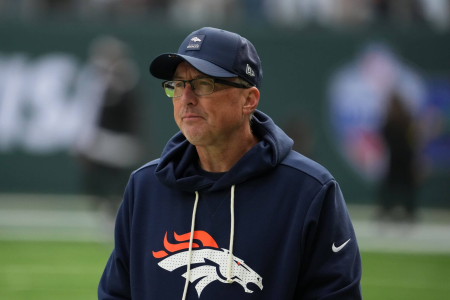
Pete Carmichael has experience with Bills head coach Joe Brady. Kirby Lee / Imagn Images
Pete Carmichael encompasses what Joe Brady said he was looking for
When Brady took questions as the new Bills head coach for the first time, one of the significant talking points was how he would balance both the head coach role and being the offensive play caller. Responding to questions about his potential time management, Brady made it known that he wanted to spend a lot of time in the defensive meeting rooms sometimes throughout the week, and that, above all else, it was important to have the right staff and an offensive coordinator whom he could trust to carry out his vision.Carmichael quickly filled the role thanks to his experience with Brady and as someone who has led the life of an offensive coordinator without the game-day play-calling role. Carmichael did so in New Orleans for current Broncos head coach Sean Payton when both were with the Saints. And what Carmichael said Thursday was right in line with Brady’s vision for the role.
“I think, the main thing is, when you talk about things that might come up with the head coach that he’s got to deal with, and he’s not able to be in the room,” Carmichael said, “that the message that he wants portrayed, whether it’s to the coaching staff, the team, whoever, that I’m portraying the exact same message that he would want the players to hear.”
The last time the Bills had a head coach who called plays on offense was Chan Gailey for three seasons beginning in 2010, and his offensive coordinator at the time, Curtis Modkins, was more of an assistant coach than a game planner. Brady made sure it was known that Carmichael would be far more than that. Brady said that Carmichael, who does have NFL play-calling experience, would help develop the game plan and prepare each week to call plays. Then, should Brady’s head coach responsibilities take him elsewhere, Carmichael can step in and call plays at a moment’s notice.
Brady retaining some offensive staff members
The day the Bills introduced Brady as head coach, he mentioned that some members of McDermott’s 2025 coaching staff would be retained. One week later, Brady mentioned six who will remain with the organization: running backs coach Kelly Skipper, tight ends coach Rob Boras, assistant offensive line coach Austin Gund, quality control/assistant wide receivers coach DJ Mangas, passing game specialist Marc Lubick and offensive quality control assistant Kyle Shurmur. The two most notable at this point are Skipper and Boras, who have been with the organization since McDermott arrived and will be heading into their 10th seasons in Buffalo. These are the jobs they held in 2025, and it remains to be seen whether any of them have new titles or responsibilities.What’s next: The Bills will huddle up for the next two-plus weeks ahead of the 2026 NFL Scouting Combine in late February.