

Why the Bills’ run game is the perfect playoff test for Eagles defense
The Eagles are 1-5 this season when they surrender 125 rushing yards or more, facing the Bills who lead the NFL in rushing at 158.9 YPG.
 www.nytimes.com
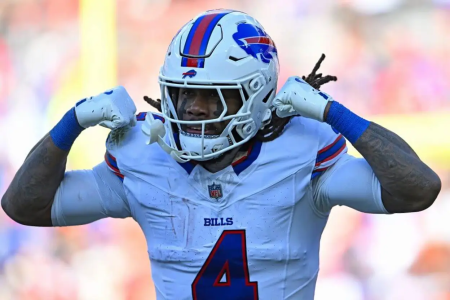
The Eagles have not yet played an opponent who uses heavy formations to Buffalo's degree. Nick Cammett / Getty Images
Most of the attention has lately been on a Philadelphia Eagles offense that has started to find its footing against two of the bottom-10 defenses in the NFL. Coach Nick Sirianni and first-time offensive coordinator Kevin Patullo’s system is no longer a net negative in terms of total EPA (10.95 per TruMedia), a status no Eagles offense had carried into December since 2020.
The balance the Eagles struck in their second-half awakening against the Washington Commanders proved efficiency was possible, albeit when afforded a talent margin that will not be so advantageous when the postseason begins.
That won’t be the case when the Eagles visit the playoff-bound Buffalo Bills on Sunday in Highmark Stadium’s penultimate game before its scheduled demolition. Snow is fittingly in the forecast for a Philadelphian farewell to the roofless venue that will host the tiebreaker of its eight-game history between the two teams. Beyond Randall Cunningham’s 95-yard touchdown pass in 1990, they have typically punished each other on the ground.
The pattern offers favorable omens for Saquon Barkley, a sports history buff, who breached 1,000 yards rushing with a 132-yard game against the Commanders. Miles Sanders, another Penn State alum, scored his first career touchdown in Buffalo on a 65-yard run in 2019. Brian Westbrook did the same against the Bills on his 62-yard run in 2003. To date back to the Eagles and Bills’ first meeting, Tom Sullivan and Norm Bulaich had dual 100-yard games to out-gain O.J. Simpson in 1973.
Barkley and James Cook could similarly duel. Cook, Buffalo’s top offensive weapon, leads the NFL in rushing (1,532 yards) and has fielded four 100-yard games against the Bills’ last five opponents. The Cleveland Browns and Houston Texans — who rank third and ninth in total defensive rush EPA, respectively — are among them. In tandem with reigning MVP Josh Allen, one of the game’s top dual-threat quarterbacks, Cook represents the biggest test yet for an Eagles defense that revealed itself to be vulnerable when surrendering 281 rushing yards in a Week 13 loss to the Chicago Bears.
With a second-straight NFC East title secured and a No. 3 seeding all but decided, the Eagles are effectively finalizing the tune-up phase of their 2025 season. The Eagles still have a 12 percent shot at the No. 2 seed, according to The Athletic’s playoff simulator, which explains why Sirianni would consider fielding any of his starters at all. Sirianni said Monday the Eagles are considering the health scenarios “for each guy.”
Jalen Carter returned to practice Tuesday for the first time since undergoing shoulder procedures that sidelined the two-time Pro Bowl defensive tackle for three games. Nakobe Dean did not practice after exiting Saturday’s game with a hamstring injury. Defensive coordinator Vic Fangio said Dean is “iffy for this week.”
Whether or not Carter and Dean play, Fangio will be tasked with addressing the systemic lapses that hint at an Achilles heel. The Eagles are 1-5 this season when they surrender 125 rushing yards or more. (Jordan Davis’ blocked field goal against the Los Angeles Rams prevents them from being winless.) They had been 11-9 in such games during the first four seasons of the Sirianni era. The scenario-based record underlines the heavy lifting the Eagles’ defense has done this year and hints at one of the ways the franchise’s title defense could end. Beneath the surface-level stats of the Bills and their top-ranked rushing offense (158.9 yards per game), their approach supplies a distinct training ground for two NFC contenders the Eagles could eventually face.
Update your feed. Follow new interests below for the latest stories.
Roughen the footage of Buffalo’s 15 games, and it’d be sometimes difficult to distinguish its offense from the Simpson-era Bills referenced above. Offensive coordinator Joe Brady’s system operates best in heavy formations. They are most efficient when operating within three-tight end packages (0.35 EPA/play, per TruMedia). No team runs plays featuring a fullback and two tight ends at a higher percentage than the Bills (14.2). Of Cook’s 36 runs of 10-plus yards, 14 of them featured a fullback and seven featured three tight ends. Cook ran for a 44-yard touchdown in Sunday’s 23-20 win over the Cleveland Browns (the NFL’s third-ranked defense in total rush EPA) behind a pulling center in a three-tight end formation.
“Very elusive,” Fangio said of Cook. “He’s a jump cut guy, and once he gets in the open fiel,d he’s got the speed to hit the home run. He’s really good. He’s patient, but once he sees that he hits it and he’s really good.”
To the point of Philadelphia’s postseason stakes, the currently top-seeded Seattle Seahawks and playoff-bound San Francisco 49ers lead the NFC in fullback usage. The 49ers, in particular, field 10-time Pro Bowler Kyle Juszczyk on 44.8 percent of their plays. The Bills similarly force their opponents to field base defensive packages at a higher volume than usual, and hammer away with their run game until openings emerge.
The Eagles play formidable defense against heavy formations. They own a fourth-ranked 0.20 EPA/play against two-back packages and surrender rushing yards against 13 personnel at a fourth-ranked 2.8 yards per carry. They arguably field their strongest lineup when playing in base. Nickel Cooper DeJean moves to outside cornerback opposite Quinyon Mitchell (both were just named Pro Bowlers for the first time), and a full-strength three-man interior line includes Carter, Davis and team sack-leader Moro Ojomo. Byron Young has also recorded 2.5 sacks and two tackles for loss in his three-game relief of Carter.
Still, the Eagles have not yet played an opponent who uses heavy formations to Buffalo’s degree (or San Francisco or Seattle’s). They have also, at times, been susceptible to those who play such a style well.
New York Giants running back Cam Skattebo had three runs of 10-plus yards out of 13 personnel packages in a Week 6 win over the Eagles. Skattebo suffered a season-ending leg injury during the second quarter in their Week 8 rematch, in which the Giants only ran one 13 personnel play. Los Angeles Chargers running back Omarion Hampton had two runs of 10-plus yards in a Week 14 win over the Eagles out of heavy formations.
Those two games touch on the evolution of Fangio’s defense this year. The Giants exploited the Eagles’ depleted depth at edge rusher and a defensive front in which rookie Jihaad Campbell’s early development at inside linebacker prevented Fangio from placing Zack Baun along the edge.
By Week 14, the Eagles had acquired Jaelan Phillips via trade and Dean had fully returned from his patellar injury, enabling Baun’s edge-setting role, but the Chargers still found ways to barge through with alignments that afforded them a pre-snap advantage. Hampton took a left toss (away from Phillips) for 11 yards when Chargers fullback Scott Matlock, who lined up as a second off-ball tight end, gained an outside angle on his block against Baun.
Campbell supplied snaps along the edge after Dean’s return, which Fangio said “kind of slowed his development or progress” as an off-ball linebacker.
“It’d be good to get him back there and focused on that,” Fangio said.
It is clear that Fangio prefers playing Dean over Campbell, but it may behoove the Eagles to field their rookie to further protect Dean in a game that is not guaranteed to be consequential.
“Good news is, I don’t think it’s too serious,” Fangio said of Dean’s injury. “And I don’t think we’re done seeing him for this season.”