

The U.S. men’s Olympic hockey team won gold — and then lost the room
The widespread celebration is over now. And some of the U.S. men's Olympic hockey team's goodwill has diminished.
 www.nytimes.com
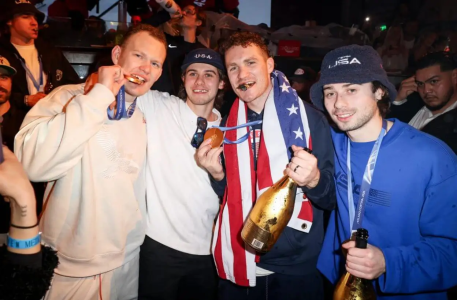
The widespread celebration is over now. And some of the U.S. men's Olympic hockey team's goodwill has diminished.
Alexander Tamargo / Getty Images
For a few hours on Sunday afternoon, the nation felt smaller. This America of vast divides and rickety social bridges deferred, briefly, to the unifying power of sports. Strangers high-fived in bars. Grownups hugged with wet eyes. Politics and culture wars were suspended for the length of three heart-stopping periods of hockey and one cathartic overtime.
The U.S. men’s hockey team won Olympic gold for the first time since the “Miracle on Ice” 46 years ago, and for a time, the joy belonged to everyone.
By the next day, it didn’t.
In the immediate aftermath of their victory, the team took a customary, congratulatory call from President Donald Trump, and some players laughed at a misogynistic joke about the gold-winning women’s hockey team that many Americans wouldn’t find funny. They celebrated in the locker room with beer-chugging FBI Director Kash Patel, who is now under scrutiny for using taxpayer money to fund a sports getaway. Then, after a wild night of partying in Miami following their return from Italy, some members of the team announced plans to step in the House Chamber – a stage upon which symbolism is never neutral – and make an appearance at Trump’s State of the Union.
In normal times, this would be an obligatory celebration for a championship team. They take presidential calls. They party too hard. They visit Washington and stroll through the corridors of power.
But this isn’t a neutral climate. This isn’t a neutral president. And in a nation this polarized, the proximity carries weight whether the players are being intentional or merely naive. America no longer experiences these rituals in the same way, and it may never again. Athletes would be wise to recognize that, in this climate, celebration is easily repurposed into political capital.
The hockey team neither created this divide nor possessed a shrewd political instinct to wrap their victory in a partisan glow. But when they stepped so early into that embrace, they narrowed their moment. It doesn’t ruin what they accomplished in defeating a seemingly indomitable Canadian squad. But the widespread celebration is over now. And some of their goodwill has diminished.
It would be a copout for me to blame only the environment that they must navigate, to rant about how everything is poisonously political now, to lament the impossibility of sustained joy in a culture that incubates outrage. These are all factors, but let’s not infantilize this team. These are men who thrilled a nation and rocked the world, and as adults, they need to be more savvy.
That goes for every prominent team in sports. It’s nice, even expected, to be feted as a winner. But who’s celebrating you – and why they’re doing it and how they’re doing it – matters more. Trump, perhaps more than most modern presidents, understands the optics of standing next to winners. It normalizes him. It softens his cruel instincts and crude jokes, recasting them as locker-room banter. It washes his reputation and reduces the impact of polls that indicate a significant majority of Americans disapprove of his second term.
These champions have agency. In the afterglow of triumph, they have more agency than they ever will. They should be wary of giving it away so casually.
No one can take that gold medal, or how it made all of us feel, away from Team USA. For a fleeting moment, those players quieted our noisy room and made it less toxic. And they’ve already lost some of the room.
It’s not because they set out to divide it. It’s just that, in America right now, proximity to power distorts the meaning of everything around it.
They misread the moment. In our current state, there is no such thing as incidental symbolism. The images and associations matter. They’re almost as powerful as the accomplishment that led to them. Within 48 hours, their celebration drifted into a partisan orbit, and the unity thinned.
Shared moments are precious now. The men’s hockey team conjured some inspiration for an afternoon. That was the trophy to go with their medals. Then they dropped it.
The lesson isn’t that athletes should avoid recognition by political figures or avoid politics altogether. It’s about understanding The Game. When lawmakers bask in their championship glow, they gain more than the winners do. Power loves being in the vicinity of victory. It absorbs the thrill and the innocence – the easy patriotism – and redistributes it in a propagandized manner.
While the players are celebrating, the leaders are calculating. Dominant national teams don’t just represent greatness. They provide consensus, or at least the possibility of it. Since Sunday, the gold medal hasn’t come to mean less. But everything around it has shifted.
Team USA’s visibility in Washington functions as an endorsement, whether the players intend it to be or not. That may be why a handful of players have decided to stay away. However, the bulk of the team is expected to stand together. In sports, that’s called being a good teammate. In this arena, they will look like pawns.
It’s a costly image. What they’ve lost won’t appear in a record book, and in a few years, the appearance will be a faint memory to most. But during a time in which every action seems consequential, they handed over the power of unity. Their triumph is now attached to Trump. His track record suggests it won’t be used to celebrate everyone. It is more likely to be framed as dominance than shared aspiration.
The burden of representing the stars and stripes isn’t just to win. It is to amplify the best of us, to show what unites us. Victory isn’t just about the accomplishment; it’s about the striving that preceded it.
Maybe that’s what athletes must understand about sports in America now. Greatness doesn’t only involve controlling the puck. Judgment is essential.
Members of Team USA mastered the first part. They weren’t as careful with the other. Now, their historic triumph must compete for attention with their reckless after-party.