

Was that messy Bills press conference really a ‘disaster’? A former owner and GM weigh in
We spoke with voices representing each side of the news conference – a former owner, a former general manager and a leadership expert.
 www.nytimes.com
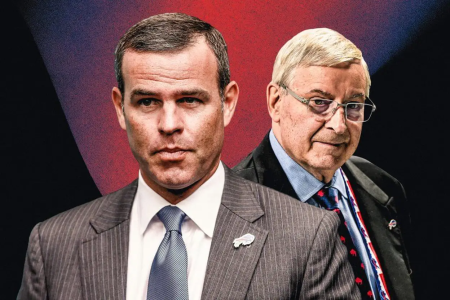
Buffalo Bills general manager Brandon Beane, left, and Bills owner Terry Pegula generated plenty of headlines
after their news conference last week. Illustration: Dan Goldfarb / The Athletic; Michael Reaves, Rich von Biberstein / Getty Images
On Thursday, the Buffalo Bills will hold a news conference to introduce their new head coach, Joe Brady, hoping for a smoother briefing than the one that unfolded last week.
At that news conference, owner Terry Pegula and general manager Brandon Beane met with reporters to explain the decision to fire head coach Sean McDermott and outlined the team’s future.
About 15 minutes in, a reporter asked Beane about drafting wide receiver Keon Coleman with the No. 33 pick in 2024. The Bills had hoped Coleman would contribute immediately, but inconsistency and disciplinary issues have limited his impact.
Before Beane could answer, however, Pegula jumped in.
“The coaching staff pushed to draft Keon,” Pegula said, adding that Coleman was not Beane’s top choice and that the GM had taken heat for the pick without deflecting blame.
Despite Beane later pushing back, saying Coleman was his pick and he stood by the selection, it was too late. Pegula’s comments caused a full news cycle of consternation and backlash, with much of the focus on the owner indirectly throwing a player “under the bus.” The gambit was, depending on the source, “a disaster”, “harmful” and “entirely uncalled for.”
From a leadership standpoint, it highlighted the balancing act of trying to protect those underneath you while not undercutting their authority. Pegula had stepped in publicly to defend Beane. Yet by explaining the internal process, Pegula risked putting more attention on both the player and the staff. Was it worth it?
Using this moment as a leadership case study, we spoke with voices representing each side of the situation — a former owner, a former longtime general manager and a leadership expert — to explore how Pegula handled the situation.
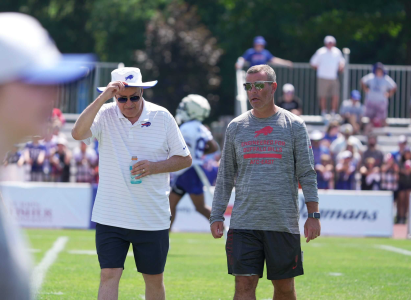
Terry Pegula, owner, CEO and president of the Buffalo Bills and Brandon Beane, general managerTina MacIntyre-Yee / Imagn Images
An owner’s take
As the backlash to Pegula’s comments grew, I reached out to Mark Cuban, former majority owner of the Dallas Mavericks. He had a different perspective.“I’m fine with it,” he said in an email.
Cuban bought the Mavericks in 2000 and owned them until December 2023. During his time as an owner, he was never afraid to make a point through the media and in public, even if that came with heavy fines from the NBA.
Cuban’s view was that Pegula knew Beane wouldn’t say anything bad about the coaches, but he likely wanted it on record that Beane wasn’t fully responsible for the pick.
“I could see doing the same thing because I know that the media and fans would hold that pick over the GM’s head,” Cuban said. “By clarifying what happened, he reduced the stress.”
Cuban said he had done something similar many times when there were issues that fans were upset about.
“I think that’s smart,” Cuban said of Pegula’s decision to share the context behind the pick. “I’ll have a discussion with the media and let them know what is going on, or if it was continuous negative press about one of our players that I wanted to end, I would do something to get fined.”
His reasoning: An owner should communicate for “the benefit of fans.” He believes that Pegula would face criticism either way, but if he can show that the decision was collective, it can ease the pressure on everyone involved.
An expert’s take
I asked Amy Edmondson, a Harvard professor who studies leadership and management, to watch a link to the news conference for her thoughts.“It’s a double-edged sword,” she said.
She explained that Pegula stepping in on Beane’s behalf might help correct unfair blame, but it also risks undermining his authority, especially if done too often.
Yet Edmondson viewed the situation as Pegula feeling that Beane was being unfairly blamed for something that was a collective decision, which is what she believes leaders should do: Listen to the opinions of those around them and compromise. Edmondson interpreted Pegula’s answer as an attempt to show that Beane valued the opinions of those around him during a big decision. To Edmondson, Pegula probably knew that if Beane explained that, he could come off as defensive.
“Is it something that you’d want to see all the time — the most senior executive sort of leaning in?” Edmondson said. “No, of course not. But I don’t think we’re seeing, at least from that clip, that he’s constantly undermining the authority of Beane.”
Edmondson said, in some ways, Pegula was modeling what she calls “teaming” — a dynamic that encourages innovation and problem-solving as a group. Open communication is critical to teaming.
“It’s not ‘I’m the owner, this guy’s the general manager, everybody stays in their lane, everybody answers the questions addressed to them,’” Edmondson said. “No, we’re a team, right? I think he was trying to illustrate that.”
As someone who studies leadership behavior, Edmondson said Pegula was likely trying to come off as honest and caring, maybe even looking to give his general manager a “tiny moment of praise in a bad situation.”
A general manager’s take
Finally, I called Bill Polian, the Hall of Fame general manager who held the GM title for three different franchises, including the Buffalo Bills from 1986 to 1992, when they appeared in four consecutive Super Bowls.He hadn’t seen the news conference and had only read excerpts from this specific moment in a few articles, so he wanted to keep his thoughts general.
He said it’s very common in the NFL for general managers, coaches and sometimes owners to make it clear to everyone before the draft that while there might be debate and differing opinions about a player, once a decision is made, that player belongs to the team that drafted him and remains theirs until he leaves.
Therefore, in Polian’s opinion, there’s no point in publicly talking about the process.
He emphasized that he is in no way criticizing Pegula. “His heart’s in the right place,” Polian told me. “I know him. I think highly of him. I think he’s a very fine man. And as I say, I’ve made a ton of mistakes myself in these kinds of situations. So I can speak from experience.”
Still, in this specific situation, Pegula did decide to let everyone in on some of the process, and when I asked Polian how, as a leader, you know that it’s the right time to ever do this, he didn’t hesitate.
“I’m not being flippant when I give you the answer,” he said. “I’m serious. Unless you’re under subpoena or oath, it’s never the right time. There is never a right time to air that.”
Polian cited two pieces of wisdom he received.
The first piece he learned from Jim Finks, a former NFL player who went on to have a Hall of Fame career as a general manager: Players play, coaches coach, scouts scout, general managers manage and owners own.
The second, he learned from Hall of Fame coach Paul Brown: When you win, say little. And when you lose, say less.
He believed in the saying, but didn’t truly feel it until his own experience proved it. Every mistake he made, he said, came from speaking before he gave himself the chance to step back, reflect and revisit the situation after a “couple of good nights’ sleep” and a fresh perspective.
“Immediacy is not your friend in these situations,” he said. “And it’s never wise, in any circumstance, to go into the details.”