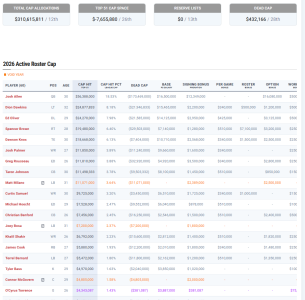
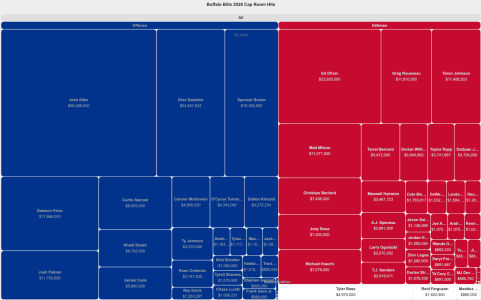
The Bills don’t have any cap space at the moment, but their situation is improving as salary cap projections rise. The NFL informed teams last week that the salary cap will rise significantly, with the 2026 cap expected to be between $301.2 million and $305.7 million.
For practical purposes, we’ll split the difference between the two figures and call it $303.5 million until the NFL lands on an exact figure. Using that figure, the Bills are projected to be $7.449 million over the 2026 salary cap, according to OverTheCap.com.
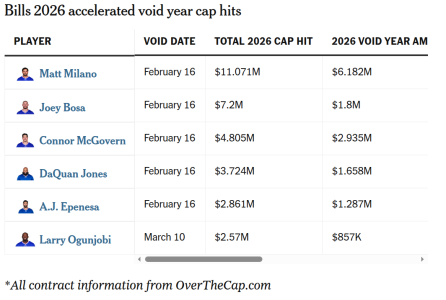
However, even that is a little misleading because of the roster-building mechanism the Bills have used for several years now — void years. While the team gets the short-term benefits of cap relief, the bill comes due when the contract expires. When a player has a void year at the end of their contract, the prorated bonus money pushed into that season is due upon the cap year after the contract expires. If a player has multiple void years on their contract, all prorated bonus money pushed out over multiple years is due in the single cap year after the contract expires. For example, Matt Milano is a free agent in March, and he has two void years with prorated bonus money — $6.182 million in a 2026 void year and $4.889 million in a 2027 void year. That entire amount, $11.071 million, is due to hit the 2026 salary cap.
The -$7.5 million is misleading as of now because those void-year deals are still in the Bills’ Top 51 contracts for offseason cap purposes. Those expiring deals with void years — Milano, Joey Bosa, Connor McGovern, DaQuan Jones, A.J. Epenesa and Larry Ogunjobi — will leave the Top 51 when each hits its void date, which in most cases, is Feb. 16. The only way to avoid the acceleration of multiple void years hitting one cap year is if the team re-signs that player before the contract’s void date. All of the Bills’ void-year deals due in 2026 have multiple void years.