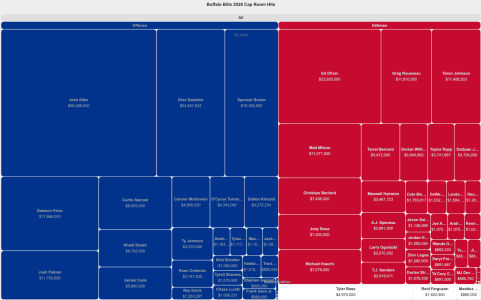
2026 CAP space - Buffalo Bills

I’m okay moving on from Dawkins or restructure that… that’s a big number. Knox… bye. Milano… figure it out cuz those void years sting. Not ready to give up on Palmer but 1 freaking infected toenail in camp and I am done.

Oliver needs a rework. Too expensive to cut him. Keep McGovern… adios Edwards.

Bye Rapp , 3, and resign Thompson. Bye Bass and Samuel… bring back Ty even if we lose Gilliam.
 

The Athletic: How can the Bills find cap space for a pivotal 2026 offseason?​


1770806625306.png
The Bills could create some cap space by cutting tight end Dawson Knox. Timothy T Ludwig / Getty Images

As the game clock hit zero Sunday night, making the Seattle Seahawks the Super Bowl 60 champions, it officially ushered in the season that sparks optimism in almost every fan base.​
The offseason is here, and for the Buffalo Bills, they’ve got some major decisions to make. On top of having a new head coach in Joe Brady, they’ve got a brand new defensive scheme they’re looking to implement with defensive coordinator Jim Leonhard, they have several key free agents and they have to decide in which positions to make their largest investments while managing negative cap space heading into their decisions.​
Without question, Bills president of football operations and general manager Brandon Beane has his work cut out for him. Although all of their defensive free agents will help in their overall transition to Leonhard’s new defensive scheme, the offense has a gaping hole at wide receiver and two starting offensive linemen — left guard David Edwards and center Connor McGovern — who are due to hit free agency in March.​
But before any of those roster decisions are made, Beane will first need to chart a course to get cap-compliant, then find enough cap space to make a meaningful difference for the 2026 Bills roster.​
Here’s a deep dive into what the Bills are looking at from a cap perspective in the offseason, the moves they can make to find cap room and how much realistic cap space they could be looking at this spring.​

How much cap space do the Bills have?

The Bills don’t have any cap space at the moment, but their situation is improving as salary cap projections rise. The NFL informed teams last week that the salary cap will rise significantly, with the 2026 cap expected to be between $301.2 million and $305.7 million.​
For practical purposes, we’ll split the difference between the two figures and call it $303.5 million until the NFL lands on an exact figure. Using that figure, the Bills are projected to be $7.449 million over the 2026 salary cap, according to OverTheCap.com.​
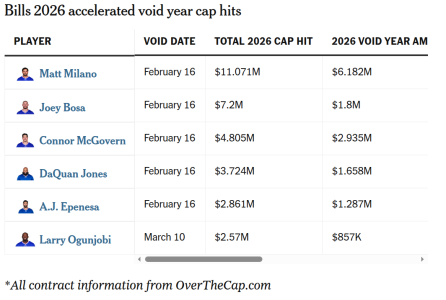
However, even that is a little misleading because of the roster-building mechanism the Bills have used for several years now — void years. While the team gets the short-term benefits of cap relief, the bill comes due when the contract expires. When a player has a void year at the end of their contract, the prorated bonus money pushed into that season is due upon the cap year after the contract expires. If a player has multiple void years on their contract, all prorated bonus money pushed out over multiple years is due in the single cap year after the contract expires. For example, Matt Milano is a free agent in March, and he has two void years with prorated bonus money — $6.182 million in a 2026 void year and $4.889 million in a 2027 void year. That entire amount, $11.071 million, is due to hit the 2026 salary cap.​
The -$7.5 million is misleading as of now because those void-year deals are still in the Bills’ Top 51 contracts for offseason cap purposes. Those expiring deals with void years — Milano, Joey Bosa, Connor McGovern, DaQuan Jones, A.J. Epenesa and Larry Ogunjobi — will leave the Top 51 when each hits its void date, which in most cases, is Feb. 16. The only way to avoid the acceleration of multiple void years hitting one cap year is if the team re-signs that player before the contract’s void date. All of the Bills’ void-year deals due in 2026 have multiple void years.​
1770806716116.png

Those deals, once those dates hit, officially become part of the Bills’ dead cap and are removed from the Top 51. They must be replaced in the Top 51 by other contracts sitting just outside of it. When you add the next six contracts that need to move into the Top 51, the total is $5.333 million. It takes the Bills’ cap deficit from -$7.449 million to -$12.782 million, making the Bills’ job a little bit more difficult.​


Where do the Bills begin to find cap space?

The first place to look is in contract restructures, though the Bills don’t have many good options to do so. There are three that make a great deal of sense, however. Contract restructures take most of the money owed to the player in that current year and convert it to a prorated bonus that can be spread out evenly over a maximum of five years. Besides the prorated amount, the only base salary the team must leave in the current year tally is the veteran minimum. Often, the player still receives their money the same way, with the restructuring mechanism used only as a bookkeeping cap measure. Players usually don’t need to be alerted to the change, unless it’s written into their contract or the team is changing the total compensation.​
The first one is easy and a guarantee almost every year. Quarterback Josh Allen’s base salary can be prorated over the next five years and create $12.16 million in cap savings.​
After Allen, the next most obvious is right tackle Spencer Brown. He only turns 28 later this month, is signed for the long term and is one of their best players. Restructuring his base salary can yield $4.74 million.​
As long as the Bills feel strongly about defensive end Greg Rousseau’s fit into the new scheme, which they likely should given his potential in a new role, converting Rousseau’s base salary into a bonus can yield $2.964 million in cap savings.​
The Bills would have other restructuring options, such as left tackle Dion Dawkins, defensive tackle Ed Oliver and defensive end Michael Hoecht, that they could use if they feel strongly enough about the player’s situation. But each player has legitimate questions, which is why we’ll put them in the “maybe” bucket. Dawkins entering his age-32 season should give that idea some pause. Oliver’s fit into the new defensive scheme may not be perfect, and he has injury concerns. Hoecht is coming off a torn Achilles, and there’s no guarantee he’ll be the same player in 2026 and beyond. In a simple restructuring of their base salaries without adding extra void years, Dawkins could yield $10.624 million in cap savings, Oliver could yield $8.55 million and Hoecht could yield $3.619 million.​
Of the three, I think the case for restructuring Oliver is the strongest, given his age (28) and Beane’s long-standing support for him. For now, we’ll play it safe and use only Allen, Brown and Rousseau. Using those three, the Bills would be cap-compliant with $7.082 million in space.​
USATSI_27257137-scaled.jpg

Curtis Samuel is a prime candidate to be cut this offseason.Gregory Fisher / Imagn Images


The next step: Who are the cut candidates?


Of the players they could realistically cut, and would make the biggest impact on their cap sheet, it really comes down to four names.​

TE Dawson Knox

Without question, their most complex decision will be on Knox. The Bills can save $9.664 million before another contract replaces it in the Top 51, which is a massive amount that could go a long way for the team. Outside of Knox, the Bills have Dalton Kincaid and Jackson Hawes at tight end, a pair of players with complementary skill sets. The team has already committed to giving Kincaid his fifth-year option for 2027, and Hawes is signed through the 2028 season. Knox isn’t as good a receiver as Kincaid, and isn’t as good a blocker as Hawes, but has a better blend of the two than both. Knox is also one of Allen’s best friends on the team, so there’s that element to it. However, there is no getting around a net savings of almost $9 million.​

WR Curtis Samuel

Of all their potential cuts, this one appears to be the most straightforward. The Bills’ wide receiver room is due for significant changes this offseason, given how inconsistent it was all season. Samuel has shown flashes here and there, but he was inconsistent on the field and was often injured during his two seasons in Buffalo. Cutting Samuel would yield a cap savings of $6.055 million before another contract takes its place in the Top 51. Considering the savings, plus his lack of role, this makes sense this offseason.​

S Taylor Rapp

Rapp ended the season on injured reserve and really struggled throughout the year before it. Even during his best season, in 2024, Rapp was closer to an average starter, which seems replaceable, whether it be with second-year player Jordan Hancock, or in moving nickel corner Taron Johnson to that spot as part of Leonhard’s new defense. Regardless of who they get to start next to Cole Bishop, $3.075 million of savings to move on from Rapp might be too tough to pass up. It would be around $2.2 million in net savings.​

RB Ty Johnson

Johnson has played a good role for the Bills as their third-down back over the last two seasons, but it’s somewhat of a luxury at this point. James Cook has the potential to become that three-down back for the Bills, and Ray Davis has shown enough in brief role increases that he can be that third-down back if they don’t want to put it all on Cook’s plate. The Bills just paid Cook, so getting a third running back in the draft on a four-year rookie deal seems like a smart move, especially because it’s the halfway point of Davis’ rookie contract. Cutting Johnson would be a cap savings of $2.455 million before another contract takes its place in the Top 51.​

Other potential considerations

You might be wondering, what about kicker Tyler Bass? Beane shut down those notions, saying that he “would expect” Bass to be the team’s kicker in 2026. To cut him, Bass would clear $2.93 million before another contract replaces it in the Top 51, but that doesn’t seem likely to happen. Perhaps they negotiate a pay cut for cap savings that Bass can earn back with incentives, but cutting him outright does not seem to be in their plans.​
Linebacker Dorian Williams is another one to at least consider, given that he could yield over $3.6 million in cap savings before another contract replaces it in the Top 51. At this point, it seems less likely given how thin the Bills are at linebacker, and his potential fit in Leonhard’s new defense.​
There are questions about how nickel corner Taron Johnson would fit into the new defense, and the Bills could immediately get a net savings of about $1 million to move on. However, given Leonhard’s comments about him, it seems like they’re excited to figure out how Johnson can fit in their scheme. As of now, he appears safe, but things can change quickly.​
Lastly, wide receiver Joshua Palmer could draw some consideration as a post-June 1 cut, which would save them $5.31 million, but that wouldn’t help their present-day cap space as they navigate re-signings and free agency. Even if it happens, we’re not factoring it in.​

If they do the basic and most realistic moves, what could their cap space be?

Under a projected salary cap of $303.5 million, including the restructures of Allen, Brown and Rousseau, cutting Knox, Samuel, Rapp and Johnson, and then factoring in the Top 51 contracts that enter the cap situation, they would get to $24.79 million of cap space for 2026.​
That does not include the Oliver restructure, pay cuts to existing players, or other potential players they could cut outright. Oliver’s contract restructure would bring them to $33.34 million in cap space. Even without it, a little under $25 million gives the Bills enough to make some real moves with backloaded contracts and get them in the door on some big conversations, whether in the trade or free agent market.​
 
Back
Top